Free NewsletterPro Login

Warning: Undefined variable $stocks in /var/www/briefs.co/htdocs/wp-content/plugins/oxygen/component-framework/components/classes/code-block.class.php(133) : eval()'d code on line 448

Warning: foreach() argument must be of type array|object, null given in /var/www/briefs.co/htdocs/wp-content/plugins/oxygen/component-framework/components/classes/code-block.class.php(133) : eval()'d code on line 448

Warning: Undefined variable $funds in /var/www/briefs.co/htdocs/wp-content/plugins/oxygen/component-framework/components/classes/code-block.class.php(133) : eval()'d code on line 472

Warning: foreach() argument must be of type array|object, null given in /var/www/briefs.co/htdocs/wp-content/plugins/oxygen/component-framework/components/classes/code-block.class.php(133) : eval()'d code on line 472
/* the link was here */

Brent Crude And Global Food Prices Have Moved Together For Nearly Three Decades

Published May 9, 2026
[tts_player]
Share:
Summary:
  • The St. Louis Fed says Brent crude and the global food price index have tracked each other since 1998.
  • Both lines surged in 2008 and again in 2022.
  • Brent ended Q1 2026 at $118 a barrel after starting the year at $61.

Oil and groceries seem like two different things. The St. Louis Fed says they are not.

In a March 2026 post, Fed staff showed that Brent crude and the global food index have moved as a pair for nearly thirty years. Both rose in the 2008 boom. Both crashed in the 2009 crisis. Both surged again in 2022 after Russia invaded Ukraine.

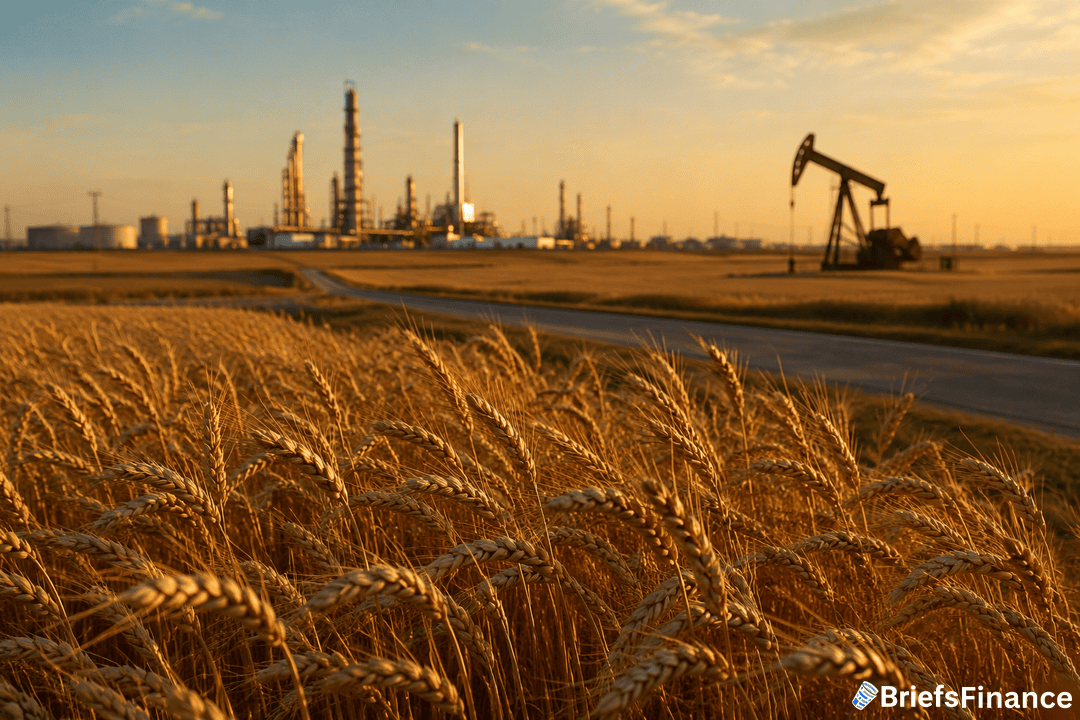
The chart looks less like a fluke. It looks more like a coupled system. That is why oil moves are back near the top of the food watchlist.

Why The Two Move Together

The Fed lists three reasons. The first is direct. Oil costs feed into food costs through fuel for tractors. They feed in through fertilizer made from gas. They feed in through trucks that move groceries.

The second is shared demand. When the world economy heats up, both oil and food rise at once. That can make one look like the cause when both are riding the same wave.

The third is shock. A war or a supply cut can hit both markets at the same time. That is the pattern playing out right now. The Fed points to 2008, 2014, 2020, and 2022 as past examples.

The Channel Is Active Again

Brent finished Q1 2026 at $118 a barrel. It started the year at $61. The EIA says it is the largest real-terms quarterly jump in its data since 1988.

The trigger was Middle East action on February 28. That action shut the Strait of Hormuz. The strait carries about a third of the world's seaborne fertilizer trade.

When oil moves this hard and this fast, the food index almost always follows. The lag is what trips shoppers up.

The Lag Is The Trickiest Part

Past cycles in 2008 and 2022 show food prices peak six to nine months after the energy spike. Grocery contracts are signed weeks ahead. Fertilizer costs only show up after the next harvest. Existing stock cushions the shelf for a while.

That is why a barrel of crude in March can rewrite a grocery receipt in September. The two are linked. The link just runs slow.

The Read For Investors

The FRED chart is not a market call. It is a base rate. Oil and food have moved as a pair through every major shock the data captures. The 2026 setup looks like the past shocks, not different from them.

That is why portfolio managers who had no view on groceries six months ago are now watching food CPI data more closely. The two streams keep merging.

What To Watch

The next FRED Blog update will show whether the Brent and food lines are running together or pulling apart. A wider gap would say the Hormuz shock is fading. A tighter one would say the oil-to-grocery channel is doing what it has done for nearly thirty years.

Investors should also watch the EIA's monthly diesel forecast. The food link runs through diesel as much as crude. Both have to ease for the food story to ease.

The bill for this oil shock is still in the mail.
Disclosure

Recent News

1 2 3 64

Get Market Briefs delivered to your inbox every morning for free!

No fluff. No noise. No politics. Just finance news you can read in 5 minutes.

Blogs

August 31, 2026
America Is Running Out of Debt Buyers. Treasury Bills Are the Government's Fix
  • The government took in about $5 trillion in taxes in 2025 and spent about $7 trillion, and the national debt is now over $40 trillion.
  • Investors, banks, and foreign countries are all lending less to the U.S., so starting September 9 the government plans to sell more short-term treasury bills and use that cash to buy back its long-term debt.
  • Government interest rates set the floor for your mortgage, your car loan, and your credit card, and short-term Treasury ETFs like SGOV are one way investors are playing it.
Read More
August 23, 2026
How to Get the Most From Your Guideline 401k
  • Guideline is a company that provides low-cost 401k plans, popular with small businesses and their employees.
  • A "Guideline 401k" follows the same core rules as any 401k: tax-advantaged growth, contribution limits, and often an employer match.
  • The biggest results come from capturing the full match, choosing low-cost funds, and picking Roth or traditional to fit your situation.
Read More
August 23, 2026
Principal 401k: What to Know About Your Plan
  • Principal is one of many companies that manage workplace 401k plans, so a "Principal 401k" is simply a 401k where Principal is the provider.
  • The rules of a 401k are the same no matter who runs it: pre-tax or Roth contributions, tax-advantaged growth, and often an employer match.
  • The biggest wins come from grabbing the full match, picking low-cost funds, and knowing whether Roth or traditional fits you.
Read More
August 23, 2026
What a Tariff Dividend Means for Your Money
  • A "tariff dividend" is the idea of taking money the government collects from tariffs and paying some of it back to citizens.
  • To judge the idea, you first need to know what a tariff is: a tax on imported goods, usually paid by the companies bringing them in.
  • Tariffs ripple through prices, businesses, and your investments, so the smart move is understanding those ripples, not just the headline.
Read More
August 23, 2026
No Tax on Overtime: How Overtime Pay Is Taxed
  • "No tax on overtime" refers to a tax break that lets certain workers deduct some overtime pay, lowering the income they get taxed on.
  • A deduction does not mean overtime is truly tax-free. It means part of that pay is subtracted before your tax is figured.
  • The bigger money lesson: how you earn money changes how it is taxed, and investors often get the friendliest treatment of all.
Read More
August 23, 2026
Reading the Silver Price Forecast for 2026
  • Nobody can honestly promise a specific silver price for 2026. Any exact number is a guess, so treat forecasts as opinions, not facts.
  • Silver is unusual because it is both a precious metal and an industrial metal, so its price answers to two very different forces.
  • Instead of chasing a forecast, learn the drivers - inflation, interest rates, recession fear, and industrial demand - so you can judge any prediction yourself.
Read More
August 23, 2026
What to Do When Reddit Stocks Go Viral
  • "Reddit stocks" usually means stocks getting hyped in online communities, where crowds can send a price soaring or crashing fast.
  • These tips can be entertaining and sometimes useful, but they are opinions, not research, and often come loaded with hype.
  • The safe move is to treat every online tip as a starting point, then do your own homework before risking a dollar.
Read More
August 23, 2026
Why Is Bitcoin Dropping Right Now?
  • Bitcoin drops for a mix of reasons: interest rates, big-picture money policy, regulation news, and simple shifts in how much risk investors want to take.
  • Bitcoin has a fixed supply and no earnings, so its price runs almost entirely on supply, demand, and sentiment.
  • Sharp drops are normal for bitcoin. Understanding the drivers matters more than reacting to any single day.
Read More
August 23, 2026
The Fidelity 500 Index Fund, Made Simple for Beginners
  • The Fidelity 500 Index Fund is a low-cost fund that tracks the S&P 500, an index of 500 large U.S. companies.
  • Buying it means owning a tiny slice of 500 businesses at once, which spreads your risk in a single purchase.
  • Index funds like this win over time mostly by keeping fees low and letting compounding do the work.
Read More
August 23, 2026
USA Penny Stocks: Risks and Rewards Explained
  • USA penny stocks are very low-priced shares of very small companies, often trading under $5 and sometimes under $1.
  • They dangle the dream of huge, fast gains, but carry brutal risks: low liquidity, wild swings, and high failure rates.
  • Most investors build wealth faster with quality companies and funds than by chasing cheap shares.
Read More
1 2 3 25
Share via
Copy link











