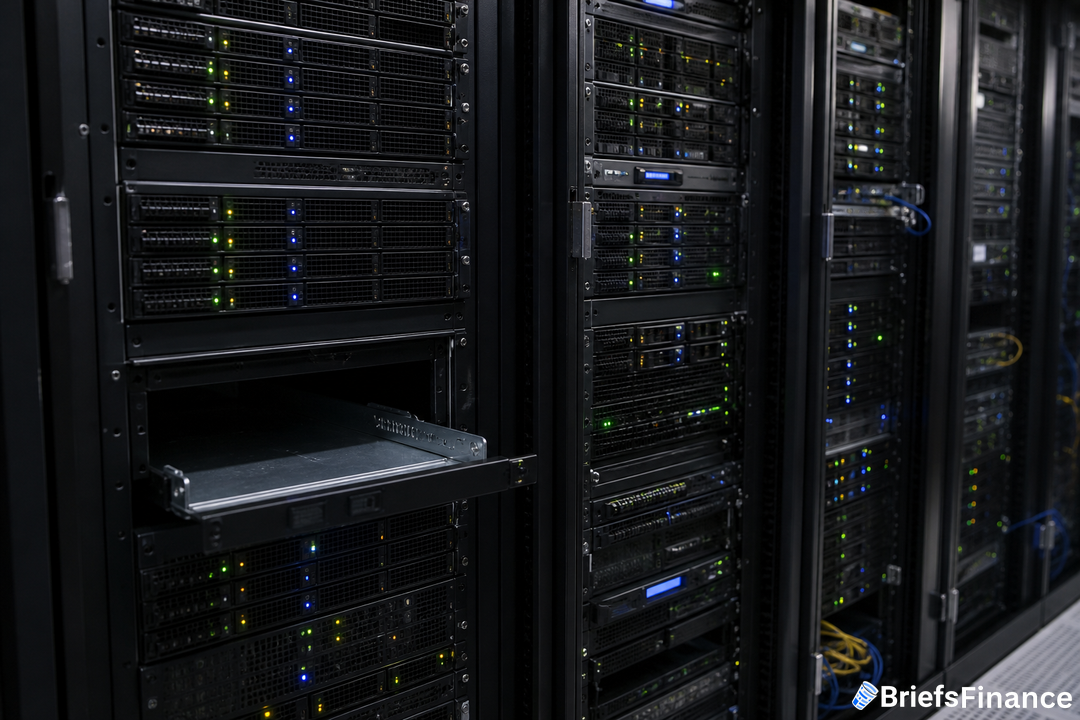
Nvidia turns lender-in-chief to push more GPUs
After building the chips that kicked off the generative AI boom, Nvidia is now using its balance sheet to help fund the companies that need those chips. CEO Jensen Huang's playbook is to put in capital, help customers access loans, and lean on the firm's investment grade rating so mega projects borrow more cheaply.
By July, Nvidia had arranged $36 billion of off-balance-sheet AI cloud agreements that serve as guarantees for neocloud partners. In August, it laid out more than $500 billion of off-balance-sheet promises slated over the next several years, most of which come due by fiscal 2029. Huang summed up the pivot in August, saying, "We used to build chips that we sell," and, "now, Nvidia's AI factory platform is really an investable asset." On a podcast last week he added, "We're the most rentable. We're fungible, and we're durable."
Demand, he says, is not the bottleneck. Huang told CNBC this week that interest in neoclouds is "off the charts," and said in Berlin that what is missing is "the working capital to fuel that growth," because "there's just so much demand across so many sectors of AI, there's a scarcity of capital." Nvidia declined to comment otherwise.
Nvidia's cash flow is a key edge. Its equity holdings were marked at $99 billion at the end of the second quarter. Revenue in the latest fiscal year reached $216 billion, roughly eight times higher since ChatGPT launched in late 2022.
Across the first six months of the year, free cash flow reached $70 billion, compared with a bit over $4 billion at AMD, whereas Alphabet swung to negative cash flow in the second quarter to finance its expansion. Competition is rising, though, from Google's TPUs in its cloud and AMD's Helios rack launched in July.
Mega guarantees, long leases and who carries the risk
OpenAI's planned site in Pike County, Ohio - the potential world's largest data center - comes with Nvidia's largest guarantee and a requirement that Nvidia hardware be used for at least 20 years. The company backed up to $105 billion tied to chips, land and power for the proposed 10 gigawatt complex. It also signed up for $20 billion of future data center leases it expects to assign to third parties.
Most of these promises only turn into cash outlays if a project participant defaults. Should OpenAI fail to pay or become insolvent, Nvidia may take over the lease, secure a replacement tenant, or request that SB Energy, the landlord, sell the facility. For the latter two, Nvidia agreed to cover any shortfall below a minimum price up to $105 billion, or it could make a lump sum payment to SB Energy. The commitment terminates if OpenAI provides collateral or attains a sufficiently high credit rating.
When market headlines involve complex financing, stay clear-headed with the free Market Briefs newsletter that explains it quickly
At CoreWeave, where Nvidia holds an equity stake, it has committed to purchase as much as $6.3 billion of compute if CoreWeave is unable to sell it otherwise. Backstops vary, including minimum resale prices or minimum hourly offtake prices for GPUs if a lender has to recover assets. For Sharon AI and additional neocloud partners, Nvidia has employed revenue-sharing structures. The company says these AI cloud partners see strong customer demand and healthy pipelines yet require massive infrastructure to fulfill it.
In August, Nvidia said it expanded its lending bench by partnering with six major asset managers in a $500 billion financing initiative that treats compute infrastructure as an asset class, and it includes as much as $125 billion of residual-value guarantees for GPU transactions. It put $2 billion to work in Brookfield's inaugural AI Infrastructure Partners Fund targeting $10 billion, and also agreed to be an LP in KKR's $11 billion Helix Digital Infrastructure vehicle, as well as Valor Equity Partners' $5.4 billion compute-focused fund.
Stress shows up at neocloud partners
Credit is tightening for several Nvidia-linked names. Shares of CoreWeave, Nebius and IREN are each down at least 30% this month. CoreWeave's credit default swap spread moved past 11% as investors paid more for default insurance. The company carries roughly $51.6 billion in total debt, of which approximately $35 billion consists of notes, bonds, and loans, and the yields on its 2031 and 2032 bonds climbed above 15%.
Nvidia has exposure to other neoclouds facing setbacks. The firm holds an equity stake in Australia-based AI cloud company Firmus, which pulled its IPO plans this month. Nscale in the U.K. and SoftBank-backed SB Energy each submitted U.S. IPO filings in September, but there have been no updates for weeks.
The stock has not escaped the volatility. Nvidia just posted a third straight down week, and shares are off 7.6% for October, on track for the weakest month since last November. Trainer at New Constructs cautioned, "If the demand for compute doesn't meet these really super lofty expectations, we're going to have a problem." Separately, Gene Munster of Deepwater Asset Management told CNBC last month, "They'll do $700 billion in revenue next year," adding that such scale "affords them the ability to finance some of their customers." During the last six to 12 months, Nvidia's credit guarantees have, for the most part, started kicking in.
What this could mean for your portfolio
Backstops lower borrowing costs and speed rollouts, but they also put more risk on Nvidia if counterparties falter. Investors are weighing how the company might use its cash and its $5 trillion market capitalization to accelerate chip deliveries to customers, along with the risks that approach brings.
In plain English: Nvidia is betting that underwriting today's buildout sells more of its GPUs tomorrow. That edge is reinforced by a full stack of software, services, integrated hardware and financing. The flip side is visible in this month's drops at CoreWeave, Nebius and IREN, higher debt costs, and in the question Trainer raised about demand living up to lofty expectations. Nvidia still dominates AI compute, with systems like Vera Rubin - a seven foot rack with 72 GPUs that can weigh about as much as a pickup truck and costs more than $7 million per Morgan Stanley - even as rivals push alternatives.
Because staying informed helps you navigate uncertainty, sign up for Market Briefs to get concise daily context delivered free