Q3 by the numbers
Tesla beat forecasts on both profit and sales, reporting adjusted earnings of 48 cents per share versus the 43 cents analysts expected and revenue of $28.05 billion against a $27.9 billion consensus. In after-hours trading, the shares barely moved.
Overall revenue was essentially flat compared with $28.24 billion a year ago. Inside the mix, automotive revenue fell 3% to $20.56 billion, energy dropped 16% to $2.88 billion, and services and other climbed 33% to $4.61 billion.
Net income attributable to common shareholders slid 29% to $787 million, equal to 22 cents per share, compared with $1.11 billion, or 32 cents, in the prior year. Tesla pointed to lower average selling prices and trouble securing enough batteries to build vehicles to clear a backlog of orders as headwinds for automotive revenue and profits. The drop in profitability also reflects ramped investment in robotics and artificial intelligence initiatives.
Spending spiked. Capital expenditures reached $3.73 billion, more than double a year ago. Free cash flow was $1.53 billion, down 62% year over year, after turning negative in the second quarter.
Demand, deliveries, and subscriptions
The take rate for FSD (Supervised) - Tesla's partially automated driving package priced at $99 per month in the U.S. - rose by 20 percentage points versus the second quarter. Active FSD subscriptions rose 67% year over year to 1.74 million. As the company put it, "We believe that FSD is driving demand in markets where it is available, and we continue to work with regulators to get it approved in other markets."
Big headlines often raise more questions than answers, so get clarity with the free daily Market Briefs newsletter in five minutes or less a day.
Third quarter vehicle deliveries were 486,532, about 2% below the prior year. Deliveries are Tesla's closest proxy for sales, though the company does not define the metric precisely in its materials.
During the quarter, Tesla set new records for vehicle sales in Canada, Japan, Taiwan, and Australia. Growth has been modest recently in its core market as Chinese EV brands including BYD and Xiaomi have been winning favor in Asia and Europe with lower-cost, novel electric vehicles. Last year, Tesla also felt the impact of the expiration of a federal EV tax credit. A display of the Tesla Bot, or Optimus, appeared next to Tesla logos at a mall exhibition in Hong Kong on September 18, 2026.
Musk's merger talk with SpaceX
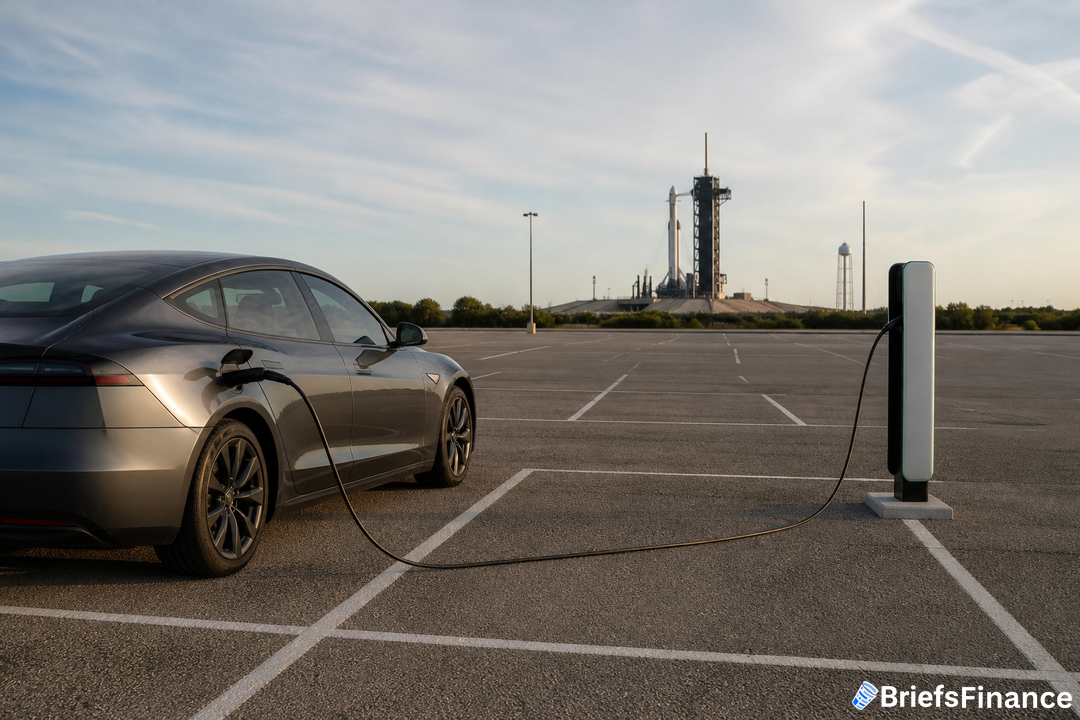
The report came one day after CEO Elon Musk, speaking to investors on SpaceX's quarterly call, said combining Tesla and SpaceX "would be a good idea," and added, "at the end of the day, the shareholders have to be supportive of this." He said both boards have formed special committees to evaluate a potential tie-up, and that on the Tesla side a deal would require securing a vote representing 50% of all shares, which he called "quite a high hurdle." Musk also remarked, "I feel like I'm tap dancing through a minefield."
The companies already overlap on projects, including work tied to Tesla's recently announced Roadster refresh and a semiconductor factory being built with SpaceX and Intel in Grimes County, Texas. Taken together, that partnership and other overlaps have amplified speculation that Musk's companies might unite in a deal that would be historic. Tesla executives plan to brief investors on a 5:30 p.m. ET conference call.
What it means for your portfolio
The quarter mixed an earnings beat with pressure in automotive, while services and software helped offset softness. Cash generation tightened as Tesla plowed money into AI, robotics and chips.
The merger question now sits with special committees, and any deal would need backing equal to 50% of all Tesla shares. Near term, the markers to watch are clear: 486,532 quarterly deliveries, pricing dynamics amid battery supply challenges, and the FSD (Supervised) subscriber base at $99 per month.
Markets touch daily decisions, so make smarter moves with the free daily Market Briefs newsletter, delivered in under five minutes a day.