Free NewsletterPro Login

Warning: Undefined variable $stocks in /var/www/briefs.co/htdocs/wp-content/plugins/oxygen/component-framework/components/classes/code-block.class.php(133) : eval()'d code on line 448

Warning: foreach() argument must be of type array|object, null given in /var/www/briefs.co/htdocs/wp-content/plugins/oxygen/component-framework/components/classes/code-block.class.php(133) : eval()'d code on line 448

Warning: Undefined variable $funds in /var/www/briefs.co/htdocs/wp-content/plugins/oxygen/component-framework/components/classes/code-block.class.php(133) : eval()'d code on line 472

Warning: foreach() argument must be of type array|object, null given in /var/www/briefs.co/htdocs/wp-content/plugins/oxygen/component-framework/components/classes/code-block.class.php(133) : eval()'d code on line 472
/* the link was here */

Robinhood's Stock Tokens are pulling memes into stock-like trades

Published Oct 2, 2026
Share:
Summary:
  • Robinhood's Stock Tokens are digital securities intended to track individual stocks, backed 1:1 by the corresponding shares and published with a live onchain reference price. They aren't actual shares and don't carry voting rights.
  • Traders are pairing Stock Tokens with memecoins on Robinhood Chain, with daily volume peaking around $440 million in early September and a popular set of tokens hitting a combined value near $69 million at their top.
  • Flashpoints include a Hims-linked memecoin that jumped from about $600,000 to about $80 million in roughly a week, an unofficial Farmmi token that helped fuel a mushroom-themed coin worth about 10 times the company, and an AMC spat that saw A Meme Coin (MEME) climb to nearly $150 million.

A meme trader's shortcut into familiar names

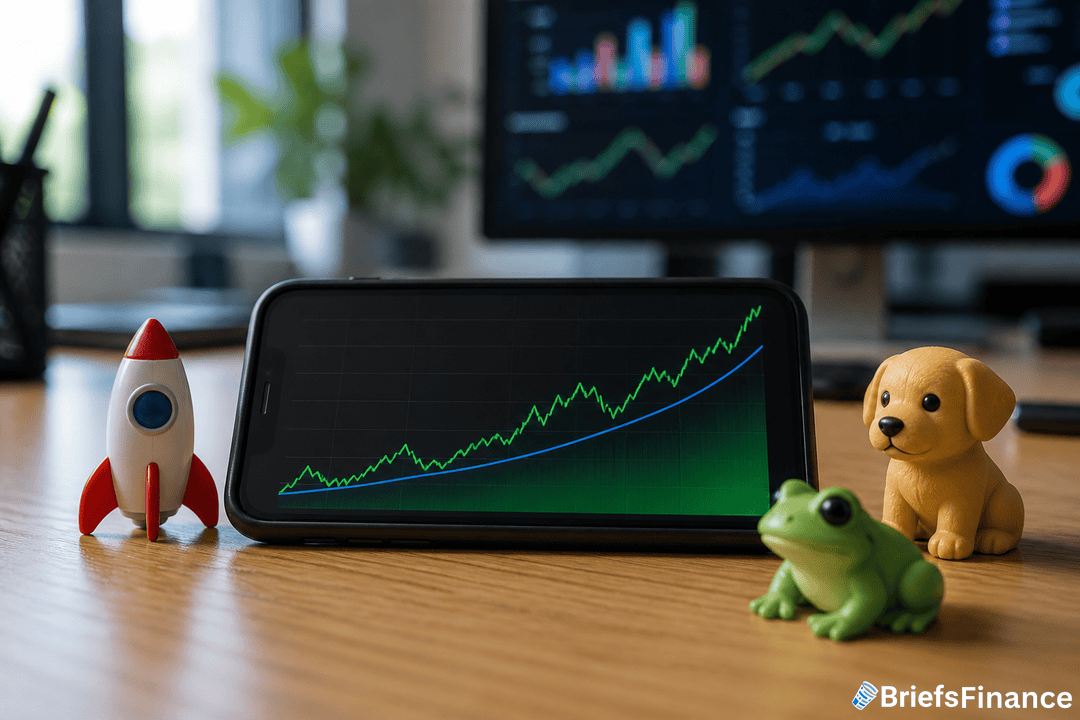
After two years chasing memecoins, 27-year-old Singapore trader Low Ze Sheng found a new bridge between jokes and blue chips: Robinhood's Stock Tokens. Because these tokens trade on the same open crypto rails as memes, Low can swap, say, a token tied to Snap or Nvidia directly for a memecoin and then flip back, all inside a liquidity pool.

"It feels like I'm in the Snapchat trade since I need to have it to buy the memecoin in the liquidity pool," Low said. "And it doesn't feel like gambling. It's on Robinhood which is trustable."

Over five years on from the meme-stock frenzy, retail traders are layering fresh speculation onto a permissionless blockchain. That setup lets outsiders spin up markets around public companies without those firms creating or controlling them.

How the tokens work, and where prices can drift

According to Robinhood, every Stock Token matches the underlying shares on a 1:1 basis held with a custodian, and it publishes a live onchain reference tied to the underlying stock. That reference feed, however, does not dictate the swap prices inside decentralized liquidity pools; there, pool supply and demand set the rate, and thin liquidity can cause prices to stray.

Under Robinhood's current structure, Stock Tokens aren't the shares themselves and don't provide voting rights. A Robinhood representative declined to comment.

Regulators are starting to make room for this, too. Last month, the Securities and Exchange Commission issued temporary exemptions that permit some platforms to trade tokenized US stocks onchain so long as certain conditions are met. And this week, Robinhood announced plans to roll out weekend trading in US stocks, plus leveraged perpetual futures for selected cryptocurrencies.

The numbers, the oddities, and the blowups

Data from a Dune dashboard by X user @adam_tehc indicates that trading in memecoin-Stock Token pools hit roughly $440 million at the peak in early September, then declined. Top pairings included an ETF linked to the S&P 500, as well as Nvidia, SpaceX and Meta. According to RWA.xyz, when activity topped out, those tokens - all of which can trade independently - were worth about $69 million in total.

Crypto investor Eric Conner leaned in early. He purchased a memecoin linked to Hims & Hers Health when it was worth about $600,000, and within roughly a week the valuation was about $80 million. "We tokenize stocks, and the first thing people do with it is meme it," Conner said.

Even when new trading tools change how people trade, steady habits matter, so download the free Always Be Buying E-Book

"I think that's just a sign of the times and a sign of the future." The linkage also gave holders of the memecoin a reason to cheer for Hims, and Since then, Conner has gone on podcasts tied to the company's investor community. "Pretty much everyone holding one of these meme stocks is interested in the underlying stock going up, and I think that's why the general stock communities will probably embrace this," he said. "It's my theory that each major stock will have a meme stock kind of winner and community behind it."

The Hims episode also illustrated how token pricing can drift away from the underlying equity. Over a late-August weekend, one pool accumulated an unusually large chunk of tokenized Hims, and the token ran up to over four times the price of the actual shares. When US markets reopened Monday, Hims shares barely moved.

Farmmi, a tiny Nasdaq-listed mushroom seller, offered another twist. On Sept. 2, its stock jumped up to 321% before retreating. Ahead of that move, Robinhood Chain participants crowded into a meme coin named for one of Farmmi's mushrooms, which was matched with an unofficial Farmmi token that did not correspond to the real shares.

At the top, the meme coin's value was about 10 times that of the company itself. Farmmi showed what can happen when "memecoin retail speculation and virality collide with 24/7 markets onchain," said Tanay Ved, an analyst at Talos.

Even CEO pushback has become raw material for speculation. When AMC Entertainment's Adam Aron discovered that a token linked to AMC was being traded on Robinhood without the company's involvement, he called on Robinhood to halt it. Robinhood co-founder Vlad Tenev pushed back.

In response, traders coalesced around A Meme Coin, or MEME, linking it to tokenized AMC shares. At its peak, the value of MEME climbed to nearly $150 million.

Why this matters for your money

Wall Street has long pitched tokenization as new financial plumbing. Robinhood Chain's frenzy showed another angle: stock exposure is turning into the building blocks for crypto speculation, which can make some of the riskiest bets feel more like everyday stock trades. "I think it is interesting because it shows that in the on-chain environment, like things you can permissionlessly build," Alex Thorn, who leads firmwide research at Galaxy Digital, said. "Who knows what else we might find out with tokenized stocks one day?"

All of this can change how day traders perceive risk. "My friend who will not buy memecoins will at least be motivated to try this because it does look like the stock market with the boring part gone," said Low.

Whatever the latest tokens or trends, consistent investing beats chasing noise, download the free Always Be Buying E-Book

Disclosure

Recent News

1 2 3 … 91

Get Market Briefs delivered to your inbox every morning for free!

No fluff. No noise. No politics. Just finance news you can read in 5 minutes.

Blogs

October 2, 2026
Fed Interest Rates May Rise Again in 2026 - and the Newest Culprit Is AI
  • Fed Governor Barr told a meeting our head of investing research attended that higher rates are likely in 2026, lower inflation may not come soon, and AI is now pushing prices up.
  • The same week, President Trump asked the biggest AI companies to police themselves under an accord that's morally but not legally binding, because the White House sees AI as a race with China.
  • Higher rates put downward pressure on asset prices and squeeze borrowers, but the way through hasn't changed: own investments, buy on a schedule, and treat downturns as discounts.
Read More
October 1, 2026
Housing Market 2026: Why Office Buildings Are Cracking Before Houses Do
  • Office buildings are selling for 80% to 95% off because their five-year loans are resetting at much higher rates while half-empty floors have gutted the income those buildings are valued on.
  • Housing is under pressure, not cracking: a $400,000 mortgage costs $975 more a month than at 3%, but six of every seven mortgages are still under 6% and those owners are staying put.
  • Whether pressure turns into cracks is a race between unaffordability and the economy, and either way Jaspreet's rule is to treat your house as a liability and buy only what you can afford.
Read More
September 30, 2026
Dividend Investing vs. Growth Investing: Why the Slower Portfolio Can End Up Bigger
  • "What stock should I buy?" is the wrong first question. Growth, income, or wealth preservation comes first, and the goal changes which stocks even make sense.
  • At $500 a month for 30 years, 13% growth builds about $1.75 million. 10% growth plus a reinvested 4% dividend builds a little more than $2.2 million and pays a little more than $80,000 a year.
  • Income investors have US dividend ETFs, REITs, and international dividend funds to study. Growth investors have the Nasdaq 100, AI and chip funds, and small caps. None of it is a recommendation.
Read More
September 29, 2026
Why Is Gold Going Down? A 5.2% Treasury Yield Just Took Its Job
  • President Trump rejected Iran's deal to reopen the Strait of Hormuz, oil prices jumped back up, and gold fell instead of rising.
  • Treasury yields hit their highest level in more than 20 years, so investors sold gold and bought Treasuries that pay interest.
  • Higher Treasury yields make the national debt, mortgages, car loans, and credit cards more expensive, with the Fed's next rate decision due October 28.
Read More
September 28, 2026
The Strategic Bitcoin Reserve: Why the Government Wants Bitcoin to Explode
  • The US government holds about 328,000 Bitcoin, worth roughly $25 billion, and since a 2025 executive order it keeps seized coins instead of selling them.
  • Washington wants a bigger pile of assets so its $40 trillion national debt looks smaller next to them, which lets it keep borrowing and spending.
  • Bitcoin's wild price swings, and a government holding a coin built to escape governments, are the two risks investors need to watch.
Read More
September 25, 2026
BRIEFS EXCLUSIVE: 43% Of Respondents Say Bills Outran Their Income Over Past Two Years
  • 43% of the 494 Market Briefs readers surveyed said their bills grew faster than their income over the past two years, even though 79% could cover a surprise $5,000 expense tomorrow.
  • Half of readers own gold or crypto, the two classic bets against a weaker dollar, and only 13% bought nothing at all in the last 12 months.
  • The median reader says it takes $150,000 a year to feel financially secure, about $62,000 above the U.S. median household income.
Read More
September 25, 2026
The Economy Is Booming. So Why Did Stocks and Bonds Fall Together?
  • S&P Global says the US economy is growing at its fastest rate since 2021, with corporate profits up 28.9% in a year, almost four times the historical average.
  • Stocks and bonds fell at the same time, which is not how the two markets normally behave, because Treasury yields above 5% now compete with stocks for investors' money.
  • Jaspreet Singh lays out three ways to invest through a shift like this: always be buying, buy the crash, or follow the money before it hits the headlines.
Read More
September 24, 2026
The 2026 Economic Reset Is Starting: Are We in a Recession, or Is the Pain Still Ahead?
  • The Federal Reserve has flipped from stimulating the economy to fighting inflation with higher interest rates, while the White House still wants growth at almost any cost.
  • The national debt tops $40 trillion, has outgrown the entire U.S. economy, and its interest payments are now the government's fastest-growing expense.
  • Higher rates bring pain for private equity, private credit, and speculative assets, but they open opportunities for investors holding cash, treasuries, and value assets.
Read More
September 23, 2026
Are We in a Recession? Without AI, America Might Already Be in One - and Washington Knows It
  • The White House attributes about three quarters of U.S. economic growth to AI, and many believe the economy would already be in a recession without it.
  • Washington has three reasons it cannot let the AI boom slow down: staying the world's superpower, outgrowing $40 trillion in national debt, and protecting a government stock portfolio worth billions.
  • Every market goes through booms and busts, and investors who understand the cycle get to buy the downturn instead of panic-selling with the crowd.
Read More
September 22, 2026
Will Interest Rates Go Down in 2026? Where the Money Moves Either Way
  • The Fed is leaning toward higher rates to fight 4% inflation, while the White House and a cracking job market push the other way.
  • If rates rise, money has tended to move toward short-term Treasuries, floating-rate loans, energy, banks and dividend payers.
  • If rates fall, it has tended to move toward gold, silver and Bitcoin, real estate, small caps, the S&P 500 and speculative bets.
Read More
1 2 3 … 28
Share via
Copy link










