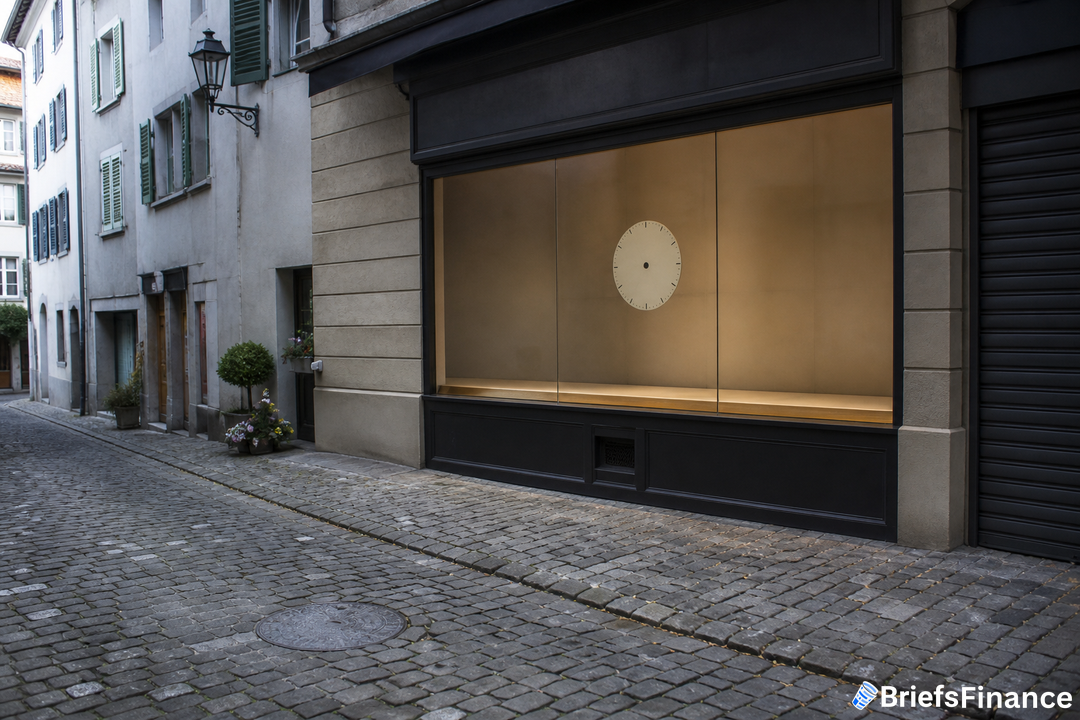
Big crowd, bigger questions
Geneva's annual late-summer watch week was packed, but the strong turnout masked rising nerves about where growth comes from next. "Today, that's the main challenge of the industry," said Jean-Christophe Babin, who leads Geneva Watch Days and also chairs Bulgari. His read: Gen Z and young millennials care less about status and badges, and more about "excitement, emotion, discovery."
Babin says the industry has played it safe - fine-tuning mechanics while neglecting bold concepts - and cites the Audemars Piguet x Swatch Royal Pop collaboration as a shock of energy that can attract first-time buyers without turning off longtime fans. Launched earlier this year, it flips Royal Oak design cues into a colorful, pocket-watch style aimed in part at younger shoppers. "This is really what we are missing, this type of innovation more often and for more brands. If we don't do that, it will be very difficult to recover volumes," he said.
The old playbook is running out of runway
For years, Swiss maisons offset falling units by climbing the price ladder. That cushioning mainly protects giants like Rolex, Patek Philippe and Cartier that command near-fanatic followings. Mid-tier brands and their suppliers are being hit hard.
At the ultra-high end, interest is still there, said Rodolfo Festa-Bianchet, CEO and co-founder of Bianchet, whose pieces sit toward the top of the price spectrum. His take on the market: continued "collector interest, but it's a tougher market for those in the middle."
New rivals and new shopping habits
Young shoppers are a key engine behind resales, favoring pre-owned and vintage pieces bought online to bypass waitlists, snag out-of-production references, and get immediate delivery rather than queuing for a new watch for months or even years. Alongside tougher competition from Japan and rising Chinese players, these behaviors are dragging down Swiss export volumes - an issue the industry finds more worrisome than the conflict in the Middle East.
Babin said Chinese-made movements for standard complications are now on par with ETA SA or Sellita. He also cited Chinese luxury jeweler Laopu's viral rise as a reminder that incumbents can be displaced quickly. Chinese watchmakers are increasingly selling mechanical pieces directly to global buyers online, sidestepping traditional retail and pressing Swiss brands, especially in the middle price band.
Markets move every day, and most of it never reaches you in time. Get the free Market Briefs daily newsletter and stay ahead of it.
Japan's Seiko, Citizen and Casio are thriving because they are not trying to trade up the way many Swiss houses do, said Oliver Müller, founder of advisory firm LuxeConsult. "Gen Z probably gives less weight to the Swiss-made hallmark," he said, adding that while each rival is small alone, together they are siphoning volume from institutional Swiss-made names in the mid-price segment.
What it means for your money
Switzerland is still the luxury watch capital, but shipments slid to 14.6 million last year from 25.4 million in 2016, according to industry figures. Investors are looking for a bounce after a string of hard years, burdened by geopolitical tensions, tariffs, and weaker demand from China. Breitling CEO Georges Kern cautions this could be the "new normal."
The industry's challenge is no longer just pushing prices higher. It now must persuade younger cohorts to purchase more timepieces. If brands scale up the kind of bold experiments Babin champions, they could capture buyers now flocking to resale and online channels. If not, expect volume pain to persist, with the middle of the market - and the suppliers behind it - feeling it most.