From the Keyboard Phone to the Robot Brain
People of a certain age remember BlackBerry as the little keyboard phone that lived in every suit pocket. That phone is ancient history. The company itself is still around, and it now makes software meant to keep critical machines from failing at the exact worst moment.
That software is called QNX. Chief Executive John Giamatteo said, "Robotics is one of the fastest-growing businesses" inside the QNX portfolio. He thinks it could even outgrow the car business that gave QNX its reputation. "We think that could be even a faster-growing segment of the industry for things like robotics," he said.
QNX made its name in vehicles, and that base is still huge. The software is installed in 275 million vehicles around the world. The catch with QNX-style software is that it has to work perfectly when the stakes are high, because a glitch in the wrong place can be dangerous.
Robots come with the same demand. They have to move, stop, and react without guessing. Giamatteo sees that as a natural opening.
He did not break out specific robotics sales, but he said a portion of the company's royalty backlog is already coming from robots. In plain terms, a royalty backlog is money customers have agreed to pay down the road as their products go into production. BlackBerry's QNX backlog sits at $950 million, and some of that total has robotics attached to it.
The pivot from cars to robots shows how change creates opportunity, so get the Always Be Buying E-Book
Working Robots, Not Sci-Fi Humanoids
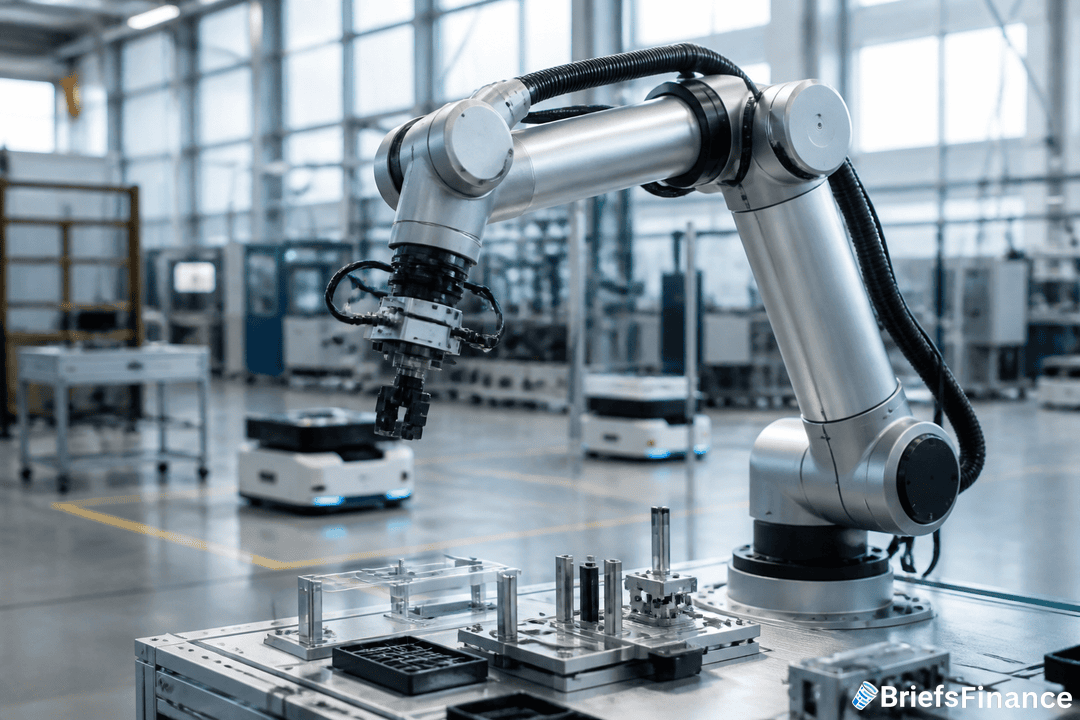
BlackBerry is not aiming at the human-looking robots that dominate tech demos. It is going after the working class of robots: warehouse machines, robotic forklifts, and medical devices.
These are the kinds of tools that do repetitive jobs without a coffee break, and they need reliable software just as much as a car does. Giamatteo says that wave is coming. "Robotics is going to shift in a hardcore way," he said, "and we couldn't be more excited about the opportunity in front of us."
The company is also positioning itself for what the tech world calls physical AI. That is a broad term for software that helps machines sense the real world and act on it, and it covers both robotics and autonomous driving.
In April, BlackBerry expanded a partnership with Nvidia to pair QNX with Nvidia systems in robotics, medical technology, and industrial applications. The deal is a signal that BlackBerry wants to be part of the physical AI wave, not just the auto industry.
What the Robotics Push Means for Your Portfolio
Investors have already taken notice. BlackBerry's stock has doubled this year, helped by improving margins and profitability. The robotics push is part of that move.
For anyone watching the stock, the open question is whether robotics can turn from a buzzy idea into a real source of revenue. The QNX backlog suggests some of that is happening. The Nvidia partnership suggests the company wants to be in the conversation early.
There are still unknowns. Giamatteo did not share how much robotics revenue BlackBerry is collecting today, and partnerships do not automatically become profits. But the direction is no longer a rumor.
BlackBerry may never make a phone again, and that is fine. The bigger opportunity is being the quiet software brain behind machines that load trucks, organize warehouses, and assist doctors. For your portfolio, that is a different kind of story from the old keyboard phone, and it is a much more interesting one.
Just as robotics opens new frontiers, your investing can stay steady with the free Always Be Buying E-Book