Free NewsletterPro Login
S&P 500 6,287 +0.42%
DOW 44,521 -0.18%
NASDAQ 21,103 +0.71%

Warning: Undefined variable $funds in /var/www/briefs.co/htdocs/wp-content/plugins/oxygen/component-framework/components/classes/code-block.class.php(133) : eval()'d code on line 491

Warning: foreach() argument must be of type array|object, null given in /var/www/briefs.co/htdocs/wp-content/plugins/oxygen/component-framework/components/classes/code-block.class.php(133) : eval()'d code on line 491
/* the link was here */

USDA's Larger-Than-Expected Corn Yield Reduction Boosts Prices

Published Aug 12, 2026
[tts_player]
Share:
Summary:
  • The USDA cut its corn yield projection to 180.7 bushels per acre, a bigger reduction than analysts expected and well below last year's 186.5 bushels.
  • Corn futures posted their biggest gain since June following the news, as traders had anticipated a downward revision but not one this large.
  • An earlier attack on a major Russian grain port had already stoked concerns about Black Sea export disruptions, compounding the price pressure.

Your breakfast cereal just got a little more expensive.

Corn futures posted their biggest gain since June after the U.S. Department of Agriculture's yield cut for the nation's leading grain came in larger than expected.

The Big Cut

It might not sound like much, but a few bushels per acre is a big deal when you grow corn across millions of acres.

The USDA now projects 180.7 bushels per acre, compared with 183 last month and well below the 186.5 bushels recorded last year. That gap matters because traders had already watched hot weather stress crops across the Northern Hemisphere, and many analysts were expecting a downward revision.

They just didn't expect it this big.

The earlier gains in grain prices came Wednesday after an attack on a major Russian grain port raised fresh concerns that the Russia-Ukraine war could disrupt Black Sea exports. Add a U.S. harvest that's coming in smaller than expected, and you have a recipe for higher prices at the market.

The Numbers Behind the Move

The USDA is doing something different this time around with how it gathers data.

The agency now uses satellite imagery and its own field inspections alongside tens of thousands of grower surveys. That mix of tools is meant to strengthen the accuracy of its crop estimates, even as fewer growers choose to participate in the surveys.

There's also a timing shift. The agency raised its corn acreage forecast in this report, which is earlier than usual. Last season, that big update didn't arrive until January, and late revisions last year left a bad taste in the market's mouth.

Get the free Always Be Buying eBook and learn the simple system for building wealth on any income

Those late changes pummeled corn prices, and traders have been wary of trusting USDA numbers ever since.

"This re-vamped survey methodology found more acres, earlier," said Alexis Maxwell, a Bloomberg Intelligence analyst. "For a market still stung by last year's multiple, late-in-season revisions, this report marks initial steps into revitalizing confidence with USDA forecasts."

That earlier-than-usual update could help rebuild trust, even as it catches some traders off guard.

Good News Hiding in the Forecast

Here's the twist: the story isn't all about smaller crops.

The USDA still expects production to edge up to 16.013 billion bushels, which would be the second-largest U.S. harvest ever. Record yields are expected in several states, including Iowa, the leading corn producer.

So how can yields fall and production still rise? More acres.

In other words, farmers are planting more corn, but each acre isn't producing quite as much as it did during last year's record run.

The Heat Factor

This isn't just a U.S. story, and that's part of why prices moved.

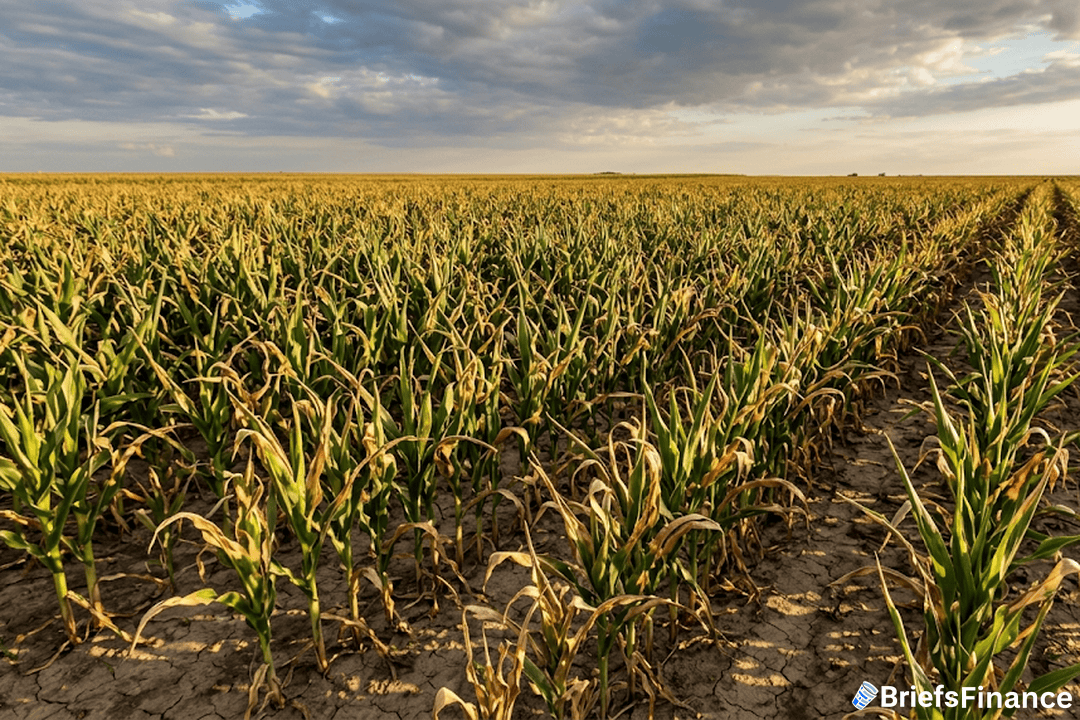
Recent heat waves across the Northern Hemisphere have stressed grain crops in the U.S. and much of Europe. Analysts had already been lowering their harvest projections for both regions, which means the corn market was primed for a supply squeeze before the USDA even released its report.

The attack on the Russian grain port added another layer of worry, because the Black Sea region plays an outsized role in global grain supplies. Any disruption there can send ripple effects through prices worldwide.

What This Means for You

Corn is in everything, which is why this matters beyond the futures trading floor.

The price you pay for food at the grocery store is tied to what farmers pay for seed and feed. When corn gets more expensive, that cost works its way through the supply chain, eventually showing up in meat prices, packaged goods, and breakfast staples.

A second-greatest harvest in U.S. history might sound like plenty, but global demand is strong and weather risks are mounting. If Europe keeps cooking and the Black Sea situation stays tense, corn prices could have more room to run.

For investors, the takeaway is simple. Weather, war, and government reports move grain markets, and the USDA's ability to get its numbers right has a direct effect on how much investors trust those moves. This report suggests the agency is trying to rebuild that trust, one revision at a time.

Whether the new approach holds up remains to be seen. But for now, the market has its answer to what happened, and it's paying up for corn.

Download the free Always Be Buying eBook and start putting your money to work today
Disclosure

Recent News

1 2 3 53

Get Market Briefs delivered to your inbox every morning for free!

No fluff. No noise. No politics. Just finance news you can read in 5 minutes.

Blogs

June 29, 2026
Portfolio Diversification: Why Putting All Your Eggs in One Basket Destroys Wealth
  • Real diversification means spreading investments across all 11 economic sectors plus bonds, alternatives, and cash so no single bet can sink the portfolio.
  • Different sectors perform at different times, so a diversified portfolio captures upswings while smoothing the brutal drawdowns that wipe out concentrated bets.
  • Total market index funds offer the simplest path to diversification, and annual rebalancing is what keeps the structure working over time.
Read More
June 29, 2026
Non Taxable Income: What It Is and Why It Matters
  • Non taxable income is money you receive that you don't owe income tax on.
  • The tax code treats workers, investors, and business owners very differently, and investors often come out ahead.
  • Learning how income is taxed is a quiet superpower for keeping more of what you earn.
Read More
June 29, 2026
Semiconductor Stocks: A Simple Guide for Investors
  • Semiconductor stocks are companies that design and make computer chips, the brains inside nearly every modern device.
  • The AI boom has turned chips into one of the market's most important and most watched groups.
  • They offer big growth potential, but come with high valuations and a notoriously cyclical history.
Read More
June 25, 2026
How Stocks Work: A Simple Guide for Beginners
  • A stock is a slice of ownership in a company - buy one, and you own a piece of the business.
  • You make money two ways: the share price rising over time, and dividends paid to shareholders.
  • The simplest path for most beginners is buying into the whole market through a low-cost index fund.
Read More
June 25, 2026
Stop Loss vs Stop Limit: What's the Difference?
  • A stop loss order sells your stock once it hits a trigger price, prioritizing getting you out.
  • A stop limit order only sells within a price range you set, prioritizing price over a guaranteed exit.
  • The trade-off: a stop loss almost always executes; a stop limit might not if the price moves too fast.
Read More
June 25, 2026
Energy Stocks: A Simple Guide for Investors
  • Energy stocks are companies that produce and supply the power the world runs on, from oil and gas to newer sources.
  • They make up one of the 11 sectors of the market and tend to move with energy prices and big-picture shifts.
  • Like any sector, the key is diversification and understanding the forces driving demand.
Read More
June 18, 2026
What Is a Stop Loss Order? A Simple Guide
  • A stop loss order automatically sells a stock once it falls to a price you set.
  • It's a tool to cap losses or lock in gains without watching the market all day.
  • It works best for active strategies, and can backfire if used carelessly on long-term holdings.
Read More
June 18, 2026
Best S&P 500 Index Fund: How to Choose One
  • The best S&P 500 index fund for most investors is simply the cheapest, most established one that tracks the index well.
  • Funds like VOO, IVV, and SPY all hold the same 500 companies, so the biggest difference is the fee.
  • Pick one, automate your buys, and let time do the heavy lifting.
Read More
June 17, 2026
What Are Penny Stocks? Risks and Rewards Explained
  • Penny stocks are very low-priced shares of very small companies, often trading for just a few dollars or less.
  • They promise huge gains but carry huge risks: low liquidity, high failure rates, and wild price swings.
  • Most investors are better served by quality companies and funds than by chasing cheap shares.
Read More
June 17, 2026
Best Stocks for Beginners With Little Money
  • The best stocks for beginners with little money usually aren't individual stocks at all - they're low-cost index funds.
  • You can start with $100 or less and use small, regular investments to build wealth over time.
  • Focus on diversification and consistency, not on picking the next big winner.
Read More
1 2 3 24
Share via
Copy link











