Free NewsletterPro Login
S&P 500 6,287 +0.42%
DOW 44,521 -0.18%
NASDAQ 21,103 +0.71%

Warning: Undefined variable $funds in /var/www/briefs.co/htdocs/wp-content/plugins/oxygen/component-framework/components/classes/code-block.class.php(133) : eval()'d code on line 491

Warning: foreach() argument must be of type array|object, null given in /var/www/briefs.co/htdocs/wp-content/plugins/oxygen/component-framework/components/classes/code-block.class.php(133) : eval()'d code on line 491
/* the link was here */

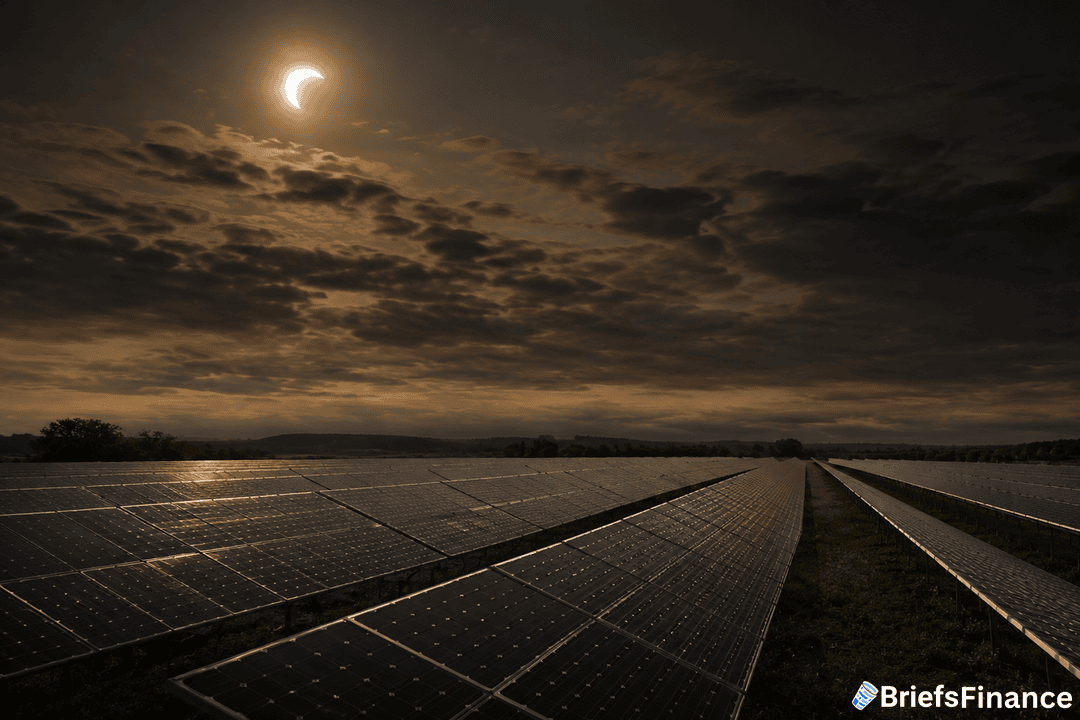
Eclipse to Cause a Temporary Reduction in European Solar Generation

Published Aug 11, 2026
[tts_player]
Share:
Summary:
  • A solar eclipse on Wednesday evening, August 12, will cut solar output across the UK and western Europe.
  • The UK sees peak impact near 8 p.m., with 95% coverage trimming output by just over 1 gigawatt.
  • Europe-wide output could fall by roughly 9.7 gigawatts under clear skies.

A Rare Event With a Lot of Warning

A solar eclipse sounds like a perfect excuse to look up. For the people who run Europe's power grid, it is a reminder that the sun does not always show up for work.

On Wednesday evening, August 12, the moon will slide in front of the sun, and solar power output will take a hit across the UK and western Europe. Thousands of tourists are expected in northern Spain to watch it, while grid operators are watching their screens instead.

The timing makes things a little trickier than usual. The region leans heavily on solar, and the eclipse lands right as the grid is already starting to shift from solar to other sources for the evening.

Eclipses are rare, but they are not surprises. Forecasters can calculate their timing hundreds of years ahead, which gives the people in charge of the grid time to prepare. This advance notice is crucial because solar capacity has expanded rapidly across Europe in recent years. As more solar panels are installed, even a short-lived dip in sunshine can create significant ripples in the power system, requiring grid operators to have backup plans ready.

The Numbers Behind the Dip

The UK will feel it most directly around 8 p.m., when the moon covers 95% of the sun.

That should cut British solar output by just over 1 gigawatt.

Across Europe, the effect is bigger. Under clear skies, solar output could drop by roughly 9.7 gigawatts starting around 7:15 p.m., according to Entso-e, the group that represents European grid operators.

Get the free Always Be Buying eBook and learn the simple system for building wealth on any income

The timing softens the blow. Because the sun will be close to the horizon, other generators will already be increasing output for evening demand, so the solar dip is not coming out of nowhere.

Natural gas, hydropower, and nuclear plants will cover the gap.

Grid Operators Saw This Coming

Ryan Carson, an energy forecaster at the UK's National Energy System Operator, said the eclipse's reach goes far beyond the UK. "The effects are quite far-reaching geographically, all the way across Europe," he said.

Carson said the team has had time to get ready. "We have been analyzing this since about one year ago," he said.

Spain is the one place getting a total eclipse, and its grid operators are not leaving anything to chance. Spanish solar plant operators say they are ready and are coordinating with Red Electrica, the national grid operator.

Acciona, whose solar installations sit directly in the eclipse's path, expects only a minor effect because the event happens at sunset, when solar production is already winding down. Still, the company has included the eclipse in its generation forecasts.

Manuel Calleja, Head of Centers at Acciona Energía, said the eclipse is built into the company's plans. "Everything is included in our models," he said.

"We include the eclipse in the forecast that we share with the TSO, so they know in advance how photovoltaic production is going to reduce," Calleja said. Photovoltaic is just a technical way of saying solar power.

The TSO, or transmission system operator, is the group that runs the high-voltage grid.

Calleja also said flexible sources like hydroelectric dams and gas-fired combined-cycle turbines can step in to cover temporary solar losses. Those plants would normally be starting up for Spain's evening peak anyway, which is part of why the impact should be manageable.

The Bigger Test Comes Next Summer

This eclipse should be a relatively minor event for the grid. The real challenge is coming next summer, when a second eclipse will arrive late in the morning, a time when solar power can be the largest source of electricity in many parts of Europe.

For investors and anyone who pays an electric bill, the eclipse is a small but useful preview. It shows what happens when a solar-heavy grid has to replace a big chunk of power in a hurry, and it hints at the balancing act that will only get more common as solar keeps growing.

The good news: this time, the lights should stay on. The next eclipse, next summer, will be the one worth watching.

Download the free Always Be Buying eBook and start putting your money to work today
Disclosure

Recent News

1 2 3 53

Get Market Briefs delivered to your inbox every morning for free!

No fluff. No noise. No politics. Just finance news you can read in 5 minutes.

Blogs

June 29, 2026
Portfolio Diversification: Why Putting All Your Eggs in One Basket Destroys Wealth
  • Real diversification means spreading investments across all 11 economic sectors plus bonds, alternatives, and cash so no single bet can sink the portfolio.
  • Different sectors perform at different times, so a diversified portfolio captures upswings while smoothing the brutal drawdowns that wipe out concentrated bets.
  • Total market index funds offer the simplest path to diversification, and annual rebalancing is what keeps the structure working over time.
Read More
June 29, 2026
Non Taxable Income: What It Is and Why It Matters
  • Non taxable income is money you receive that you don't owe income tax on.
  • The tax code treats workers, investors, and business owners very differently, and investors often come out ahead.
  • Learning how income is taxed is a quiet superpower for keeping more of what you earn.
Read More
June 29, 2026
Semiconductor Stocks: A Simple Guide for Investors
  • Semiconductor stocks are companies that design and make computer chips, the brains inside nearly every modern device.
  • The AI boom has turned chips into one of the market's most important and most watched groups.
  • They offer big growth potential, but come with high valuations and a notoriously cyclical history.
Read More
June 25, 2026
How Stocks Work: A Simple Guide for Beginners
  • A stock is a slice of ownership in a company - buy one, and you own a piece of the business.
  • You make money two ways: the share price rising over time, and dividends paid to shareholders.
  • The simplest path for most beginners is buying into the whole market through a low-cost index fund.
Read More
June 25, 2026
Stop Loss vs Stop Limit: What's the Difference?
  • A stop loss order sells your stock once it hits a trigger price, prioritizing getting you out.
  • A stop limit order only sells within a price range you set, prioritizing price over a guaranteed exit.
  • The trade-off: a stop loss almost always executes; a stop limit might not if the price moves too fast.
Read More
June 25, 2026
Energy Stocks: A Simple Guide for Investors
  • Energy stocks are companies that produce and supply the power the world runs on, from oil and gas to newer sources.
  • They make up one of the 11 sectors of the market and tend to move with energy prices and big-picture shifts.
  • Like any sector, the key is diversification and understanding the forces driving demand.
Read More
June 18, 2026
What Is a Stop Loss Order? A Simple Guide
  • A stop loss order automatically sells a stock once it falls to a price you set.
  • It's a tool to cap losses or lock in gains without watching the market all day.
  • It works best for active strategies, and can backfire if used carelessly on long-term holdings.
Read More
June 18, 2026
Best S&P 500 Index Fund: How to Choose One
  • The best S&P 500 index fund for most investors is simply the cheapest, most established one that tracks the index well.
  • Funds like VOO, IVV, and SPY all hold the same 500 companies, so the biggest difference is the fee.
  • Pick one, automate your buys, and let time do the heavy lifting.
Read More
June 17, 2026
What Are Penny Stocks? Risks and Rewards Explained
  • Penny stocks are very low-priced shares of very small companies, often trading for just a few dollars or less.
  • They promise huge gains but carry huge risks: low liquidity, high failure rates, and wild price swings.
  • Most investors are better served by quality companies and funds than by chasing cheap shares.
Read More
June 17, 2026
Best Stocks for Beginners With Little Money
  • The best stocks for beginners with little money usually aren't individual stocks at all - they're low-cost index funds.
  • You can start with $100 or less and use small, regular investments to build wealth over time.
  • Focus on diversification and consistency, not on picking the next big winner.
Read More
1 2 3 24
Share via
Copy link











