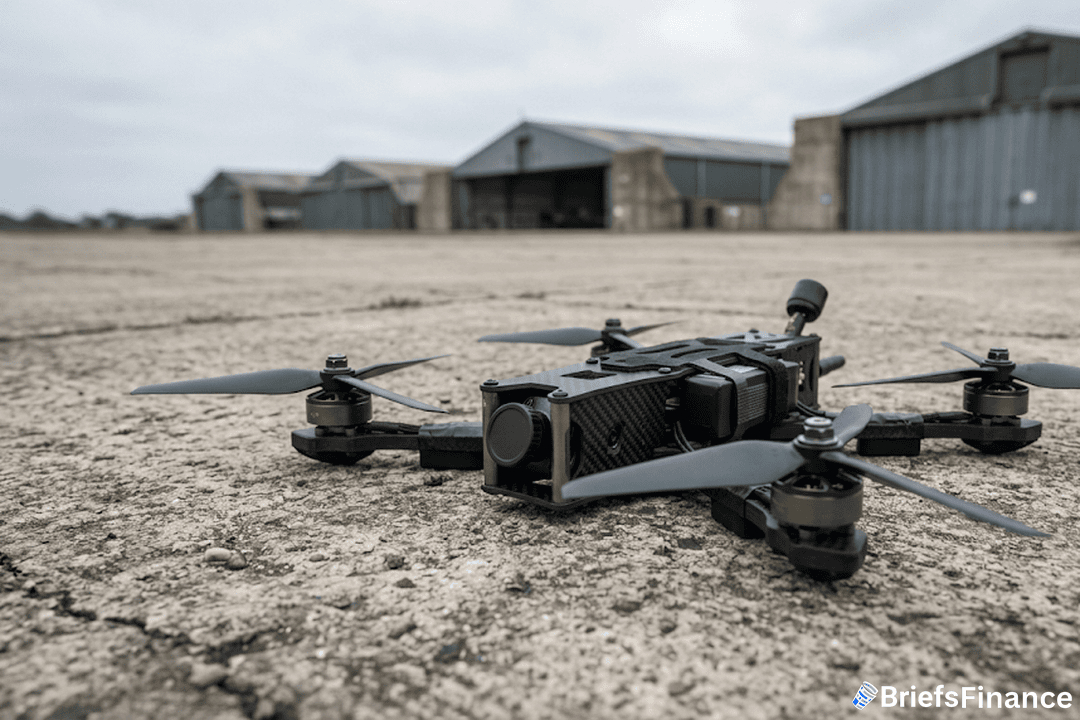
The war in Ukraine changed how Olaf Hichwa thinks about drones.
Hichwa, the chief technology officer at defense startup Neros Inc., watched early in the conflict as an Iranian-designed Shahed-136 drone slipped past defenses and hit a key radar for the THAAD missile-defense system. The cheap, single-use aircraft did what expensive missiles could not.
"We don't have the luxury of toiling in a lab," Hichwa said.
That urgency just paid off in a big way. Neros secured $250 million in new financing, an infusion that boosted its worth threefold to $2.5 billion. Sequoia Capital co-led the round with American Strategic Technology Fund, and Thiel Capital joined in as well.
Investors Bet Big on Drone Startups
The money is going toward one thing: building a lot more drones, fast.
Neros, based in Torrance, California, was founded just three years ago. It makes low-cost attack drones like the Archer, which is designed to destroy larger and pricier military systems. Think of it as the David in a portfolio of Goliaths.
The Pentagon is starting to think the same way. After procurement rule changes late last year opened the door for new commercial entrants, defense-tech startups raised roughly $35 billion in six months. That is a record half-year, according to PitchBook.
Neros is part of a wave that includes Anduril Industries Inc. and Shield AI Inc., all startups betting that the military wants autonomy and AI alongside traditional contractors.
Get the free Always Be Buying eBook and learn the simple system for building wealth on any income
The company's founders, Hichwa and CEO Soren Monroe-Anderson, sped up work on a new interceptor drone called Bandit after seeing the Shahed-136 hit the THAAD radar system. They showed a Bandit prototype at the latest board meeting and want it in combat by year-end.
The catch: The pressure to deliver is real, but so is the challenge of scaling up.
From 14,000 Drones a Year to One Million
Here is where the numbers get ambitious.
Neros currently has production capacity of about 14,000 Archer drones a year. The new capital is meant to push that to one million annually by 2028. Headcount will grow from 200 to 350 employees.
Monroe-Anderson says the plan is aggressive but doable because Bandit and Archer share many parts. Still, he is careful about rushing the process.
"Automating too early is a mistake and it's a common one," he said.
Right now, Neros automates pre-shipment flight tests, but other production steps remain manual. That is where David DiDomenico comes in. Last week, the company hired him as vice president of operations after stints at SpaceX and Astranis Space Technologies Corp. His job is to strengthen manufacturing and the supply chain.
The funding will also pay for upgrades: a drone-controlling handset that charges more easily, and a new Archer variant called Archer AI that can keep target locks, coordinate with other drones, and operate where GPS is unavailable.
What This Means for Your Portfolio
The shift here is bigger than one company's valuation.
Investors are watching whether the Pentagon will lean on young startups to rebuild US weaponry with AI and autonomy at the center. The $35 billion raised in the last six months suggests the market believes yes.
"Autonomy is 1,000 different systems. It's not binary," Monroe-Anderson said.
That is a useful way to think about the whole defense-tech boom. It is not a single winner-take-all race. It is a sprawling effort with room for many players, each solving a different piece of the puzzle.
For investors, the question is whether these valuations reflect real demand or early excitement. The production targets give it a concrete path. But going from 14,000 to one million drones a year is a massive jump, and the company admits it still needs more automation to get there.
The story is still being written. What is clear is that the way wars are fought is changing, and the market is putting real money behind that change.
Download the free Always Be Buying eBook and start putting your money to work today