Free NewsletterPro Login
S&P 500 6,287 +0.42%
DOW 44,521 -0.18%
NASDAQ 21,103 +0.71%
S&P 500 +12.4%
Briefs Finance Fund +24.8%
JOIN THE FUND →

Merz: EU Budget Too Large, Wants Pact by Late 2026

Published Jul 29, 2026
[tts_player]
Share:
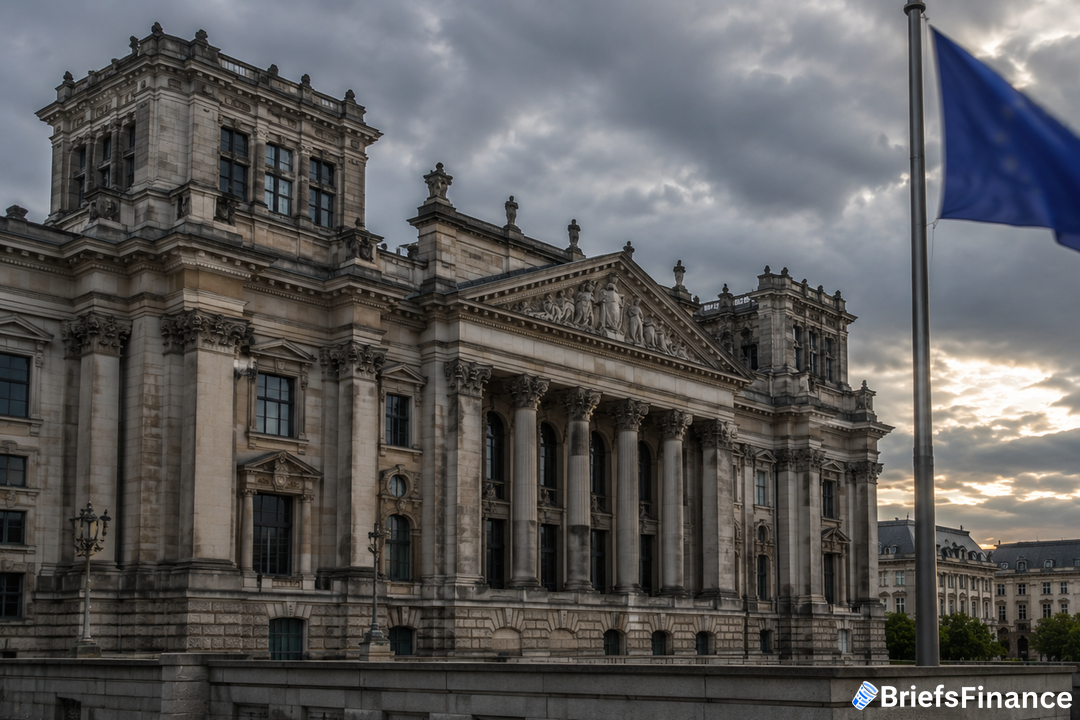
Grand neoclassical European government building with an EU flag under cloudy sky
Summary:
  • German Chancellor Friedrich Merz rejected the European Commission's proposed €1.76 trillion budget as too large and unsustainable.
  • Merz wants EU member states to finalize a new seven-year spending plan by the end of 2026 to avoid delays.
  • Political pressure from upcoming 2027 elections in France and Spain is driving the push for an early agreement.

Merz Calls EU Budget Too Big, Too Late

German Chancellor Friedrich Merz thinks the European Union's next budget misses the mark by several hundred billion euros. The EU's executive branch had offered to cut the budget by about 2% - a reduction Merz shot down as far too small. He argued the figures are unbalanced and that member states need to go much deeper with cuts.

"Such a vast expansion of the European budget is unsustainable for us - the figures are unbalanced," Merz said.

He also laid down a tight timeline. If they miss that window, the next EU budget cycle will not start on time.

"We aim to conclude these extremely difficult and complex negotiations by the end of 2026, if possible," Merz said. "Only then will European Union programs be able to launch as planned from January 2028."

Get the market news that matters in a five-minute read with Market Briefs, our free daily newsletter

Elections in France and Spain Add Pressure

The rush to get a deal done is not just about numbers. It is about politics.

Far-right leader Marine Le Pen already leads in French opinion polls, which could stall or shift budget talks if they drag into election season. Merz is worried that political deadlock in France or Spain would make a reasonable compromise nearly impossible.

That is why he is working closely with French President Emmanuel Macron, who traditionally wants higher EU spending. The two leaders are trying to hammer out a plan before France votes.

"Work between Germany and France is essential at a time when Russia threatens our security, when the People's Republic of China poses a challenge to our economy and when the transatlantic partnership is no longer taken for granted," Merz said.

Ireland, which holds the rotating EU presidency, will play a key role in drafting a compromise budget. Dublin must balance Germany's push for austerity against the spending demands of southern member states. The Irish presidency's ability to broker a deal before the 2027 elections is seen as essential.

The EU's seven-year spending blueprint, officially called the multiannual financial framework, covers a wide range of expenditures including farm support and infrastructure development. Delays in agreement could disrupt programs that rely on EU funding, affecting millions of citizens across the continent.

The budget negotiations carry high stakes because they determine financing for agricultural subsidies, regional development, and border security. Merz's push for austerity reflects Germany's traditional fiscal conservatism, while southern member states like Spain and Italy typically advocate for higher spending to support their economies. The 2027 elections in France and Spain add urgency, as political shifts could reshape the negotiating landscape.

A suspected Islamist terror attack on a major LGBTQ event in Berlin last Sunday cast a shadow over Merz's three-hour Dublin visit. The attack, described by German authorities as Islamist, left one woman dead and several people severely wounded. Additionally, Merz is facing growing backlash from his own CDU party over a cabinet reshuffle that senior members have called poorly planned and executed.

Join Market Briefs, our free daily newsletter, for a quick daily rundown of the markets
Disclosure

Recent News

1 2 3 44

Get Market Briefs delivered to your inbox every morning for free!

No fluff. No noise. No politics. Just finance news you can read in 5 minutes.

Blogs

June 29, 2026
Portfolio Diversification: Why Putting All Your Eggs in One Basket Destroys Wealth
  • Real diversification means spreading investments across all 11 economic sectors plus bonds, alternatives, and cash so no single bet can sink the portfolio.
  • Different sectors perform at different times, so a diversified portfolio captures upswings while smoothing the brutal drawdowns that wipe out concentrated bets.
  • Total market index funds offer the simplest path to diversification, and annual rebalancing is what keeps the structure working over time.
Read More
June 29, 2026
Non Taxable Income: What It Is and Why It Matters
  • Non taxable income is money you receive that you don't owe income tax on.
  • The tax code treats workers, investors, and business owners very differently, and investors often come out ahead.
  • Learning how income is taxed is a quiet superpower for keeping more of what you earn.
Read More
June 29, 2026
Semiconductor Stocks: A Simple Guide for Investors
  • Semiconductor stocks are companies that design and make computer chips, the brains inside nearly every modern device.
  • The AI boom has turned chips into one of the market's most important and most watched groups.
  • They offer big growth potential, but come with high valuations and a notoriously cyclical history.
Read More
June 25, 2026
How Stocks Work: A Simple Guide for Beginners
  • A stock is a slice of ownership in a company - buy one, and you own a piece of the business.
  • You make money two ways: the share price rising over time, and dividends paid to shareholders.
  • The simplest path for most beginners is buying into the whole market through a low-cost index fund.
Read More
June 25, 2026
Stop Loss vs Stop Limit: What's the Difference?
  • A stop loss order sells your stock once it hits a trigger price, prioritizing getting you out.
  • A stop limit order only sells within a price range you set, prioritizing price over a guaranteed exit.
  • The trade-off: a stop loss almost always executes; a stop limit might not if the price moves too fast.
Read More
June 25, 2026
Energy Stocks: A Simple Guide for Investors
  • Energy stocks are companies that produce and supply the power the world runs on, from oil and gas to newer sources.
  • They make up one of the 11 sectors of the market and tend to move with energy prices and big-picture shifts.
  • Like any sector, the key is diversification and understanding the forces driving demand.
Read More
June 18, 2026
What Is a Stop Loss Order? A Simple Guide
  • A stop loss order automatically sells a stock once it falls to a price you set.
  • It's a tool to cap losses or lock in gains without watching the market all day.
  • It works best for active strategies, and can backfire if used carelessly on long-term holdings.
Read More
June 18, 2026
Best S&P 500 Index Fund: How to Choose One
  • The best S&P 500 index fund for most investors is simply the cheapest, most established one that tracks the index well.
  • Funds like VOO, IVV, and SPY all hold the same 500 companies, so the biggest difference is the fee.
  • Pick one, automate your buys, and let time do the heavy lifting.
Read More
June 17, 2026
What Are Penny Stocks? Risks and Rewards Explained
  • Penny stocks are very low-priced shares of very small companies, often trading for just a few dollars or less.
  • They promise huge gains but carry huge risks: low liquidity, high failure rates, and wild price swings.
  • Most investors are better served by quality companies and funds than by chasing cheap shares.
Read More
June 17, 2026
Best Stocks for Beginners With Little Money
  • The best stocks for beginners with little money usually aren't individual stocks at all - they're low-cost index funds.
  • You can start with $100 or less and use small, regular investments to build wealth over time.
  • Focus on diversification and consistency, not on picking the next big winner.
Read More
1 2 3 24
Share via
Copy link












