Free NewsletterPro Login

Warning: Undefined variable $stocks in /var/www/briefs.co/htdocs/wp-content/plugins/oxygen/component-framework/components/classes/code-block.class.php(133) : eval()'d code on line 448

Warning: foreach() argument must be of type array|object, null given in /var/www/briefs.co/htdocs/wp-content/plugins/oxygen/component-framework/components/classes/code-block.class.php(133) : eval()'d code on line 448

Warning: Undefined variable $funds in /var/www/briefs.co/htdocs/wp-content/plugins/oxygen/component-framework/components/classes/code-block.class.php(133) : eval()'d code on line 472

Warning: foreach() argument must be of type array|object, null given in /var/www/briefs.co/htdocs/wp-content/plugins/oxygen/component-framework/components/classes/code-block.class.php(133) : eval()'d code on line 472
/* the link was here */

U.S. Treasury Proposes Dual Oversight for Stablecoin Issuers

Published Jul 12, 2026
[tts_player]
Share:
Summary:
  • The Treasury's proposal extends the dual banking system to stablecoins, requiring both federal and state oversight.
  • Issuers must hold 1:1 reserves in high-quality liquid assets and implement anti-money laundering programs.
  • Industry reactions are mixed, with praise for clarity but concerns over compliance costs for smaller firms.

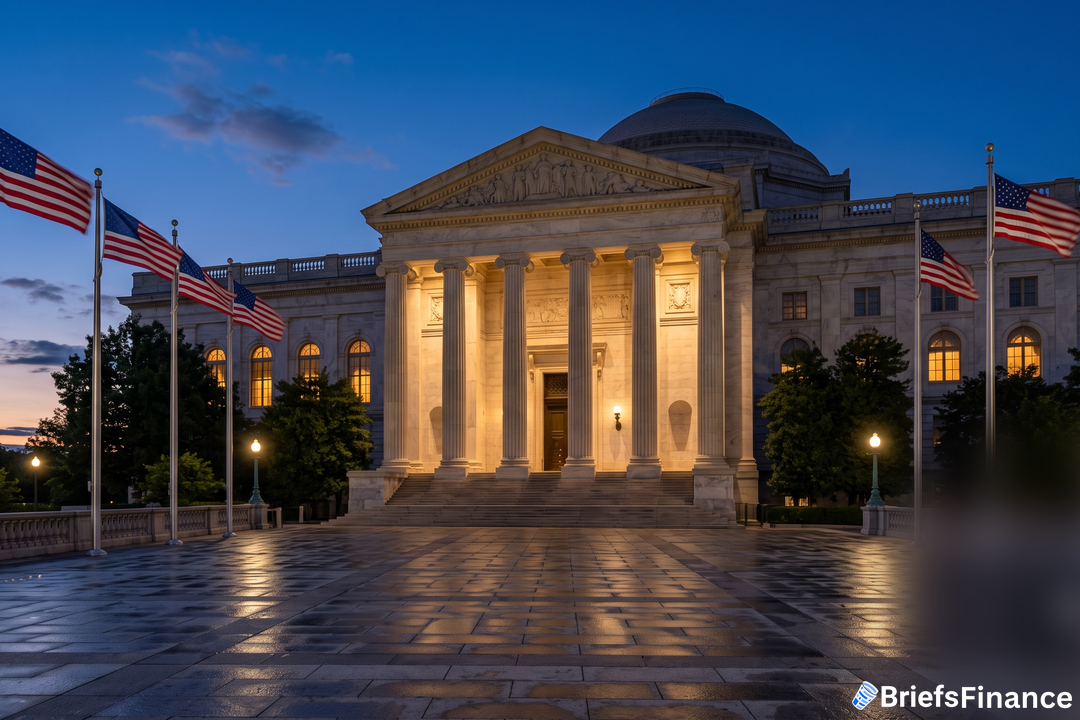
The Treasury's proposal preserves a dual banking system for stablecoins.

Understanding the Dual Banking System

The dual banking system is a cornerstone of U.S. financial regulation, allowing banks to choose a charter under either federal or state authority. For stablecoins, the Treasury's rule extends this concept by requiring issuers to satisfy the requirements of both levels of government. In accordance with the proposal, stablecoin issuers must obtain registration from a federal authority - such as the OCC or the Federal Reserve - while also obtaining a license from the state where they operate.

This ensures that no single jurisdiction has exclusive oversight, potentially preventing a race to the bottom in regulatory standards. The approach echoes the recommendations of the President's Working Group on Financial Markets, which argued that stablecoin issuers should be subject to comprehensive federal prudential regulation.

Stablecoins are digital assets designed to maintain a stable value, typically pegged to a fiat currency like the U.S. dollar. They have become a critical component of the cryptocurrency ecosystem, facilitating trading, lending, and payments. However, their rapid growth has attracted increased regulatory attention, particularly after the collapse of TerraUSD in 2022 highlighted the risks of insufficient oversight.

This dual oversight structure differs from the existing framework for traditional banks, where institutions can choose between a federal or state charter but must comply with the regulations of the chartering authority. In the case of stablecoins, the proposal mandates that all issuers meet both sets of requirements, ensuring a uniform standard of consumer protection, reserves management, and anti-money laundering compliance.

Key Provisions of the Proposal

While the full text of the rule has not been released, the Treasury's announcement indicates several core requirements.

Get the market news that matters in a five-minute read with Market Briefs, our free daily newsletter

Importantly, the rule does not create a new federal charter specifically for stablecoins; instead, it leverages existing banking charters. This means that firms like Circle, which issues USD Coin, may need to restructure their operations to comply with both state and federal guidelines. The proposal also includes consumer protections, such as clear disclosure of redemption rights and the composition of reserve assets.

The Treasury is aligned with the Financial Stability Oversight Council, which previously recommended that stablecoin issuers operate as insured depository institutions to mitigate systemic risk.

Industry Reactions and Next Steps

The stablecoin industry has responded with cautious optimism. Some executives have praised the clarity, noting that it could encourage mainstream adoption by banks and payment companies.

The rule is now open for public comment, a process that typically lasts 60 to 90 days. After that, the Treasury will release a final version, which could include modifications based on feedback. State-level regulatory bodies, including New York's DFS, will likely coordinate with federal agencies to align rules.

The proposal has also drawn attention from lawmakers on Capitol Hill, who are considering separate bills that would establish a comprehensive federal framework for stablecoins - potentially altering the dual oversight approach.

What This Means for the Future

The Treasury's proposal marks a significant shift in how the U.S. government views stablecoins. By embedding them in the dual banking system, regulators are signaling that these digital assets are here to stay and must be treated as part of the mainstream financial infrastructure. The outcome could influence global regulatory trends, as other countries watch how the U.S. balances innovation with stability.

For now, stablecoin firms face a period of adjustment, but the long-term result may be a more secure and trusted market. For investors holding stablecoins, the new rule could enhance safety by requiring issuers to hold high-quality liquid assets equal to the value of outstanding tokens. This would reduce the risk of runs and ensure that stablecoins can be redeemed at par.

However, increased compliance costs may lead to lower yields on certain products or consolidation among issuers. Ultimately, the Treasury's proposal represents a calculated step toward integrating digital currencies into the regulated financial system while preserving the longstanding dual banking model.

Join Market Briefs, our free daily newsletter, for a quick daily rundown of the markets
Disclosure

Recent News

1 2 3 62

Get Market Briefs delivered to your inbox every morning for free!

No fluff. No noise. No politics. Just finance news you can read in 5 minutes.

Blogs

August 23, 2026
How to Get the Most From Your Guideline 401k
  • Guideline is a company that provides low-cost 401k plans, popular with small businesses and their employees.
  • A "Guideline 401k" follows the same core rules as any 401k: tax-advantaged growth, contribution limits, and often an employer match.
  • The biggest results come from capturing the full match, choosing low-cost funds, and picking Roth or traditional to fit your situation.
Read More
August 23, 2026
Principal 401k: What to Know About Your Plan
  • Principal is one of many companies that manage workplace 401k plans, so a "Principal 401k" is simply a 401k where Principal is the provider.
  • The rules of a 401k are the same no matter who runs it: pre-tax or Roth contributions, tax-advantaged growth, and often an employer match.
  • The biggest wins come from grabbing the full match, picking low-cost funds, and knowing whether Roth or traditional fits you.
Read More
August 23, 2026
What a Tariff Dividend Means for Your Money
  • A "tariff dividend" is the idea of taking money the government collects from tariffs and paying some of it back to citizens.
  • To judge the idea, you first need to know what a tariff is: a tax on imported goods, usually paid by the companies bringing them in.
  • Tariffs ripple through prices, businesses, and your investments, so the smart move is understanding those ripples, not just the headline.
Read More
August 23, 2026
No Tax on Overtime: How Overtime Pay Is Taxed
  • "No tax on overtime" refers to a tax break that lets certain workers deduct some overtime pay, lowering the income they get taxed on.
  • A deduction does not mean overtime is truly tax-free. It means part of that pay is subtracted before your tax is figured.
  • The bigger money lesson: how you earn money changes how it is taxed, and investors often get the friendliest treatment of all.
Read More
August 23, 2026
Reading the Silver Price Forecast for 2026
  • Nobody can honestly promise a specific silver price for 2026. Any exact number is a guess, so treat forecasts as opinions, not facts.
  • Silver is unusual because it is both a precious metal and an industrial metal, so its price answers to two very different forces.
  • Instead of chasing a forecast, learn the drivers - inflation, interest rates, recession fear, and industrial demand - so you can judge any prediction yourself.
Read More
August 23, 2026
What to Do When Reddit Stocks Go Viral
  • "Reddit stocks" usually means stocks getting hyped in online communities, where crowds can send a price soaring or crashing fast.
  • These tips can be entertaining and sometimes useful, but they are opinions, not research, and often come loaded with hype.
  • The safe move is to treat every online tip as a starting point, then do your own homework before risking a dollar.
Read More
August 23, 2026
Why Is Bitcoin Dropping Right Now?
  • Bitcoin drops for a mix of reasons: interest rates, big-picture money policy, regulation news, and simple shifts in how much risk investors want to take.
  • Bitcoin has a fixed supply and no earnings, so its price runs almost entirely on supply, demand, and sentiment.
  • Sharp drops are normal for bitcoin. Understanding the drivers matters more than reacting to any single day.
Read More
August 23, 2026
The Fidelity 500 Index Fund, Made Simple for Beginners
  • The Fidelity 500 Index Fund is a low-cost fund that tracks the S&P 500, an index of 500 large U.S. companies.
  • Buying it means owning a tiny slice of 500 businesses at once, which spreads your risk in a single purchase.
  • Index funds like this win over time mostly by keeping fees low and letting compounding do the work.
Read More
August 23, 2026
USA Penny Stocks: Risks and Rewards Explained
  • USA penny stocks are very low-priced shares of very small companies, often trading under $5 and sometimes under $1.
  • They dangle the dream of huge, fast gains, but carry brutal risks: low liquidity, wild swings, and high failure rates.
  • Most investors build wealth faster with quality companies and funds than by chasing cheap shares.
Read More
August 23, 2026
Finding Cheap Stocks to Buy Now Without Getting Burned
  • A low share price does not mean a stock is cheap. Real value compares the price to what the business is actually worth.
  • The best cheap stocks to buy now are quality companies trading below their true value, not the tiniest, riskiest shares on the market.
  • For most beginners, a low-cost index fund is the simplest "cheap" way to own great companies at once.
Read More
1 2 3 25
Share via
Copy link











