Free NewsletterPro Login
S&P 500 6,287 +0.42%
DOW 44,521 -0.18%
NASDAQ 21,103 +0.71%
S&P 500 +12.4%
Briefs Finance Fund +24.8%
JOIN THE FUND →

Trump Declares Canada Must Pay for Wildfire Smoke Through Increased Tariffs

Published Jul 17, 2026
[tts_player]
Share:
Summary:
  • President Trump stated on Truth Social that Canada must compensate for wildfire smoke pollution via tariff hikes.
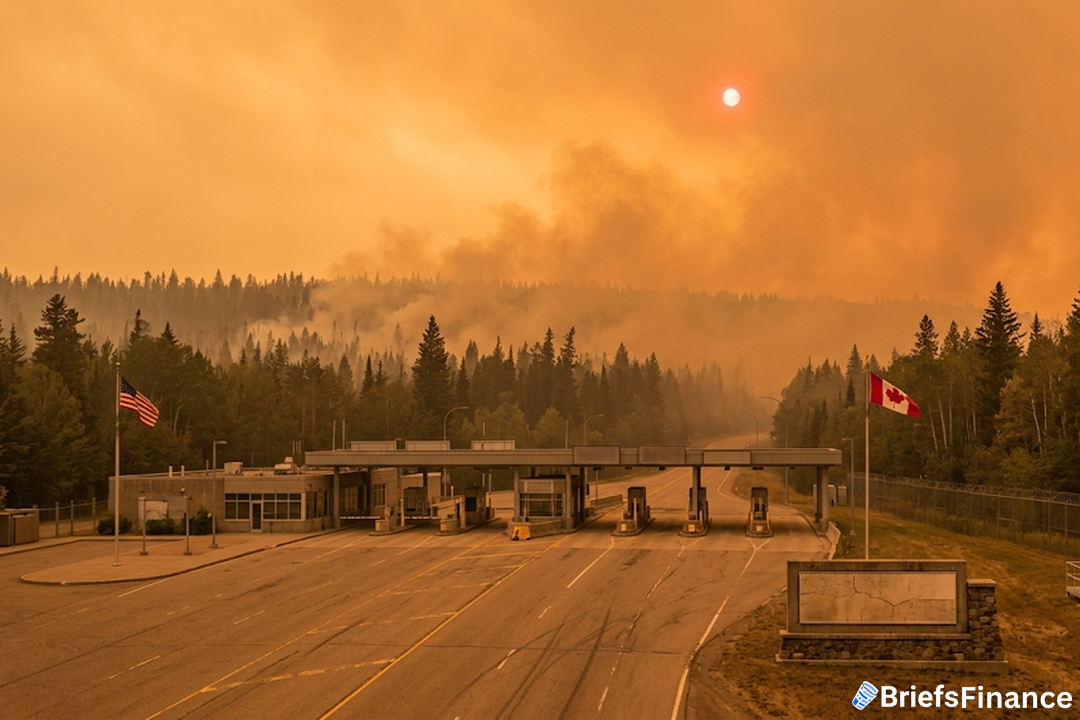
  • The smoke has forced evacuations in Northwestern Ontario and turned New York City skies orange on July 16.
  • The FIFA World Cup final scheduled for Sunday in New Jersey may be disrupted by the smoke.

President Donald Trump took to Truth Social on July 17 to call out Canada over the wildfire smoke that has been pouring into the United States. He said the situation is "totally unacceptable" and that the cost of that air pollution "must of necessity be added to the TARIFFS Canada is currently paying."

Trump said he plans to contact Canadian Prime Minister Mark Carney on Friday to discuss the matter.

The smoke has been bad enough to force evacuations. Thousands of people in Northwestern Ontario have had to leave their homes, according to Prime Minister Carney. He posted on X that the fires have "escalated significantly" in recent weeks.

Get the market news that matters in a five-minute read with Market Briefs, our free daily newsletter

On July 16, thick smoke from Canadian wildfires blanketed the New York City skyline, creating an orange tint and lowering visibility. U.S. Environmental Protection Agency head Lee Zeldin said the impacts of the Canadian wildfires are causing "great concern and harm across the United States." He said the EPA will "strongly encourage them to do everything in their power to extinguish these fires as fast as possible."

Political and Trade Context

President Trump's announcement ties environmental costs directly to trade policy, a novel approach that could escalate tensions between the two nations. Canada has grappled with severe wildfire seasons in recent years, a trend scientists link to climate change. The resulting smoke has frequently drifted across the border, triggering air quality alerts in multiple U.S. states.

The recent dismantling by the Trump administration of government laboratories that studied wildfire smoke could impede attempts to comprehend and reduce these occurrences. Meanwhile, existing tariffs on Canadian goods, imposed over trade disputes, have already strained bilateral relations. Adding pollution costs to these tariffs could provoke retaliatory measures from Canada.

The situation underscores the intersection of environmental policy and international trade, with potential ramifications for both economies and for the health of millions of Americans affected by the smoke.

Beyond the immediate environmental and health impacts, the economic stakes are high. The affected regions in the U.S., including the Northeast and Midwest, have significant populations that may face increased healthcare costs and lost productivity due to poor air quality. Furthermore, the existing tariffs on Canadian goods have already raised prices for American consumers, and adding pollution-based surcharges could exacerbate trade tensions. The Trump administration's approach signals a broader shift toward tying environmental accountability to trade policy, a move that could set a precedent for other nations.

The hazardous air has sparked concerns regarding possible effects on the FIFA World Cup final, scheduled for Sunday in northeastern New Jersey. Trump, planning to watch the Spain vs. Argentina match, went to New York City on Friday for a FIFA reception at his tower.

Join Market Briefs, our free daily newsletter, for a quick daily rundown of the markets
Disclosure

Recent News

1 2 3 38

Get Market Briefs delivered to your inbox every morning for free!

No fluff. No noise. No politics. Just finance news you can read in 5 minutes.

Blogs

June 29, 2026
Portfolio Diversification: Why Putting All Your Eggs in One Basket Destroys Wealth
  • Real diversification means spreading investments across all 11 economic sectors plus bonds, alternatives, and cash so no single bet can sink the portfolio.
  • Different sectors perform at different times, so a diversified portfolio captures upswings while smoothing the brutal drawdowns that wipe out concentrated bets.
  • Total market index funds offer the simplest path to diversification, and annual rebalancing is what keeps the structure working over time.
Read More
June 29, 2026
Non Taxable Income: What It Is and Why It Matters
  • Non taxable income is money you receive that you don't owe income tax on.
  • The tax code treats workers, investors, and business owners very differently, and investors often come out ahead.
  • Learning how income is taxed is a quiet superpower for keeping more of what you earn.
Read More
June 29, 2026
Semiconductor Stocks: A Simple Guide for Investors
  • Semiconductor stocks are companies that design and make computer chips, the brains inside nearly every modern device.
  • The AI boom has turned chips into one of the market's most important and most watched groups.
  • They offer big growth potential, but come with high valuations and a notoriously cyclical history.
Read More
June 25, 2026
How Stocks Work: A Simple Guide for Beginners
  • A stock is a slice of ownership in a company - buy one, and you own a piece of the business.
  • You make money two ways: the share price rising over time, and dividends paid to shareholders.
  • The simplest path for most beginners is buying into the whole market through a low-cost index fund.
Read More
June 25, 2026
Stop Loss vs Stop Limit: What's the Difference?
  • A stop loss order sells your stock once it hits a trigger price, prioritizing getting you out.
  • A stop limit order only sells within a price range you set, prioritizing price over a guaranteed exit.
  • The trade-off: a stop loss almost always executes; a stop limit might not if the price moves too fast.
Read More
June 25, 2026
Energy Stocks: A Simple Guide for Investors
  • Energy stocks are companies that produce and supply the power the world runs on, from oil and gas to newer sources.
  • They make up one of the 11 sectors of the market and tend to move with energy prices and big-picture shifts.
  • Like any sector, the key is diversification and understanding the forces driving demand.
Read More
June 18, 2026
What Is a Stop Loss Order? A Simple Guide
  • A stop loss order automatically sells a stock once it falls to a price you set.
  • It's a tool to cap losses or lock in gains without watching the market all day.
  • It works best for active strategies, and can backfire if used carelessly on long-term holdings.
Read More
June 18, 2026
Best S&P 500 Index Fund: How to Choose One
  • The best S&P 500 index fund for most investors is simply the cheapest, most established one that tracks the index well.
  • Funds like VOO, IVV, and SPY all hold the same 500 companies, so the biggest difference is the fee.
  • Pick one, automate your buys, and let time do the heavy lifting.
Read More
June 17, 2026
What Are Penny Stocks? Risks and Rewards Explained
  • Penny stocks are very low-priced shares of very small companies, often trading for just a few dollars or less.
  • They promise huge gains but carry huge risks: low liquidity, high failure rates, and wild price swings.
  • Most investors are better served by quality companies and funds than by chasing cheap shares.
Read More
June 17, 2026
Best Stocks for Beginners With Little Money
  • The best stocks for beginners with little money usually aren't individual stocks at all - they're low-cost index funds.
  • You can start with $100 or less and use small, regular investments to build wealth over time.
  • Focus on diversification and consistency, not on picking the next big winner.
Read More
1 2 3 24
Share via
Copy link











