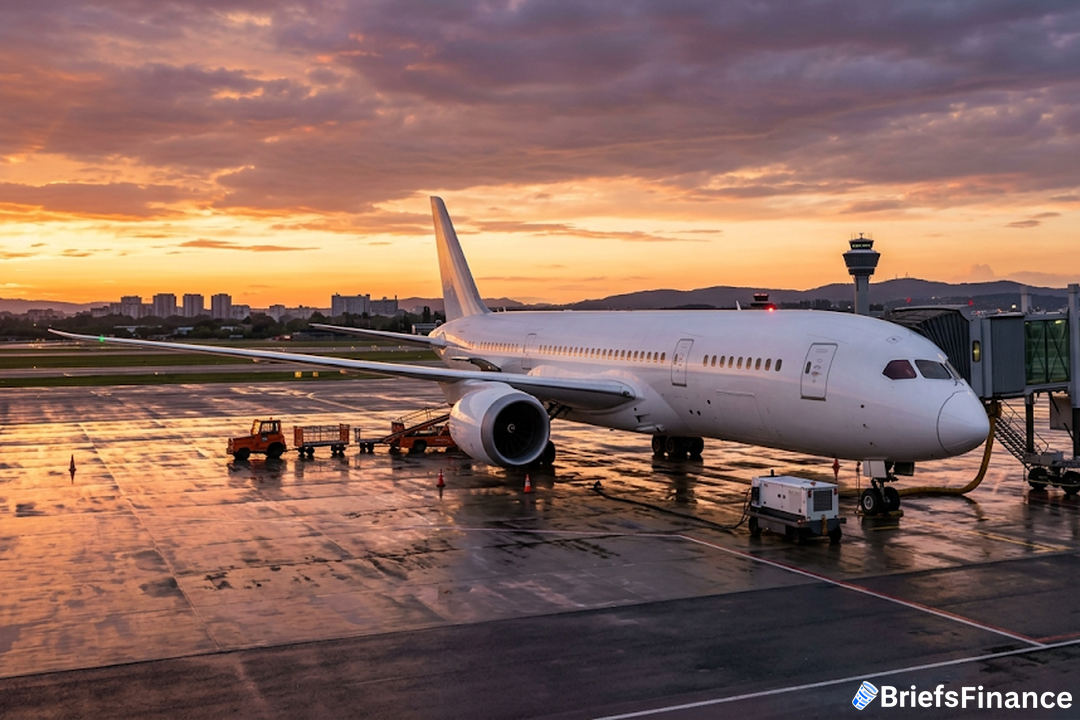
Why IndiGo Is Retreating From Europe
India's biggest airline is scaling back its European ambitions. Widebody service to London's Heathrow and Amsterdam will be shut down in October 2026, with the carrier pointing to geopolitical tensions as the main reason for the change.
All six Boeing Co. 787 Dreamliners involved in the damp-lease deal with Norse Atlantic ASA are going back to the Norwegian airline. Under a damp lease, Norse supplies the planes, pilots and maintenance. IndiGo had taken the aircraft to add long-haul capacity quickly while waiting for Airbus A350s already on order.
The Mumbai-to-Amsterdam route remains on the schedule, but IndiGo will use its Airbus SE A321XLR narrowbody jets rather than the 787s. The London Heathrow route is expected to come back after the A350 deliveries start, according to IndiGo's statement.
Rerouting around airspace restrictions adds time and fuel, and the airline has already cited currency pressures as another drag. That made the economics of keeping six 787s on the India-Europe routes difficult to defend. The A321XLR gives the carrier a way to keep a thinner Amsterdam schedule alive.
What the Airline Says
In a press release, InterGlobe Aviation Ltd., IndiGo's parent, said: "Airspace constraints, elevated fuel costs and currency pressures have impacted route efficiency, schedule integrity, connectivity and overall competitiveness."
Get the market news that matters in a five-minute read with Market Briefs, our free daily newsletter
IndiGo surprised investors this month by posting a second consecutive quarterly loss, tied to higher costs from the conflict involving Iran. Willie Walsh, who once led British Airways and parent IAG SA with a reputation for aggressive cost reductions, will become IndiGo CEO on Aug. 3. IndiGo has also said its Manchester, England route will be eliminated at the end of August.
Indian carriers have been forced to cancel flights and reroute international services to avoid Iranian airspace, adding to the restrictions already in place because Pakistan's airspace is unavailable.
The Bridge Back to Norse
The 787 deployment had become an important financial lifeline for Norse, whose low-cost, long-haul business between Europe and the US has struggled to generate consistent profits. Half of Norse's fleet was tied up in the IndiGo damp lease.
Now that the aircraft are coming back, Norse says it is talking with other airlines about charter opportunities for as many as five of them. It will also use some planes on its own transatlantic routes, including services to Orlando and New York. A strategic review is still underway, and Norse has said the review could lead to a sale, a merger, or a partnership.
The abrupt reversal leaves IndiGo with a narrower near-term long-haul presence in Europe.
Long-Haul Plans Still Taking Shape
The damp lease was meant as a bridge while IndiGo waited for the A350s on order. With those deliveries still ahead, the end of the 787 arrangement leaves a gap in its European schedule apart from the thinner A321XLR service to Amsterdam. The broader constraints from closed airspace and higher fuel costs are likely to remain part of the airline's planning until conditions change.
Market Reaction
Shares of InterGlobe Aviation, IndiGo's parent, rose 1.14% to 5,171.00. Norse Atlantic gained 1.38% to 0.39, while International Consolidated Airlines Group advanced 1.53% to 431.90.
Join Market Briefs, our free daily newsletter, for a quick daily rundown of the markets