Free NewsletterPro Login
S&P 500 6,287 +0.42%
DOW 44,521 -0.18%
NASDAQ 21,103 +0.71%

Warning: Undefined variable $funds in /var/www/briefs.co/htdocs/wp-content/plugins/oxygen/component-framework/components/classes/code-block.class.php(133) : eval()'d code on line 491

Warning: foreach() argument must be of type array|object, null given in /var/www/briefs.co/htdocs/wp-content/plugins/oxygen/component-framework/components/classes/code-block.class.php(133) : eval()'d code on line 491
/* the link was here */

Russia's Cheap Banderol Missiles Strangle Ukraine's Grain Ports

Published Jul 31, 2026
[tts_player]
Share:
Summary:
  • Russia's low-cost Banderol missile is hammering the Black Sea ports Ukraine relies on for exports.
  • The weapon carries a 150-kilogram warhead, outruns Ukrainian interceptor drones, and is far cheaper than the missiles needed to shoot it down.
  • Attacks on the Greater Odesa hub have damaged more than 20 ships and sharply slowed grain traffic, with one official calling the ports "98% closed."

The Weapon

Russia has a new weapon in its arsenal, and it is disrupting Ukraine's shipping corridor.

It is called the Banderol, a low-cost cruise missile that has become central to Russia's attacks on Odesa's port area. Each unit costs $150,000 to $300,000, and Ukrainian officials believe Russian factories are turning out hundreds of them annually. According to officials, stricter limits on imported components might slow production.

President Volodymyr Zelenskyy's sanctions-policy commissioner, Vladyslav Vlasiuk, said the Banderol was designed to sit between cheap, slow Shahed drones and faster, more accurate Kh-101 cruise missiles. Work on it started in 2021, he said, and the current version contains many imported parts.

"This is a very dangerous gizmo," "Vlasiuk told journalists as he showed off part of a Banderol fired last year".

"The majority of strikes on the port infrastructure in Odesa are with Banderols," Vlasiuk said.

According to his team's analysis, the Banderol was used in 80% of attacks on the greater Odesa port hub, which includes Chornomorsk and Pivden. The Russian Defense Ministry offered no immediate response to questions from reporters.

The Cost Problem

Compared with Shahed drones, the Banderol carries a heavier blast: its warhead weighs 150 kilograms (330 pounds). Its flight speed lets it outrun Ukraine's latest interceptor drones. But each unit costs an estimated $150,000 to $300,000, so firing a Patriot interceptor or another expensive surface-to-air missile to stop it is a difficult call, especially since those defenses are already in short supply in Ukraine and elsewhere.

Get the market news that matters in a five-minute read with Market Briefs, our free daily newsletter

Ukrainian navy spokesman Dmytro Pletenchuk said of the weapon: "In speed and maneuverability, it's not exactly a missile."

The missile is roughly 5 meters (16 feet) long. Its box-shaped fuselage features short straight wings that fold, along with three tail fins and two guidance fins near the nose, all of which also fold.

Besides being carried by bigger long-endurance drones like Russia's Orion, the weapon has also appeared on ground-based launchers. Serhii "Flash" Beskrestnov, who advised recently dismissed Defense Minister Mykhailo Fedorov on electronic warfare, highlighted the new ground-launch configuration in a July 28 Facebook post.

Because Banderols are cheap and produced in large numbers, Russian forces can fire them in sustained attacks without quickly draining their budget. Ukrainian commanders, meanwhile, face a hard choice: spend another scarce interceptor or let the missile come in.

Impact on Ports and Grain Trade

Because their range is only a few hundred kilometers, Russian forces send them toward Odesa from launch sites in Crimea. Pletenchuk described the Greater Odesa port system as "the largest gateway for Ukrainian exports, particularly grains and oilseeds."

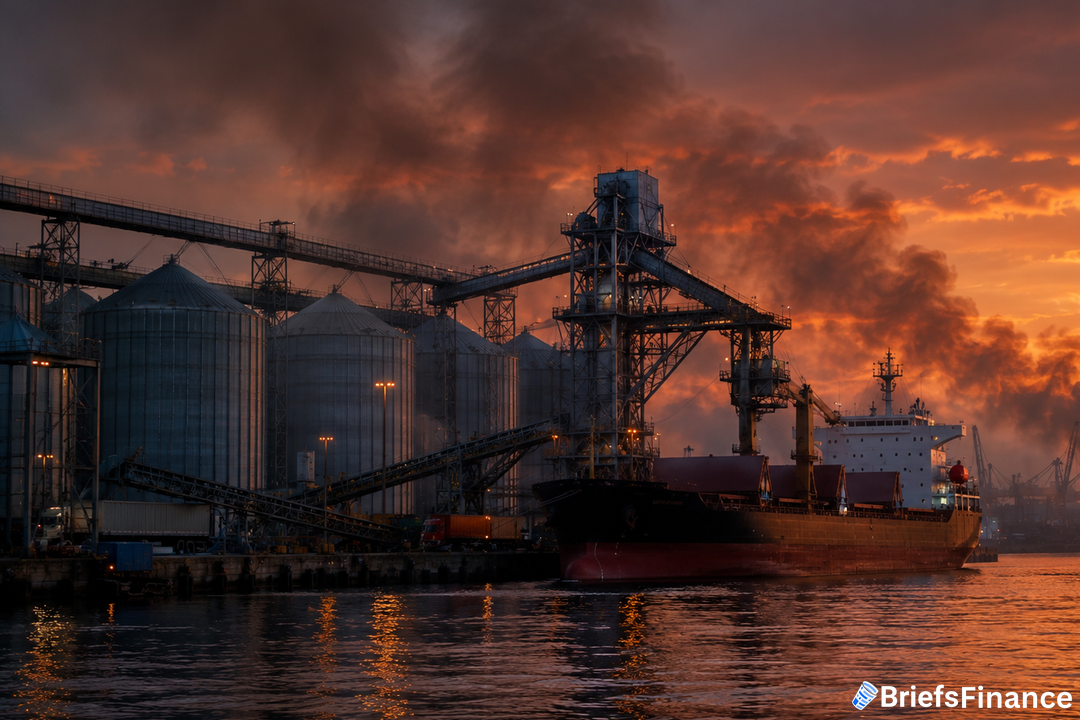
The Greater Odesa hub is Ukraine's principal deep-water outlet for agricultural trade, and the repeated missile strikes have slowed that trade substantially.

"The work of our corridor has stopped - not entirely, but nonetheless, certainly the flow has slowed substantially. More than 20 ships have been damaged," Pletenchuk said. Pletenchuk also noted those 20 damaged merchant vessels were far fewer than the roughly 200 Russian ships Ukraine has destroyed in the Sea of Azov and the Black Sea.

Constantine Sobol, who runs the Odesa-based shipping firm Marelis Navigation, took a darker view, calling the regional harbors - Ukraine's only remaining route to the Black Sea - "98% closed."

"At the moment you can consider it the stoppage of Ukrainian deep-water export and import," Sobol said.

The Bottom Line

The Banderol is cheap to build, cheap to launch, and expensive to stop. With Ukraine's main grain export corridor under renewed pressure, the economic damage could be felt well beyond Odesa.

Join Market Briefs, our free daily newsletter, for a quick daily rundown of the markets
Disclosure

Recent News

1 2 3 46

Get Market Briefs delivered to your inbox every morning for free!

No fluff. No noise. No politics. Just finance news you can read in 5 minutes.

Blogs

June 29, 2026
Portfolio Diversification: Why Putting All Your Eggs in One Basket Destroys Wealth
  • Real diversification means spreading investments across all 11 economic sectors plus bonds, alternatives, and cash so no single bet can sink the portfolio.
  • Different sectors perform at different times, so a diversified portfolio captures upswings while smoothing the brutal drawdowns that wipe out concentrated bets.
  • Total market index funds offer the simplest path to diversification, and annual rebalancing is what keeps the structure working over time.
Read More
June 29, 2026
Non Taxable Income: What It Is and Why It Matters
  • Non taxable income is money you receive that you don't owe income tax on.
  • The tax code treats workers, investors, and business owners very differently, and investors often come out ahead.
  • Learning how income is taxed is a quiet superpower for keeping more of what you earn.
Read More
June 29, 2026
Semiconductor Stocks: A Simple Guide for Investors
  • Semiconductor stocks are companies that design and make computer chips, the brains inside nearly every modern device.
  • The AI boom has turned chips into one of the market's most important and most watched groups.
  • They offer big growth potential, but come with high valuations and a notoriously cyclical history.
Read More
June 25, 2026
How Stocks Work: A Simple Guide for Beginners
  • A stock is a slice of ownership in a company - buy one, and you own a piece of the business.
  • You make money two ways: the share price rising over time, and dividends paid to shareholders.
  • The simplest path for most beginners is buying into the whole market through a low-cost index fund.
Read More
June 25, 2026
Stop Loss vs Stop Limit: What's the Difference?
  • A stop loss order sells your stock once it hits a trigger price, prioritizing getting you out.
  • A stop limit order only sells within a price range you set, prioritizing price over a guaranteed exit.
  • The trade-off: a stop loss almost always executes; a stop limit might not if the price moves too fast.
Read More
June 25, 2026
Energy Stocks: A Simple Guide for Investors
  • Energy stocks are companies that produce and supply the power the world runs on, from oil and gas to newer sources.
  • They make up one of the 11 sectors of the market and tend to move with energy prices and big-picture shifts.
  • Like any sector, the key is diversification and understanding the forces driving demand.
Read More
June 18, 2026
What Is a Stop Loss Order? A Simple Guide
  • A stop loss order automatically sells a stock once it falls to a price you set.
  • It's a tool to cap losses or lock in gains without watching the market all day.
  • It works best for active strategies, and can backfire if used carelessly on long-term holdings.
Read More
June 18, 2026
Best S&P 500 Index Fund: How to Choose One
  • The best S&P 500 index fund for most investors is simply the cheapest, most established one that tracks the index well.
  • Funds like VOO, IVV, and SPY all hold the same 500 companies, so the biggest difference is the fee.
  • Pick one, automate your buys, and let time do the heavy lifting.
Read More
June 17, 2026
What Are Penny Stocks? Risks and Rewards Explained
  • Penny stocks are very low-priced shares of very small companies, often trading for just a few dollars or less.
  • They promise huge gains but carry huge risks: low liquidity, high failure rates, and wild price swings.
  • Most investors are better served by quality companies and funds than by chasing cheap shares.
Read More
June 17, 2026
Best Stocks for Beginners With Little Money
  • The best stocks for beginners with little money usually aren't individual stocks at all - they're low-cost index funds.
  • You can start with $100 or less and use small, regular investments to build wealth over time.
  • Focus on diversification and consistency, not on picking the next big winner.
Read More
1 2 3 24
Share via
Copy link












