Warning: Undefined variable $stocks in /var/www/briefs.co/htdocs/wp-content/plugins/oxygen/component-framework/components/classes/code-block.class.php(133) : eval()'d code on line 448
Warning: foreach() argument must be of type array|object, null given in /var/www/briefs.co/htdocs/wp-content/plugins/oxygen/component-framework/components/classes/code-block.class.php(133) : eval()'d code on line 448
Warning: Undefined variable $funds in /var/www/briefs.co/htdocs/wp-content/plugins/oxygen/component-framework/components/classes/code-block.class.php(133) : eval()'d code on line 472
Warning: foreach() argument must be of type array|object, null given in /var/www/briefs.co/htdocs/wp-content/plugins/oxygen/component-framework/components/classes/code-block.class.php(133) : eval()'d code on line 472
/* the link was here */
×
Free investor livestream — Nov 17
How To Use ChatGPT & Claude To Research Stocks Like A Pro
Simplexity Robotics raised $100 million in a pre-Series A led by Ant Group, pegging its valuation at $1.6 billion.
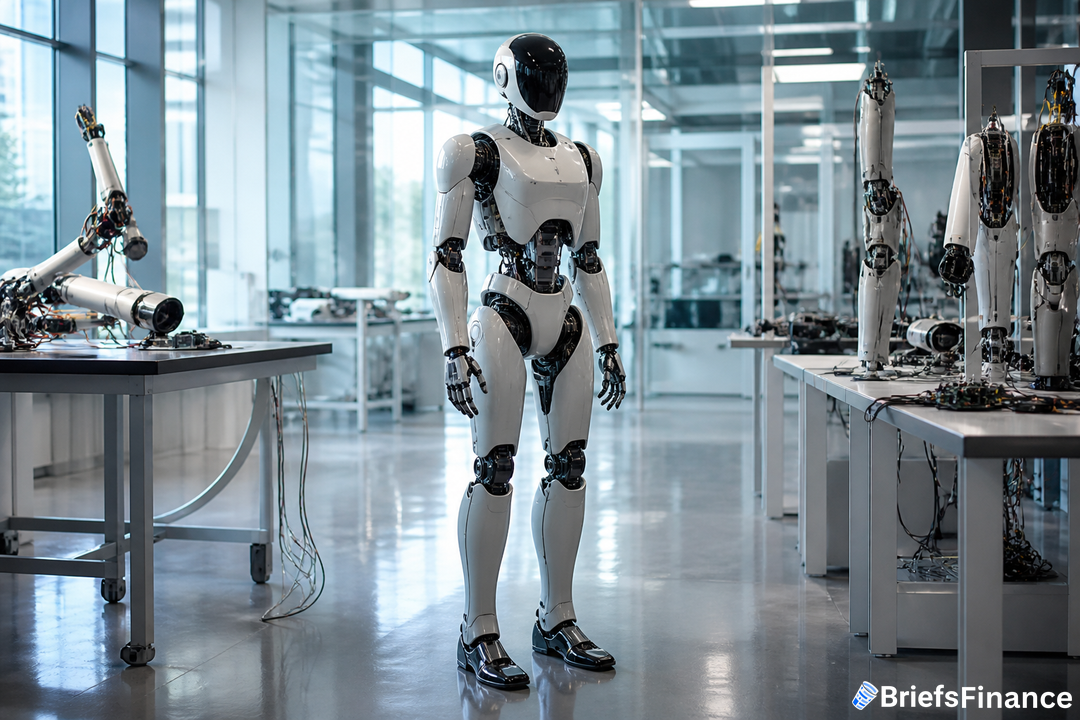
The company rolled out its second humanoid, iX, a wheeled bot that can serve drinks, deliver items and guide tours.
Former Li Auto executives Wang Kai, Jia Peng and Wang Jiajia founded Simplexity last summer, and Wang says it cleared a $1 billion valuation within months.
The deal and who backed it
Simplexity closed a $100 million pre-Series A round led by Jack Ma backed Ant Group, valuing the startup at $1.6 billion. According to chairman and co-founder Wang Kai, speaking to Bloomberg News, existing backers Tencent Holdings Ltd., HSG and Lanchi Ventures joined the round.
Ant's check adds to its growing robotics portfolio, which already counts Unitree, Astribot and Zeroth. Wang said he launched Simplexity last summer with Jia Peng and Wang Jiajia after leadership roles at Li Auto, and that the young company crossed the $1 billion mark in short order.
What Simplexity is building
On Monday the startup unveiled its second humanoid robot, called iX. The wheeled robot is marketed as capable of making and serving drinks, picking up and dropping off items, and guiding tours.
The company's debut humanoid uses a wheeled base in an industrial configuration and is already deployed for manufacturing, logistics sorting, retail tasks, and pharmaceutical packaging. Simplexity has trained it to operate CNC machines - computer controlled tools that cut, drill and shape materials - in a bid to ease a shortage of operators.
The company designs both the hardware and the software and adapts them for specific jobs and body types. It develops the full software stack in-house, spanning its own AI world models and the real world data that trains them. As Wang put it, "We bring the foundation models, the data sets, the supply chain and the customers all working together to advance commercial robots."
When new technologies reshape industries, it helps to get clear context, so sign up for the free Market Briefs today.
Customers, production and a modular arm
Among the first buyers are Korean robotics firm Rlwrld Inc., Tsinghua University, and forklift manufacturer Hangcha Group Co., and Simplexity says a warehouse sorting line with Hangcha is already up and running. Other named customers include precision components maker Suzhou Dongshan Precision Manufacturing Co., as well as Leaderdrive, which the company calls a main customer.
The company says that, for Leaderdrive, it runs an intelligent CNC robot production line it claims is the world's first, with robots producing precision motion-control parts nonstop.
Simplexity is also developing what it says will be China's first modular humanoid arm, with joint modules that can be taken apart and reassembled at different lengths to match specific tasks.
The market setup and why it matters for investors
China has pulled into the lead in humanoids, with 97% of units shipped during the first three quarters of 2026, bolstered by government support and a tight-knit domestic supply chain. Planners have flagged bubble risk, though competition is exactly why Wang sees upside: "If we can sell and survive here, we can sell at bigger margins anywhere in the world."
The labor math frames the use case. "Our robots target the work that people don't want to do," Wang said, noting China's roughly 3 million CNC machines, an average operator age of 45 and about $20,000 a year in pay. He added of shop floors, "It's a noisy, tough environment, you inhale a lot of dust," followed by the goal: "We want the robots to conquer that type of work."
The bottom line: funding from a marquee fintech investor, a second humanoid aimed at service tasks, and paying industrial customers point to commercial momentum. Execution will play out against a crowded field and a regulator warned froth, but if Simplexity can sell in China, global margins could be richer.
Markets move with innovation and global trends, and staying informed makes decisions easier, subscribe to Market Briefs newsletter for quick daily briefings.
Anthropic has gone public at a valuation of about $1.5 trillion, while Amazon went public in 1997 at around $440 million. Anthropic has about $33 billion in revenue this year and no profit, and investors are paying more than 40 times its sales, against about 3 times for Amazon. Briefs Finance CEO Jaspreet Singh says nobody knows what comes next, and that long-term investors use downturns to buy instead of panic selling.
Tech stocks are selling off because investors don't know who will lead Nvidia, the company that has been funding the AI industry and selling it chips.
Inflation has the Federal Reserve planning to raise interest rates, with a hike expected in December, and that puts pressure on homebuyers, private equity and the $40 trillion national debt.
Briefs Finance CEO Jaspreet Singh says nobody has a crystal ball, so his rules are to buy when markets are low, hold long term and invest only what you're willing to lose.
The national debt is above $40 trillion, and the Federal Reserve has gone from sending Washington its profits to losing money.
President Trump's four-part plan leans on shorter-term debt, stablecoin companies buying Treasuries, a bigger balance sheet and government stakes in private companies.
The goal is to outgrow the debt, not pay it off, so Jaspreet Singh points investors to the seven industries where Washington wants growth.
The Fed makes its next rate decision on December 9 and is now talking about jumbo interest rate hikes of 0.5%, though one in December looks unlikely.
Washington will pay a record $1.05 trillion in interest this year on $40 trillion of debt, and that debt resets at higher rates as the Fed hikes.
Jaspreet Singh's five moves are to pay down variable-rate debt, earn interest on your savings, know which stocks feel the pressure, look at value and hedge.
Margin debt, the money investors borrow to buy stocks, is at a record of around 4.6% of GDP, up from 3.9% in 2021.
ETF money has more than tripled in five years to 7% of GDP, while corporate buybacks and 401(k) money sit below their earlier peaks.
Margin calls and panic selling can make the next downturn deeper, so Jaspreet Singh keeps buying broad market funds and says most investors should skip margin debt.
Jensen Huang is out at Nvidia over affairs with multiple people, and the company he founded has been the bank of American AI, with about $30 billion into OpenAI and $10 billion into Anthropic.
A hotter-than-expected inflation report has Fed officials talking about a possible 0.5% hike in December, and gold, silver, and bitcoin fell on the news.
President Trump said the US may not need a deal with Iran, keeping oil prices and inflation risk high. Jaspreet Singh breaks down what it all means for AI stocks and your portfolio.
Stocks are booming at the fastest pace in years, jobless claims just hit a 57-year low, and most investors still feel like nobody is hiring.
The Fed is protecting the dollar over the economy, oil swings on every Iran headline, and a few AI companies are carrying an S&P 500 where four of five stocks sit in a correction.
Jaspreet Singh explains why circular financing between Nvidia, OpenAI, Anthropic, and SpaceX rhymes with 2008's house of cards, and how his three investing pillars handle a stock market bubble.
The Fed has raised rates, cut them, then raised them again only twice in the last 60 years, and both times the economy fell into a recession and stocks crashed.
The same stop-and-go cycle is playing out now, with one big difference: US debt is 125% of GDP today versus about 30% in 1980.
In the 1970s gold rose roughly 24x, real estate 157%, stocks lagged, and cash lost half its value. Jaspreet Singh lays out five assets to consider before the next flip.
The IRS 2027 tax plan keeps the same seven rates but widens every bracket and lifts the married-filing-jointly standard deduction to $33,200.
The 0% long-term capital gains bracket rises to $102,100, so a household living on $135,300 of investment income could owe $0 in federal income tax.
C corporations still pay 21%, small businesses keep the 20% QBI deduction, and the 401(k) limit climbs to $25,500 with an $8,500 catch-up for investors over 50.
Make sure to check your inbox for the first email.
Before you go
We’re hosting our first ever livestream on how investors can use ChatGPT & Claude to invest like a pro. It’s on 11/17 and is hosted by our CEO Jaspreet Singh.