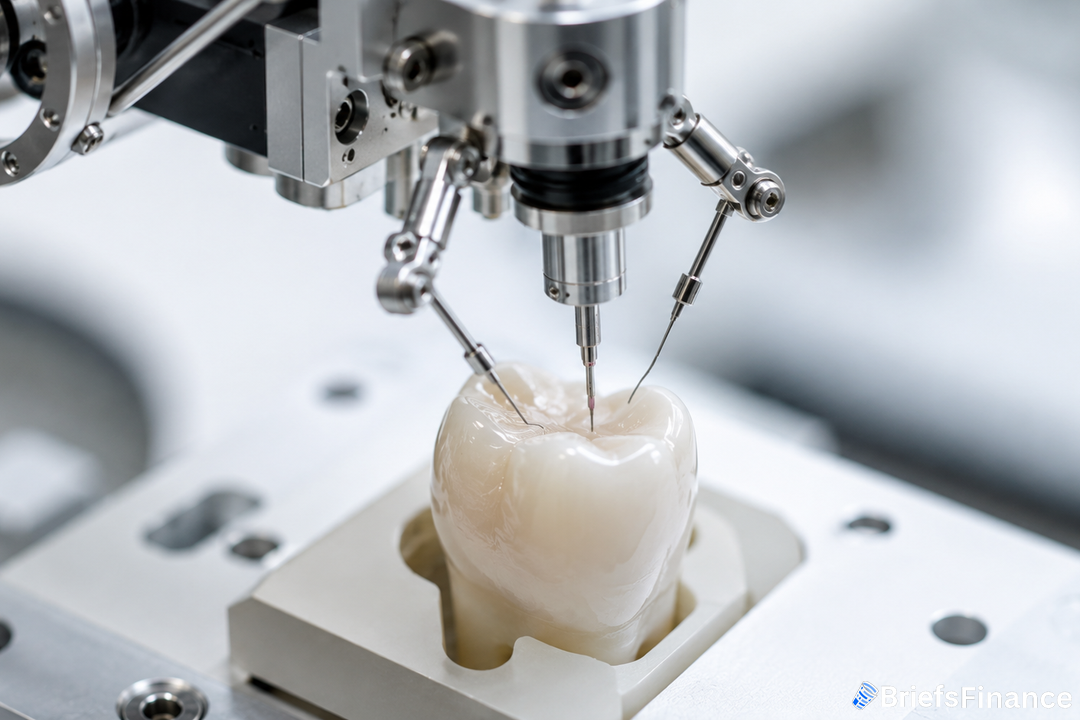
What Is MIR and How Does It Work?
A dental crown is a common fix for a damaged tooth, but getting one usually means sitting through multiple appointments. The dentist removes decay, shapes the tooth, takes an impression, fits a temporary crown, and then waits for the permanent one to come back from a lab. MIR aims to streamline this step.
The force it applies during drilling stays below five newtons. To put that in perspective, a half‑liter bottle of water weighs about that same amount. So the robot is small, precise, and gentle.
Its current process involves two stages. First, a wider drill works on the top of the tooth model. Then a thinner drill shapes the sides. The robot is still a prototype, but the early results are promising.
Why a Robot Could Save You a Visit
The whole reason for building MIR is to speed up the crown process. Right now, you need that first appointment to prepare the tooth and take the impression. Then the permanent crown gets made in a lab, which takes days or weeks. That means a second visit to have it glued in.
Get the market news that matters in a five-minute read with Market Briefs, our free daily newsletter
Researchers want to shift as much of that work as possible into a digital workflow. Imagine this: after a quick scan of your tooth, the robot prepares the surface while the data for the crown gets sent straight to a milling machine or 3D printer. You walk out with the crown ordered the same day.
The team behind MIR includes researchers from the University of Basel, the University of Zurich, the ARTORG Center at the University of Bern, and Camlog Biotechnologies. The work is sponsored by Innosuisse, the Swiss innovation agency. Dr. Yukiko Tomooka is the first author of the research paper, and Professor Georg Rauter leads the group.
Why does it matter? Fewer dental visits mean less time in the chair and potentially lower costs for you. For anyone who dreads the dentist or just has a busy schedule, that is a real win.
The MIR project is part of a broader push toward fully digital dentistry. With intraoral scanners and same-day milling already common, automating the drilling step could complete the transition, reducing both chair time and the potential for human error.
What Still Needs to Happen
The robot is not ready for your mouth yet. So far, the robot has undergone testing solely on artificial tooth models and ceramic materials designed to imitate natural teeth. No actual patients have been involved.
Before it can work on a real person, the robot needs sensors and a camera to track its position during the procedure. That way it can monitor the treatment and adjust if the patient moves. The system also has to handle a power outage - it needs to know exactly where it stopped and pick up from the correct spot.
Those are big engineering challenges, but the team is working on them. If they succeed, a tiny robot comparable to a wine cork could change how dentists prepare crowns. That would mean less time in the chair and more of your day back.
Join Market Briefs, our free daily newsletter, for a quick daily rundown of the markets