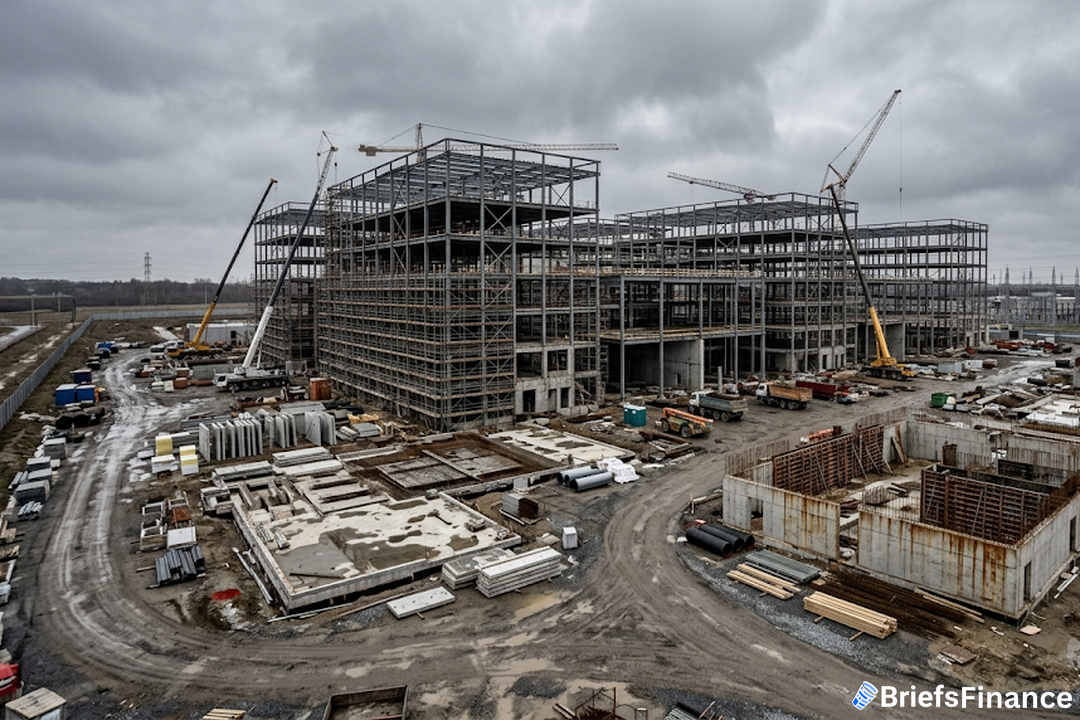
The Boom Is Running Into Real-World Problems
For the last couple of years, data centers have been a major focus in finance.
Andrej Danis, a managing director and partner at AlixPartners, said, "Two-thirds of the market expects distress within 18 months, and the investors and lenders are the most convinced of anyone." He added, "That's not a demand problem. That's a margin problem."
Why the Pressure Is Building From All Sides
Additional challenges include construction holdups, a lack of available workers, stricter financing conditions, and local opposition to technology facility projects. Growing bottlenecks in equipment and fierce rivalry for qualified tradespeople such as electricians and plumbers have damaged the sector's prospects.
Get the market news that matters in a five-minute read with Market Briefs, our free daily newsletter
QTS, with backing from Blackstone Inc., issued $4.6 billion in green bonds in April to finance its major site in Fayetteville, Georgia, a project that has faced local resistance.
The amount of capital raised in 2026 has already exceeded the total for all of 2025.
However, following SpaceX's $25 billion debt issuance, lender exhaustion threatens to reduce available funds for smaller initiatives. Signs of strain are emerging following Amazon.com Inc.'s $25 billion bond sale earlier this month. That offering, the company's biggest on record, was designed to finance its artificial intelligence and data center growth.
Yet the bond's limited oversubscription and tepid secondary-market trading indicated waning investor appetite. Just last week, data center firm Prime Data Centers LLC delayed an intended bond issuance.
Danis said, "The neoclouds that survive are the ones building a viable business by selling directly to enterprise clients at scale."
As the industry matures, the focus is shifting from raw expansion to operational efficiency. Many developers are now prioritizing locations with existing power infrastructure and streamlined permitting processes to avoid the delays that have plagued projects in regions like Northern Virginia and Georgia. The AlixPartners survey also noted that nearly half of respondents expect credit conditions to worsen, further squeezing developers reliant on debt markets.
The broader AI infrastructure boom has drawn enormous capital, but the rapid expansion is now colliding with physical and financial constraints. Energy costs have surged, supply chains for critical components remain strained, and local governments are increasingly pushing back against the massive power and water demands of hyperscale facilities. Meanwhile, the sheer volume of bond and loan issuance - over $334 billion already in 2026 - has begun to saturate debt markets, making it harder for smaller or less-established players to secure funding.
The AlixPartners survey highlights that investors and lenders, who are most exposed to defaults, are the most pessimistic about the near-term outlook. This combination of rising costs, regulatory hurdles, and tightening credit could trigger a wave of restructurings or bankruptcies among overleveraged builders and operators, particularly those without long-term contracts with major cloud providers.
Join Market Briefs, our free daily newsletter, for a quick daily rundown of the markets