Pacific premiums pop, North American discounts bite
Canadian heavy barrels are clearing at eye-catching prices in Asia. Platts, part of S&P Global Energy, reported Cold Lake shipments to South Korea hit a record $9.50 per barrel premium to Dubai in September. So far this month, that uplift has averaged $4.33, a flip from the discount seen before the Iran war.
China shows a similar tilt. Trading managers and feedstock contacts at Shandong refiners told S&P Global that recent Canadian cargoes there commanded up to a $14 premium to ICE Dated Brent.
Back home, it is the mirror image. According to General Index, Alberta's Western Canadian Select heavy grade fell as much as $28.25 per barrel below the monthly mean of West Texas Intermediate futures last week, the widest in almost four years.
Why Asia pays up while the US drags down
Canada still ships about 90 percent of its oil exports to the US, and the only pipeline corridor to the BC coast - and on to Asia - is already full. That chokepoint limits how much producers can chase the better prices across the Pacific.
That funnel into the US has collided with refinery maintenance and a pickup in Venezuelan barrels that look a lot like Canada's oil sands crude. That has left the US Gulf Coast with a buildup of dense, high sulfur crude, according to Wood Mackenzie's Jim Mitchel, the firm's oil trading analytics director. He added that a spike in freight rates has made rerouting those barrels to other regions uneconomic.
When market shifts can affect your planning, sign up for the free Market Briefs newsletter to stay informed.
The glut to the south weighs on Alberta pricing. Asia, by contrast, is scrambling for viscous, lower cost feedstock. Vortexa data indicate Venezuelan exports have dwindled to a trickle as volumes remain in the Americas; at the same time, the Iran war has disrupted Middle East flows and reduced heavy oil from Iraq.
Shipping helps Asia's case too. Crude loaded on Canada's Pacific coast typically moves on smaller Aframax tankers, which are easier to line up than the very large crude carriers common on the US Gulf routes. Sailing to China also takes roughly one third as long.
Ottawa's bet on more west coast capacity
Mark Carney's government wants to change the math by expanding access to Pacific markets. The government says it will speed up approvals and have government-owned Trans Mountain Corp. construct a new line intended to roughly double west coast exports, as part of a broader push to become an energy superpower and cut dependence on the US. One reason cited by the government: producers can capture Brent-linked pricing by shipping off the Pacific.
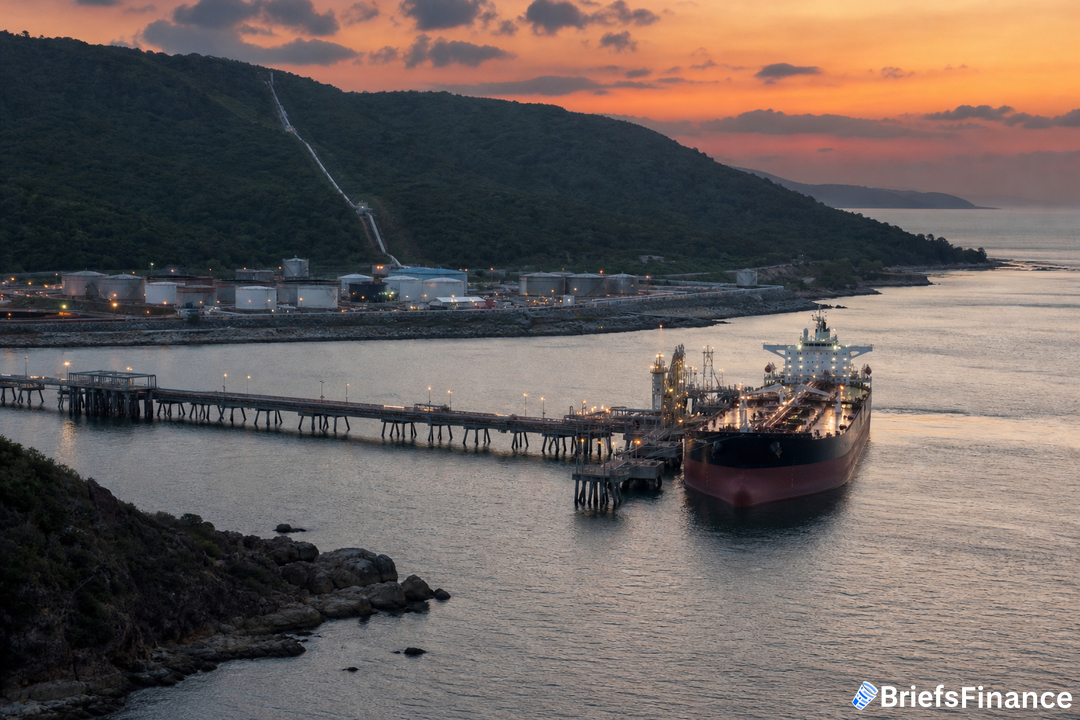
Trans Mountain's expanded pipeline has already opened the door to significant Asian exports, especially into China. At present, the system carries roughly 900,000 barrels per day, and operators aim to raise capacity to 1.2 million within the next few years. Owned by the Canadian government, the company has been assigned to spearhead a new million-barrel-a-day pipeline that would largely follow the current corridor and end at a new deepwater port just south of Vancouver capable of handling the largest crude carriers.
The current market only strengthens that case, said Susan Bell, Rystad Energy's downstream senior vice president. "If we had more capacity going off the west coast and we could get more barrels off the west coast, then the impact of Venezuela on our light-heavy differential would be much less," she said. "Our light-heavy differential could be $6 or $7 stronger than what it is right now."
The bottom line for investors
Heavy Canadian crude is worth more when it can reach Asia, yet most barrels are tied to US routes where a heavy-oil pileup has hammered local pricing. Ottawa has pledged to add Pacific capacity through Trans Mountain's upgrade and a new million-barrel-a-day line, with the stated goal of tapping Brent-linked prices and diversifying away from US demand. For portfolios exposed to western Canadian producers, the spread between Pacific-linked realizations and US-dominated discounts is the metric to watch as logistics change.
If you prefer a concise daily take on the economy and markets, try the free Market Briefs for clarity.