What is moving faster - and why that matters
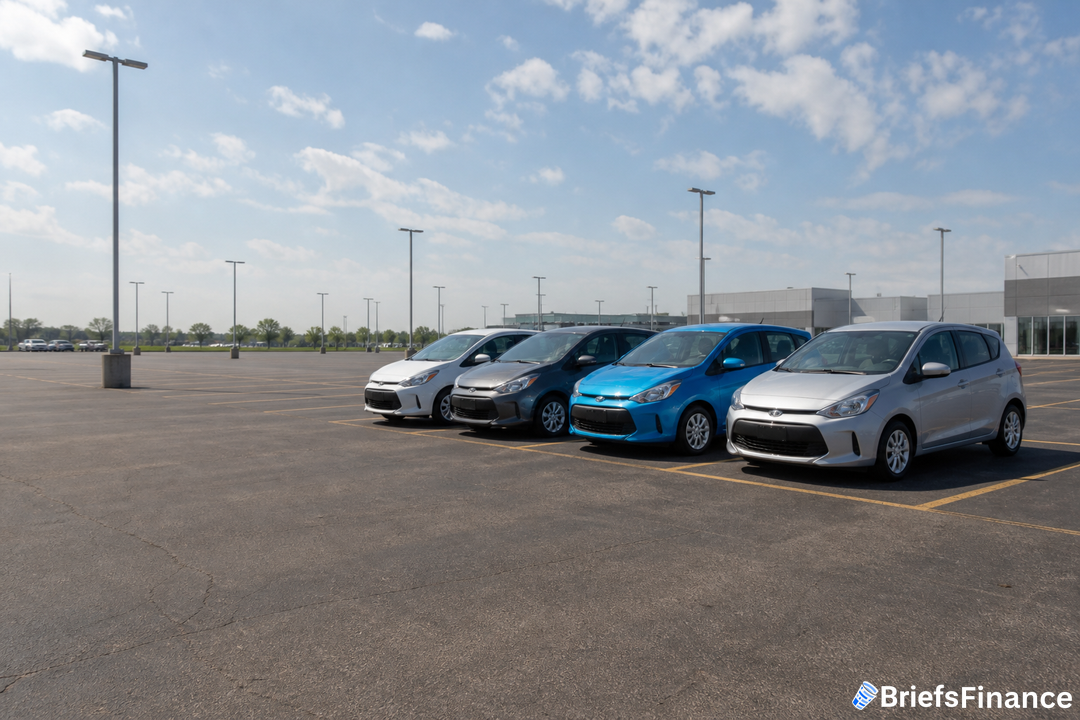
Shoppers are clearing out the cheapest new cars more quickly than earlier in the year. Edmunds found the 20,000 to 29,999 dollar band had the fastest improvement in turn time, dropping 20% over the period. The next rungs up also sped up, with 30,000 to 39,999 dollar vehicles selling about 18% quicker and 40,000 to 49,999 dollar models nearly 12% quicker over the same stretch.
The pattern splits by price. The lower tiers each moved in under two months, with the most affordable turning the quickest, while every bracket above 50,000 dollars but any tier priced above 50,000 dollars required over 60 days on average before finding a buyer. "If you're a dealer and you have inventory and that price point, you're definitely noticing," said Ivan Drury, Director of Insights at Edmunds.
Why the lower end is still thin on choices
Two things can be true at once: cheaper cars can sell faster while sales volumes fall if there are not enough to sell. "I think there are some supply things going on at that end of the market," said Mark Strand, Deputy Chief Economist at Cox Automotive. "We have to kind of grade the market on a curve until we see what's going on with fourth-quarter data."
Cox Automotive pegs the average listing at 49,726 dollars in September, even as some key categories under 40,000 dollars shrank this year. Compact car sales are off roughly 4% since the start of 2026, and compact SUVs are down nearly 8% in that timeframe.
Model availability is part of the story. The Toyota RAV4 - America's top-selling SUV - has been hard to find at many dealers this year as Toyota shifts production to its Kentucky factory, according to Strand. Toyota has moved every RAV4 variant over to hybrid propulsion just as interest in hybrids has been extraordinarily strong. Another gap is the Ford Escape, which Ford ended production of to clear the runway for its forthcoming midsize EV pickup truck.
Fewer small cars, higher sensitivity to gas and payments
"We've seen the disappearance of affordable, compact new vehicles over the last decade," said AutoForecast Solutions' Vice President of Global Forecasting Sam Fiorani. Detroit automakers swapped compact coupes and sedans for small crossover SUVs, which typically these usually come with modestly higher MSRPs than cars of similar size. As of now, no American manufacturer sells a compact passenger sedan.
Most options come from Japan and Korea, with a few German models like the Volkswagen Jetta and the Golf hatchback. "You have all these brands that have just abandoned the marketplace," Fiorani said.
Smart investors embrace new tools to find small advantages in crowded markets. We're hosting our first ever investor livestream on 11/17 to show you how to use ChatGPT and Claude to invest like a pro, hosted by Briefs Finance CEO Jaspreet Singh. Save your seat.
AutoForecast Solutions lists the Ford Mustang, General Motors' Chevrolet Corvette, and the Tesla Model 3 midsize sedan as the smallest American passenger cars. The firm classifies the Mustang and Corvette as sports cars, separate from compact sedans such as the Honda Civic or Toyota Corolla. The Mustang starts at 33,490 dollars, the Model 3 at 34,990 dollars, and the Corvette at 71,300 dollars, while the Civic, Corolla, and Jetta all start below 25,000 dollars.
"Compact vehicle buyers are very price-sensitive," Fiorani said. When fuel costs rise, it squeezes their budgets and pushes some toward used cars or to holding on to their current vehicles longer. "The people who are trying to buy the smaller vehicles are really hurt by the way the economy is at the moment," he said.
Financing strain and the read-through for investors
Used-car indicators are flashing hotter for small cars. Cox Automotive says wholesale prices for compacts - the auction prices at large venues such as its Manheim sale - have climbed and are have risen and outpaced increases in almost every other segment, a signal for broader used pricing.
Financing is stretching, too. About one-quarter of shoppers who take out financing are opting for 84-month terms - the highest on record. In the third quarter, nearly three in ten trade-ins toward new purchases carried negative equity, and many shoppers roll that deficit into the next loan, lifting the new payment.
Automakers have been producing closer to demand to avoid markdowns, with incentives averaging roughly 6.6% of the typical transaction price as of October. Leasing can lower monthly costs, but leasing rates are down.
Repeat owners are reluctant to downsize. "The moment you get into that other vehicle and it's a little bit smaller, it's not as comfortable, it doesn't fit all your stuff, all your kid's equipment for soccer practice, you're done," Drury said. Automakers know that too.
The bottom line: the cheapest new vehicles are churning faster, but thin inventories, shifting model lines, and stretched financing suggest the pressure is migrating to used cars and could indicate a softening in the marketplace. That is a mix to watch if your portfolio touches automakers, suppliers, lenders, or auction platforms.
Learning how technology can sharpen your decision making can pay off over time. On 11/17, our CEO Jaspreet Singh goes live for our first ever investor livestream on how to use ChatGPT and Claude to invest like a pro. Register to join him.