Free NewsletterPro Login
S&P 500 6,287 +0.42%
DOW 44,521 -0.18%
NASDAQ 21,103 +0.71%

Warning: Undefined variable $funds in /var/www/briefs.co/htdocs/wp-content/plugins/oxygen/component-framework/components/classes/code-block.class.php(133) : eval()'d code on line 491

Warning: foreach() argument must be of type array|object, null given in /var/www/briefs.co/htdocs/wp-content/plugins/oxygen/component-framework/components/classes/code-block.class.php(133) : eval()'d code on line 491
/* the link was here */

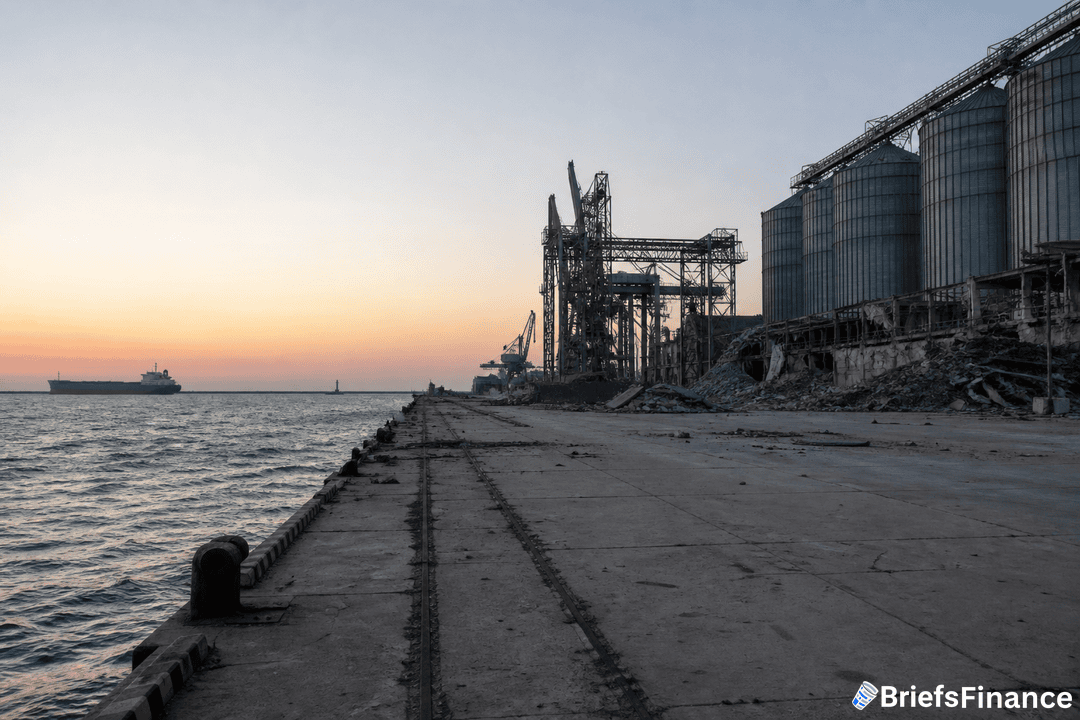
Attacks at Black Sea Port Reduce Russian Oil Shipments

Published Aug 18, 2026
[tts_player]
Share:
Summary:
  • Russia's seaborne crude exports fell for a fifth straight week, averaging 3.58 million barrels per day in the four weeks ending Aug. 16.
  • No crude was loaded at the Novorossiysk terminal in the week to Aug. 16, making the five-week decline the steepest since the start of the Ukraine war.
  • Russia's July crude output fell to 8.89 million barrels per day, a six-year low and nearly 1 million barrels per day below its OPEC+ quota.

A Fifth Week of Falling Shipments

A fleet of 31 vessels moved 22.38 million barrels of Russian crude during the week ending Aug. 16.

Russia's broader output is sliding too.

Drones and Delays at Key Ports

A tanker that had been at the port's terminal during Wednesday's attack remained at its berth in Monday's satellite images, while other berths resumed operations over the weekend.

Similar bottlenecks are showing up across Russia's export routes. Four Urals cargoes remain anchored off Egypt's Mersa el-Hamra, where offloading delays have stretched to about a month and a half, versus under a week earlier in the year.

Most Murmansk-loading cargoes end up on other vessels in the Riau archipelago, often after weeks at anchor, and many of those transfers happen with position signals hidden.

In the far east, Sokol and Sakhalin Blend cargoes may wait weeks for ship-to-ship transfers, while some ESPO cargoes, Russia's Pacific grade, sit idle near the port of Kozmino.

Russian crude at sea fell to about 94 million barrels in the week to Aug. 16, the lowest since September.

When headlines about oil shipments get rocky, the free Always Be Buying eBook can help you stay the course.

Strong deliveries to India, close to June's record of about 2.4 million barrels per day, outweighed lower overall shipments.

Where the Oil Is Going

Most of Russia's crude is still heading to Asia. During the 28 days ending Aug. 16, Asia-bound flows averaged 3.43 million barrels per day, versus a revised 3.54 million in the prior period.

Observed flows to India fell to 670,000 barrels per day from 1.11 million, but recent trends suggest that figure will land above 2 million once arrivals are counted.

About 1.54 million barrels per day are on vessels with no final destination yet. That includes 1.3 million from western ports showing Singapore, Port Said, or Suez, plus 240,000 with no destination at all.

Turkey received roughly 80,000 barrels per day, after peaking at 180,000 in the period ending July 26.

Syria averaged about 40,000 barrels per day, unchanged, while Egypt averaged about 30,000, half the level of the prior four-week period.

Background

Russia's export problems come on top of an already reduced production picture. Its seaborne crude is a key source of supply for Asian refiners, and the recent drone strikes have added to delays at western and far eastern ports, forcing traders to rely on ship-to-ship transfers and longer voyages. With output near six-year lows and more cargoes stuck at sea, the market is watching whether the disruption spreads further.

To understand the scale, consider that Russia's July output of 8.89 million barrels per day was nearly a million barrels below its OPEC+ target. The combination of drone attacks, port bottlenecks, and longer transit times has created a backlog that is only now starting to clear. If these constraints persist, they could tighten global crude supplies further, especially for Asian buyers who depend on Russian grades.

What It Means for Your Money

Even as volumes fall, prices are climbing. Baltic Urals rose $3.30 to $67.08 per barrel, Black Sea Urals rose $3.20 to $65.85, and Pacific ESPO rose $0.80 to $70.45.

Urals is up about $3 to an eight-week high. The price of Russian crude delivered to India jumped $5 to $88.34, the fourth weekly increase in a row.

The higher prices are cushioning the revenue hit. For the 28-day period ending Aug. 16, the gross value of Russia's exports averaged $1.71 billion per week, only $10 million below the revised level for the period ending Aug. 9.

Week over week, export revenue dropped by $10 million to $1.54 billion during the period ending Aug. 16, the third straight weekly fall.

When a major exporter ships less, global supply tightens, and that pressure eventually shows up in fuel prices and in the energy stocks many portfolios hold. The next weekly update lands Tuesday, Aug. 25, and it will show whether this slump is a temporary stumble or something bigger.

If supply disruptions make you think about long-term security, grab the free Always Be Buying eBook for a simple investing approach.

Disclosure

Recent News

1 2 3 56

Get Market Briefs delivered to your inbox every morning for free!

No fluff. No noise. No politics. Just finance news you can read in 5 minutes.

Blogs

June 29, 2026
Portfolio Diversification: Why Putting All Your Eggs in One Basket Destroys Wealth
  • Real diversification means spreading investments across all 11 economic sectors plus bonds, alternatives, and cash so no single bet can sink the portfolio.
  • Different sectors perform at different times, so a diversified portfolio captures upswings while smoothing the brutal drawdowns that wipe out concentrated bets.
  • Total market index funds offer the simplest path to diversification, and annual rebalancing is what keeps the structure working over time.
Read More
June 29, 2026
Non Taxable Income: What It Is and Why It Matters
  • Non taxable income is money you receive that you don't owe income tax on.
  • The tax code treats workers, investors, and business owners very differently, and investors often come out ahead.
  • Learning how income is taxed is a quiet superpower for keeping more of what you earn.
Read More
June 29, 2026
Semiconductor Stocks: A Simple Guide for Investors
  • Semiconductor stocks are companies that design and make computer chips, the brains inside nearly every modern device.
  • The AI boom has turned chips into one of the market's most important and most watched groups.
  • They offer big growth potential, but come with high valuations and a notoriously cyclical history.
Read More
June 25, 2026
How Stocks Work: A Simple Guide for Beginners
  • A stock is a slice of ownership in a company - buy one, and you own a piece of the business.
  • You make money two ways: the share price rising over time, and dividends paid to shareholders.
  • The simplest path for most beginners is buying into the whole market through a low-cost index fund.
Read More
June 25, 2026
Stop Loss vs Stop Limit: What's the Difference?
  • A stop loss order sells your stock once it hits a trigger price, prioritizing getting you out.
  • A stop limit order only sells within a price range you set, prioritizing price over a guaranteed exit.
  • The trade-off: a stop loss almost always executes; a stop limit might not if the price moves too fast.
Read More
June 25, 2026
Energy Stocks: A Simple Guide for Investors
  • Energy stocks are companies that produce and supply the power the world runs on, from oil and gas to newer sources.
  • They make up one of the 11 sectors of the market and tend to move with energy prices and big-picture shifts.
  • Like any sector, the key is diversification and understanding the forces driving demand.
Read More
June 18, 2026
What Is a Stop Loss Order? A Simple Guide
  • A stop loss order automatically sells a stock once it falls to a price you set.
  • It's a tool to cap losses or lock in gains without watching the market all day.
  • It works best for active strategies, and can backfire if used carelessly on long-term holdings.
Read More
June 18, 2026
Best S&P 500 Index Fund: How to Choose One
  • The best S&P 500 index fund for most investors is simply the cheapest, most established one that tracks the index well.
  • Funds like VOO, IVV, and SPY all hold the same 500 companies, so the biggest difference is the fee.
  • Pick one, automate your buys, and let time do the heavy lifting.
Read More
June 17, 2026
What Are Penny Stocks? Risks and Rewards Explained
  • Penny stocks are very low-priced shares of very small companies, often trading for just a few dollars or less.
  • They promise huge gains but carry huge risks: low liquidity, high failure rates, and wild price swings.
  • Most investors are better served by quality companies and funds than by chasing cheap shares.
Read More
June 17, 2026
Best Stocks for Beginners With Little Money
  • The best stocks for beginners with little money usually aren't individual stocks at all - they're low-cost index funds.
  • You can start with $100 or less and use small, regular investments to build wealth over time.
  • Focus on diversification and consistency, not on picking the next big winner.
Read More
1 2 3 24
Share via
Copy link