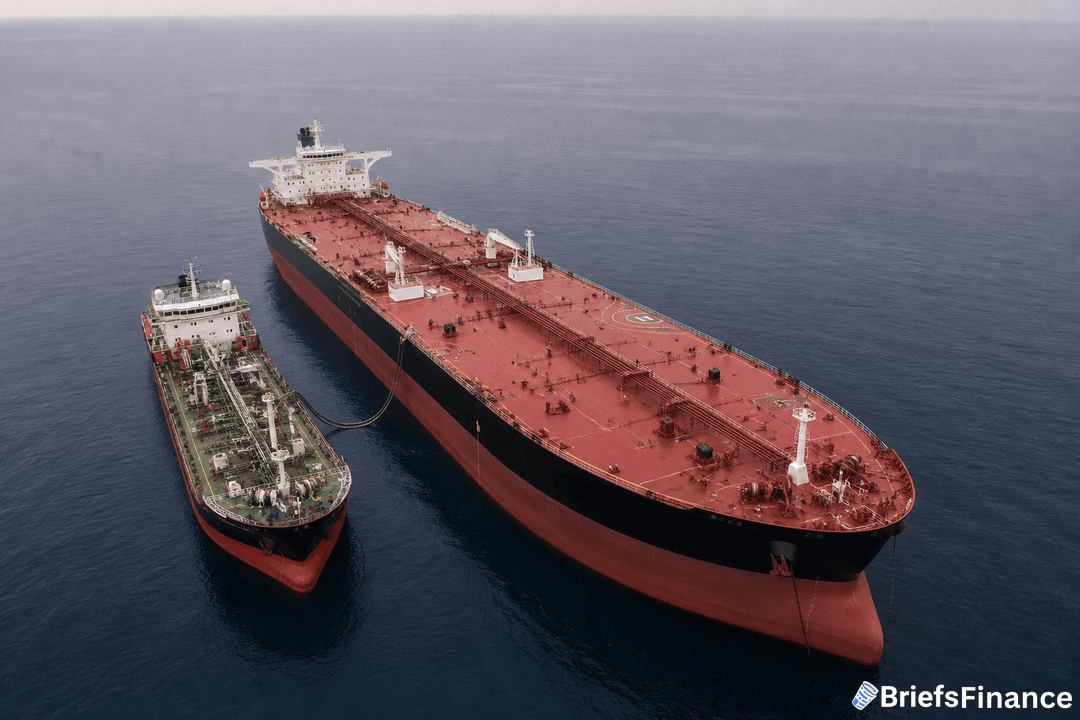
The Strait of Hormuz is one of the busiest oil highways in the world, and it is also one of the most dangerous right now. Tankers are getting attacked, crews are getting hurt, and yet oil prices are behaving as if nothing much is wrong.
That is not luck. It is a quietly growing workaround that is changing how Middle Eastern crude reaches the world.
The Numbers Behind the Calm
Before the war with Iran, roughly 20 million barrels of oil a day moved through the Strait of Hormuz. Last week, U.S. Energy Secretary Chris Wright reported that 9 million barrels crossed in just seven days, a number that surprised traders who expected far less given the attacks.
That flow has kept Brent crude, the global benchmark, in the $80-to-$90 band through August. It is nowhere near the $150 price that some analysts feared when the conflict first broke out.
So how is the oil still moving? The answer is unfolding near Oman's shores, where roughly 150 ships are now anchored, up from about 40 in January. Satellite data shows many of these vessels are waiting to take on cargo from tankers that have switched off their transponders to avoid detection.
When supply finds a way through chaos, steady investing can do the same, so grab the free Always Be Buying eBook.
A "Dark Trade" Becomes the Only Option
The system works like a relay. A tanker picks up crude at a Gulf port, sails a short distance, and transfers its cargo to another ship waiting in safer waters. That second vessel then continues the journey.
Abu Dhabi National Oil Co., known as Adnoc, has felt the danger directly. The company said 23 of its ships were attacked while transiting Hormuz, causing one death and 20 crew injuries. Adnoc said the strikes were "an attack on the infrastructure that keeps energy flowing," and it warned that the fallout extends well past the companies hit.
Saudi Arabia has been slower to join the shuttle system, but signs point to it starting. Two ships were seen loading at the Ras Tanura terminal, and the tanker firm Bahri has parked 16 supertankers off Oman, enough capacity to haul 38 million barrels.
Iraqi cargoes have also left Hormuz through similar transfer arrangements, according to tracking data from Bloomberg, Kpler, and Vortexa.
Pankaj Khanna, CEO of the maritime firm Heidmar, calls the workaround a "dark trade." He says it is the only option right now, adding, "Not all ship owners are willing to take the risk of sailing straight through the strait."
The attacks have already shown the human cost of the route: Adnoc reported one death and 20 crew injuries across 23 ships. That danger is why many owners avoid a direct passage and why the relay system has become the safer alternative.
What This Means for Your Wallet
The insurance industry is seeing steady inquiries from Gulf producers looking to cover these transfers, which suggests the shuttle system is not a one-week experiment. It is becoming part of how the region does business.
For everyday investors, the practical effect is simple. The reason gas prices have not spiked and inflation has not gotten worse is that this quiet, improvised network is holding the line. If it breaks down, the buffer disappears and the $150 barrel scenario comes back into play.
The situation is fragile, but it is working. Oil is still flowing, prices are still stable, and the world is getting the energy it needs through a system that barely existed a year ago. That is worth watching, because the longer the conflict lasts, the more the world will lean on this shadow fleet to keep things running.
Hidden workarounds keep oil flowing, and a simple system can build wealth, so get the free Always Be Buying eBook.