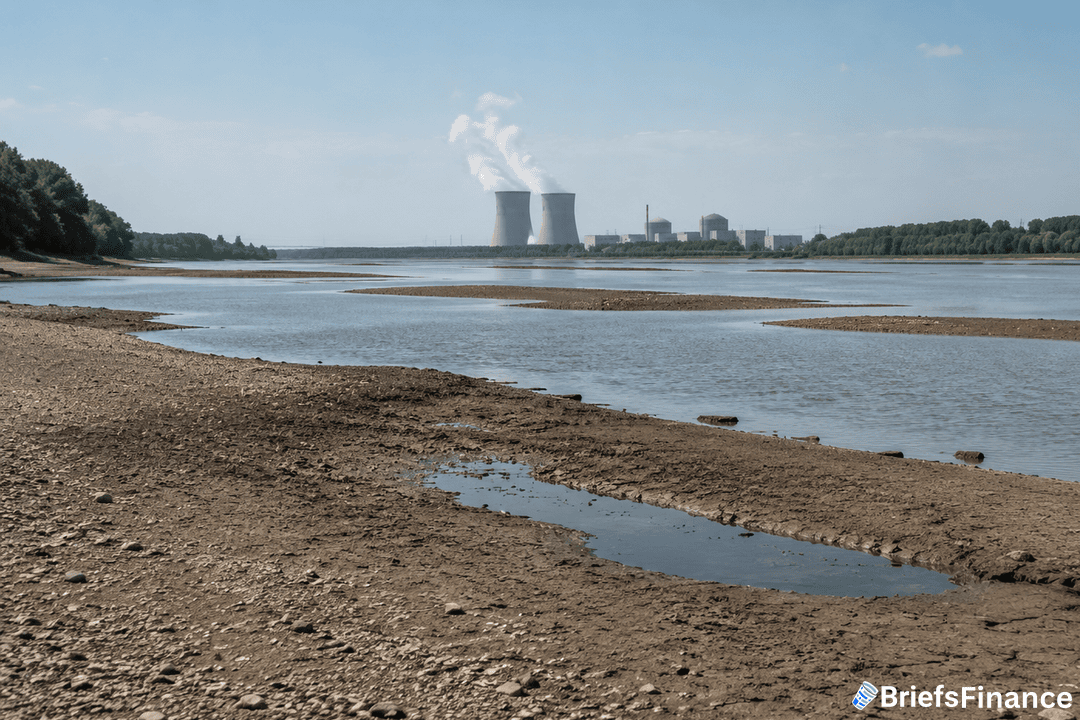
The Danube River is the quiet backbone of Hungary's power grid. When it drops too low, the country's largest nuclear plant gets dangerously close to shutting down.
That is exactly what happened this month, and now the government is publicly questioning whether its massive nuclear expansion should move forward at all.
Record Low Water Raises New Doubts
On August 13, 2026, the Danube hit a record low near the Paks nuclear plant. The water level dropped so low that the site could not pull enough cooling water from the river, bringing the existing reactors to the brink of a complete shutdown.
Hungarian Prime Minister Peter Magyar used that moment to raise a bigger question. At a press conference on Thursday, he asked whether the environmental permit for two new reactors at Paks should even stand, citing the low water levels alongside the project's years of delays and rising costs.
The timing matters because Paks is not a small piece of the country's energy picture. It produces 40% of Hungary's electricity. When a plant that size wobbles, the whole grid feels it.
A Project That Keeps Getting More Expensive
The expansion has been in the works for over a decade. It started with a 2014 agreement between Hungary and Russia, with Russia's Rosatom Corp. leading the construction of two new reactors.
Get the free Always Be Buying eBook and learn the simple system for building wealth on any income
The original price tag was €12.5 billion, which works out to about $14.4 billion. Magyar said the estimated cost has now doubled. That is twice the original budget, and the project still has a long way to go.
The History and Scale of Paks
Paks has been a cornerstone of Hungary's electricity supply since the 1980s. The four existing reactors have operated for decades with periodic upgrades. The planned expansion - two additional reactors of the same type - was intended to secure Hungary's energy independence and reduce reliance on imported fossil fuels.
However, the project's timeline has stretched from an initial completion target of the mid-2020s to well into the 2030s, and the cost overruns have made it a politically sensitive issue. The fact that the expansion is tied to Russia at a time when European energy independence is a constant topic adds another layer of complexity.
Delays and cost overruns are nothing new in big infrastructure builds, but this one carries extra weight. It is tied to Russia at a time when European energy independence is a constant topic, and it depends on a river that is becoming less predictable as the climate shifts.
Right now, only one of the four existing Paks reactors is running. The other three were shut down in recent weeks as a safety measure. That leaves Hungary leaning on a single reactor from a plant that normally carries nearly half the country's electricity.
What Happens If the Danube Stays Low
The emergency plans are not quick fixes. To keep cooling water flowing, crews would need to sink two barges near the plant and build a ground sill, which is basically a low wall in the riverbed to raise the water level. A month is a long time when your power supply is already stretched.
And the bigger question is whether this is a one-off dry spell or a pattern. If low water becomes a regular summer event, the plant's reliability becomes a recurring problem, not a rare one.
The bottom line: Hungary's nuclear future is now tied to a river that is not cooperating. The expansion was supposed to add stability and capacity, but the doubts raised this week cut straight to the core of whether the project makes sense anymore.
For everyday people in Hungary, this is not a distant policy debate. It is about whether the lights stay on and what the power bill looks like when a major plant is limping along. For anyone watching energy markets, it is a reminder that the cheapest electricity is the plant that actually runs, and the most reliable fuel is one that does not depend on the weather.
The next few months will show whether the Danube recovers or whether Hungary needs to rethink a plan that suddenly looks a lot more fragile than it did in 2014.
Download the free Always Be Buying eBook and start putting your money to work today