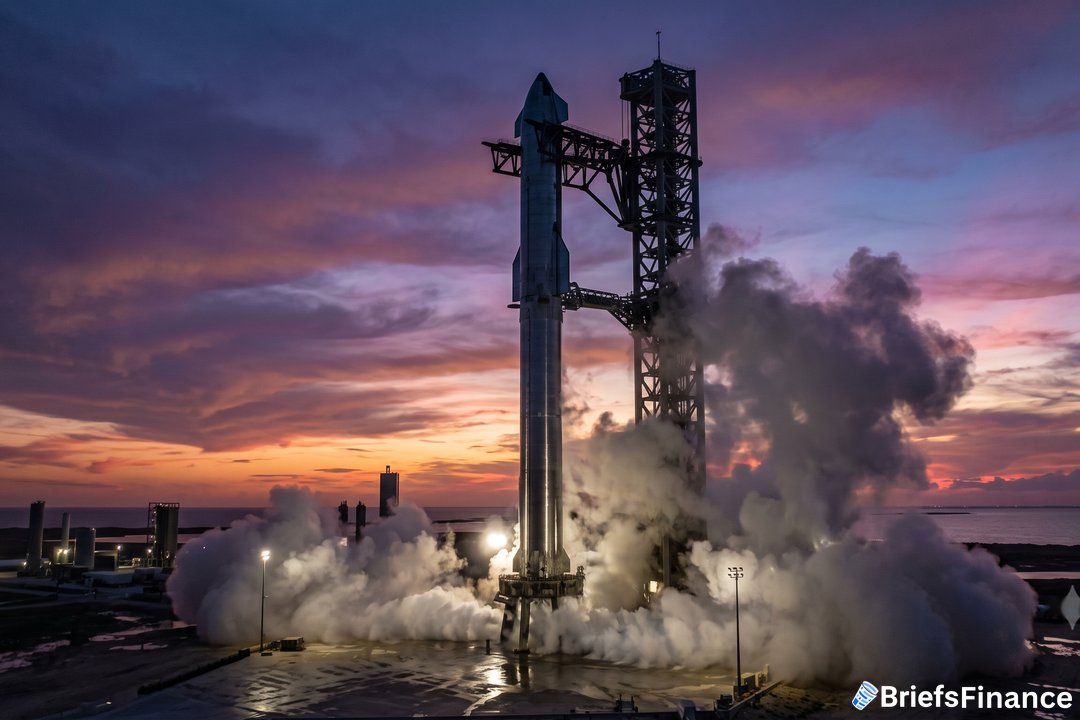
What Happened at the Launchpad
On Thursday, SpaceX called off the launch of its massive Starship rocket, while CEO Elon Musk vowed to try again "hopefully in a few days."
A launch window of 90 minutes began at 6:45 p.m. ET, and shortly after, the reusable rocket company declared on a livestream that it was aborting the attempt for the day. In a post on X, Musk stated, "Some of the engines didn't start, triggering an automatic launch abort." Later, in a subsequent X post, he said: "To be confident of a good flight, 2 Raptors will be removed & replaced. Most probable launch timing is early next week."
Get the market news that matters in a five-minute read with Market Briefs, our free daily newsletter
In after-hours trading, SpaceX shares dropped more than 3%, sliding further below its $135 IPO price. The stock has now declined for five straight trading days.
The booster had a hold activated, preventing liftoff, as the vehicle stood ready at SpaceX's Starbase facility in South Texas. During the livestream, a SpaceX employee said the hold "shut down the engines right as they were starting to ignite."
This would have been the inaugural test flight of the Starship V3 following SpaceX's huge IPO last month. A prior V3 test launch in May encountered problems. Following a smooth liftoff, multiple engines on the lower stage of the rocket did not reignite to assist in a controlled descent, resulting in the vehicle crashing into the Gulf of Mexico.
The FAA directed SpaceX to probe the anomaly, and on Monday it gave the green light for Starship to resume flights. The FAA said in a statement: "The final mishap report cites two most probable root causes for the loss of the Super Heavy booster as heat effects on propulsion system components during the ascent and erroneous engine alarm system settings." The agency noted that SpaceX has outlined four corrective measures, including vehicle hardware and software updates, "to prevent a reoccurrence of the event."
SpaceX said that for Thursday's mission, Starship intended to carry 20 operational next-generation Starlink satellites, designed to deploy their solar arrays and antennas and then try to link up with the existing Starlink network. The company noted that the satellites are expected to "demise upon reentry approximately 20 minutes after deployment."
The aborted launch highlights the persistent technical hurdles SpaceX must overcome to make the world's largest reusable rocket fully operational. Success is crucial not only for expanding the Starlink internet constellation but also for fulfilling NASA's Artemis program, which relies on Starship for crewed moon landings.
Since debuting on public markets last month, SpaceX shares surged, then declined, and temporarily fell under their $135 IPO price on Wednesday. On Thursday, the stock kept dropping, losing more than 3% to end the session at $131.11. Including the underwriters' option, SpaceX raised $85.7 billion from its IPO, setting a record as the biggest public offering in history.
Join Market Briefs, our free daily newsletter, for a quick daily rundown of the markets