Free NewsletterPro Login
S&P 500 6,287 +0.42%
DOW 44,521 -0.18%
NASDAQ 21,103 +0.71%
S&P 500 +12.4%
Briefs Finance Fund +24.8%
JOIN THE FUND →

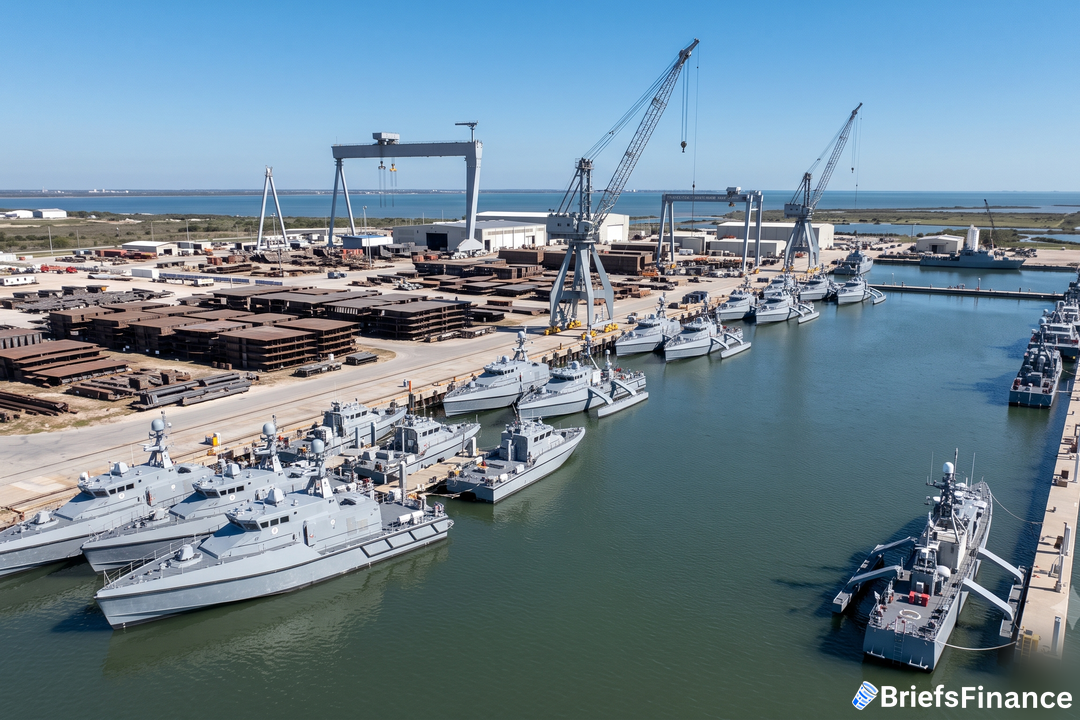
Saronic Invests $3.2 Billion in Texas Shipyard for Unmanned Vessels

Published Jul 16, 2026
[tts_player]
Share:
Saronic Invests $3.2 Billion in Texas Shipyard for Unmanned Vessels
Summary:
  • Saronic Technologies will build a $3.2 billion shipyard in Brownsville, Texas, to manufacture medium and large unmanned surface vessels.
  • The facility, called Port Alpha, is expected to begin operations by 2028 and create 10,000 jobs.
  • Saronic recently raised $1.75 billion at a $9.25 billion valuation and holds a $392 million Navy production contract.

A Shipyard for Unmanned Vessels

The project is anticipated to generate 10,000 jobs, as stated in a press release from Texas Governor Greg Abbott.

Initially, the shipyard can construct vessels as long as 850 feet, and after future expansions, it could handle ships up to 1,200 feet. That compares to Saronic's existing drones: the Corsair, a 24-foot unmanned surface vessel, and the Marauder, a 180-foot model built last year.

CEO and cofounder Dino Mavrookas, a former Navy SEAL who began building Saronic while working at Austin venture firm 8VC, said in a statement: "Built from the ground up to deliver ships at a speed and scale not seen since World War II, this investment is about more than constructing a shipyard."

Why the Military Is Interested in Drone Boats

Shortly before the announcement, US Central Command revealed that it had used weaponized unmanned boats in battle for the first time, marking a key milestone. On Sunday, three Saronic Corsair unmanned surface vessels were used in the US attack on a submarine and ship maintenance facility at Iran's Bandar Abbas naval base.

Get the market news that matters in a five-minute read with Market Briefs, our free daily newsletter

In June, a Corsair sea drone retrieved two crew members who had been downed from a US Army helicopter that went off the coast of Oman - marking the first instance of an unmanned surface vessel performing such a rescue. The utility of maritime drones has been demonstrated by conflicts in Ukraine and the Middle East. Ukraine's military stated that it employed sea drones to sink Russian vessels in the Black Sea.

The increased reliance on unmanned vessels in modern naval operations is evident from these recent events. These developments have driven demand for larger, more capable unmanned ships, leading to investments like Port Alpha.

The push for larger autonomous ships reflects the U.S. Navy's shift toward distributed lethality and unmanned systems to compete with near‑peer adversaries. Saronic's location near the deep‑water port of Brownsville and SpaceX's Starbase gives it access to aerospace talent and logistics infrastructure, further strengthening the region's role in next‑generation defense manufacturing.

Saronic's investors are betting big on the trend.

The new shipyard is situated about 20 miles from Starbase, the home base of SpaceX. The Port of Brownsville has seen increased activity as a hub for defense and aerospace manufacturing. With SpaceX's Starbase nearby, the region is attracting companies focused on next-generation technologies. This investment further solidifies Brownsville's role as a strategic location for national security projects.

What This Means

Private companies like Saronic are not publicly traded. But the scale of the investment - $3.2 billion - signals where defense dollars are flowing. Per the CEO, the shipyard aims to produce vessels with a speed and scale unmatched since World War II.

The bottom line: Unmanned vessels are moving from experimental to operational. This shipyard is a sign that the military is investing heavily in larger autonomous ships.

Join Market Briefs, our free daily newsletter, for a quick daily rundown of the markets
Disclosure

Recent News

1 2 3 37

Get Market Briefs delivered to your inbox every morning for free!

No fluff. No noise. No politics. Just finance news you can read in 5 minutes.

Blogs

June 29, 2026
Portfolio Diversification: Why Putting All Your Eggs in One Basket Destroys Wealth
  • Real diversification means spreading investments across all 11 economic sectors plus bonds, alternatives, and cash so no single bet can sink the portfolio.
  • Different sectors perform at different times, so a diversified portfolio captures upswings while smoothing the brutal drawdowns that wipe out concentrated bets.
  • Total market index funds offer the simplest path to diversification, and annual rebalancing is what keeps the structure working over time.
Read More
June 29, 2026
Non Taxable Income: What It Is and Why It Matters
  • Non taxable income is money you receive that you don't owe income tax on.
  • The tax code treats workers, investors, and business owners very differently, and investors often come out ahead.
  • Learning how income is taxed is a quiet superpower for keeping more of what you earn.
Read More
June 29, 2026
Semiconductor Stocks: A Simple Guide for Investors
  • Semiconductor stocks are companies that design and make computer chips, the brains inside nearly every modern device.
  • The AI boom has turned chips into one of the market's most important and most watched groups.
  • They offer big growth potential, but come with high valuations and a notoriously cyclical history.
Read More
June 25, 2026
How Stocks Work: A Simple Guide for Beginners
  • A stock is a slice of ownership in a company - buy one, and you own a piece of the business.
  • You make money two ways: the share price rising over time, and dividends paid to shareholders.
  • The simplest path for most beginners is buying into the whole market through a low-cost index fund.
Read More
June 25, 2026
Stop Loss vs Stop Limit: What's the Difference?
  • A stop loss order sells your stock once it hits a trigger price, prioritizing getting you out.
  • A stop limit order only sells within a price range you set, prioritizing price over a guaranteed exit.
  • The trade-off: a stop loss almost always executes; a stop limit might not if the price moves too fast.
Read More
June 25, 2026
Energy Stocks: A Simple Guide for Investors
  • Energy stocks are companies that produce and supply the power the world runs on, from oil and gas to newer sources.
  • They make up one of the 11 sectors of the market and tend to move with energy prices and big-picture shifts.
  • Like any sector, the key is diversification and understanding the forces driving demand.
Read More
June 18, 2026
What Is a Stop Loss Order? A Simple Guide
  • A stop loss order automatically sells a stock once it falls to a price you set.
  • It's a tool to cap losses or lock in gains without watching the market all day.
  • It works best for active strategies, and can backfire if used carelessly on long-term holdings.
Read More
June 18, 2026
Best S&P 500 Index Fund: How to Choose One
  • The best S&P 500 index fund for most investors is simply the cheapest, most established one that tracks the index well.
  • Funds like VOO, IVV, and SPY all hold the same 500 companies, so the biggest difference is the fee.
  • Pick one, automate your buys, and let time do the heavy lifting.
Read More
June 17, 2026
What Are Penny Stocks? Risks and Rewards Explained
  • Penny stocks are very low-priced shares of very small companies, often trading for just a few dollars or less.
  • They promise huge gains but carry huge risks: low liquidity, high failure rates, and wild price swings.
  • Most investors are better served by quality companies and funds than by chasing cheap shares.
Read More
June 17, 2026
Best Stocks for Beginners With Little Money
  • The best stocks for beginners with little money usually aren't individual stocks at all - they're low-cost index funds.
  • You can start with $100 or less and use small, regular investments to build wealth over time.
  • Focus on diversification and consistency, not on picking the next big winner.
Read More
1 2 3 24
Share via
Copy link











