Free NewsletterPro Login
S&P 500 6,287 +0.42%
DOW 44,521 -0.18%
NASDAQ 21,103 +0.71%
S&P 500 +12.4%
Briefs Finance Fund +24.8%
JOIN THE FUND →

Shallow Rhine River Cripples European Energy Transport

Published Jul 29, 2026
[tts_player]
Share:
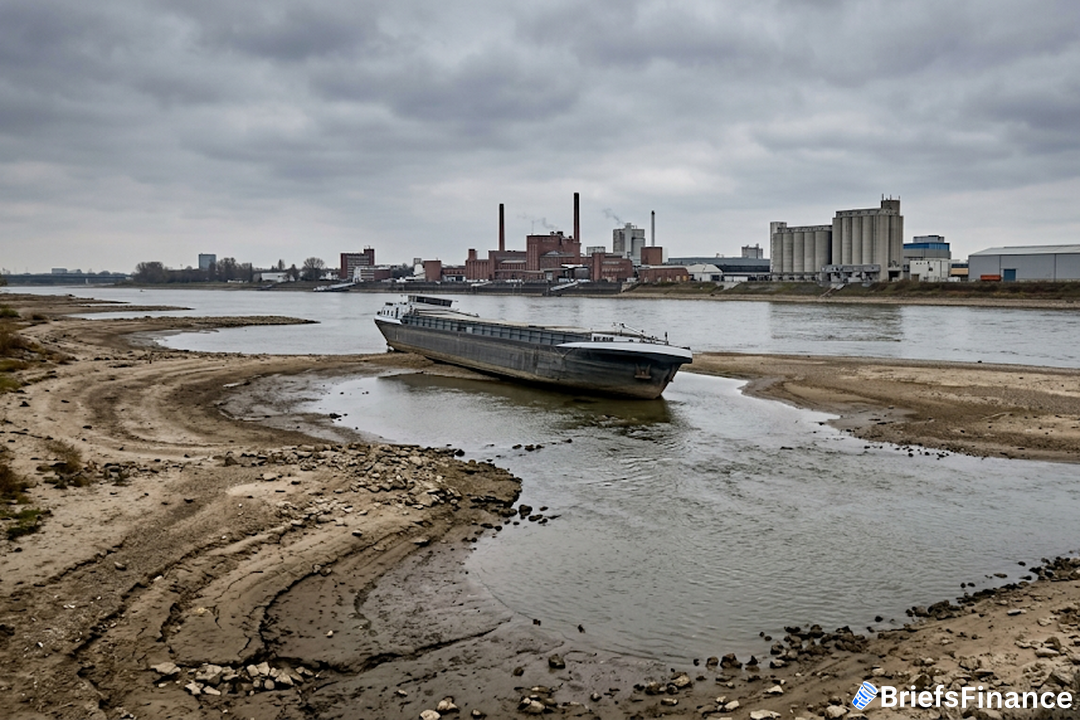
Barge grounded in a shallow river with exposed sandy banks and industry beyond
Summary:
  • Water levels at the Kaub bottleneck on the Rhine are forecast to reach 24 centimeters on Friday, the shallowest since records began in 1990.
  • Coal inventories at the Rotterdam-Antwerp port hub have surged about 75% since spring, but barge loadings have been cut by three-quarters.
  • Shipping diesel from Rotterdam to Karlsruhe has become the most expensive since 2009, as heat waves cripple a key European waterway.

Heat Waves Push the Rhine to the Brink

Another heat wave is baking Europe, and the Rhine River is paying the price.

At the Kaub measurement point, a narrow stretch that acts as a bottleneck for cargo ships, the water depth is already down to 28 centimeters. That matches the lowest reading since 2018.

"It's getting more difficult with every centimeter," said Florian Krekel, an official with Germany's Federal Waterways and Shipping Administration.

The Rhine runs about 800 miles from Switzerland to the North Sea, cutting through the industrial heart of Europe. It carries everything from coal and chemicals to oil products and iron ore. When the water gets this low, barges have to load far less cargo to avoid running aground. That pushes up costs for every barrel and bushel that moves along the river.

Already, the Rhine's dropping water levels are causing freight disruptions.

Frankfurt is forecast to hit 39°C on Thursday, with little rain expected in the coming days. That means conditions are unlikely to improve soon.

The River's Central Role in Europe's Commerce

The Rhine has long been Europe's most vital inland waterway, moving roughly 80% of all goods shipped on German rivers. Its low depth during past droughts, such as the 2018 event that stranded hundreds of vessels, cost the German economy an estimated €5 billion. The current dry spell threatens to repeat that disruption.

Get the market news that matters in a five-minute read with Market Briefs, our free daily newsletter

Industries from chemical giant BASF to refineries in the Ruhr depend on barge deliveries for raw materials and finished products. When the river cannot handle normal traffic, they are forced to turn to rail or truck, which are more expensive and less efficient.

The Energy Grid Feels the Squeeze

The timing is rough for Europe's energy markets.

But that stockpile is stuck. The river can't handle the traffic.

Alexandre Claude, chief executive of DBX Commodities Ltd., put it bluntly: "The Rhine has effectively locked the door on inland coal delivery, and Rotterdam is where the trucks are queueing up."

Diesel is getting hit too.

The heat waves have also stressed power systems, caused wildfires, and put public health at risk across the region. So the disruption is not just about shipping - it is another layer of pressure on an energy system that has been under strain for years.

What It Means for Your Portfolio

When a major shipping route slows down, the ripple effects reach further than the ports.

Energy costs inside Europe are likely to stay elevated as long as the Rhine runs low. That means higher prices for diesel, heating oil, and coal-fired power - and those costs eventually show up in everything from factory goods to trucking rates. Companies that rely on river transport for raw materials may take a hit to their profit margins.

For investors, the key question is how long the drought lasts. Weather forecasts point to more heat and little rain in the near term. If the water stays shallow into the fall, the impact on energy prices could compound.

But the bottom line: when a river that carries the region's energy starts to run dry, it is worth watching how your holdings in European energy, shipping, or industrial stocks might be exposed. The heat is real, and the costs are already climbing.

Join Market Briefs, our free daily newsletter, for a quick daily rundown of the markets
Disclosure

Recent News

1 2 3 44

Get Market Briefs delivered to your inbox every morning for free!

No fluff. No noise. No politics. Just finance news you can read in 5 minutes.

Blogs

June 29, 2026
Portfolio Diversification: Why Putting All Your Eggs in One Basket Destroys Wealth
  • Real diversification means spreading investments across all 11 economic sectors plus bonds, alternatives, and cash so no single bet can sink the portfolio.
  • Different sectors perform at different times, so a diversified portfolio captures upswings while smoothing the brutal drawdowns that wipe out concentrated bets.
  • Total market index funds offer the simplest path to diversification, and annual rebalancing is what keeps the structure working over time.
Read More
June 29, 2026
Non Taxable Income: What It Is and Why It Matters
  • Non taxable income is money you receive that you don't owe income tax on.
  • The tax code treats workers, investors, and business owners very differently, and investors often come out ahead.
  • Learning how income is taxed is a quiet superpower for keeping more of what you earn.
Read More
June 29, 2026
Semiconductor Stocks: A Simple Guide for Investors
  • Semiconductor stocks are companies that design and make computer chips, the brains inside nearly every modern device.
  • The AI boom has turned chips into one of the market's most important and most watched groups.
  • They offer big growth potential, but come with high valuations and a notoriously cyclical history.
Read More
June 25, 2026
How Stocks Work: A Simple Guide for Beginners
  • A stock is a slice of ownership in a company - buy one, and you own a piece of the business.
  • You make money two ways: the share price rising over time, and dividends paid to shareholders.
  • The simplest path for most beginners is buying into the whole market through a low-cost index fund.
Read More
June 25, 2026
Stop Loss vs Stop Limit: What's the Difference?
  • A stop loss order sells your stock once it hits a trigger price, prioritizing getting you out.
  • A stop limit order only sells within a price range you set, prioritizing price over a guaranteed exit.
  • The trade-off: a stop loss almost always executes; a stop limit might not if the price moves too fast.
Read More
June 25, 2026
Energy Stocks: A Simple Guide for Investors
  • Energy stocks are companies that produce and supply the power the world runs on, from oil and gas to newer sources.
  • They make up one of the 11 sectors of the market and tend to move with energy prices and big-picture shifts.
  • Like any sector, the key is diversification and understanding the forces driving demand.
Read More
June 18, 2026
What Is a Stop Loss Order? A Simple Guide
  • A stop loss order automatically sells a stock once it falls to a price you set.
  • It's a tool to cap losses or lock in gains without watching the market all day.
  • It works best for active strategies, and can backfire if used carelessly on long-term holdings.
Read More
June 18, 2026
Best S&P 500 Index Fund: How to Choose One
  • The best S&P 500 index fund for most investors is simply the cheapest, most established one that tracks the index well.
  • Funds like VOO, IVV, and SPY all hold the same 500 companies, so the biggest difference is the fee.
  • Pick one, automate your buys, and let time do the heavy lifting.
Read More
June 17, 2026
What Are Penny Stocks? Risks and Rewards Explained
  • Penny stocks are very low-priced shares of very small companies, often trading for just a few dollars or less.
  • They promise huge gains but carry huge risks: low liquidity, high failure rates, and wild price swings.
  • Most investors are better served by quality companies and funds than by chasing cheap shares.
Read More
June 17, 2026
Best Stocks for Beginners With Little Money
  • The best stocks for beginners with little money usually aren't individual stocks at all - they're low-cost index funds.
  • You can start with $100 or less and use small, regular investments to build wealth over time.
  • Focus on diversification and consistency, not on picking the next big winner.
Read More
1 2 3 24
Share via
Copy link











