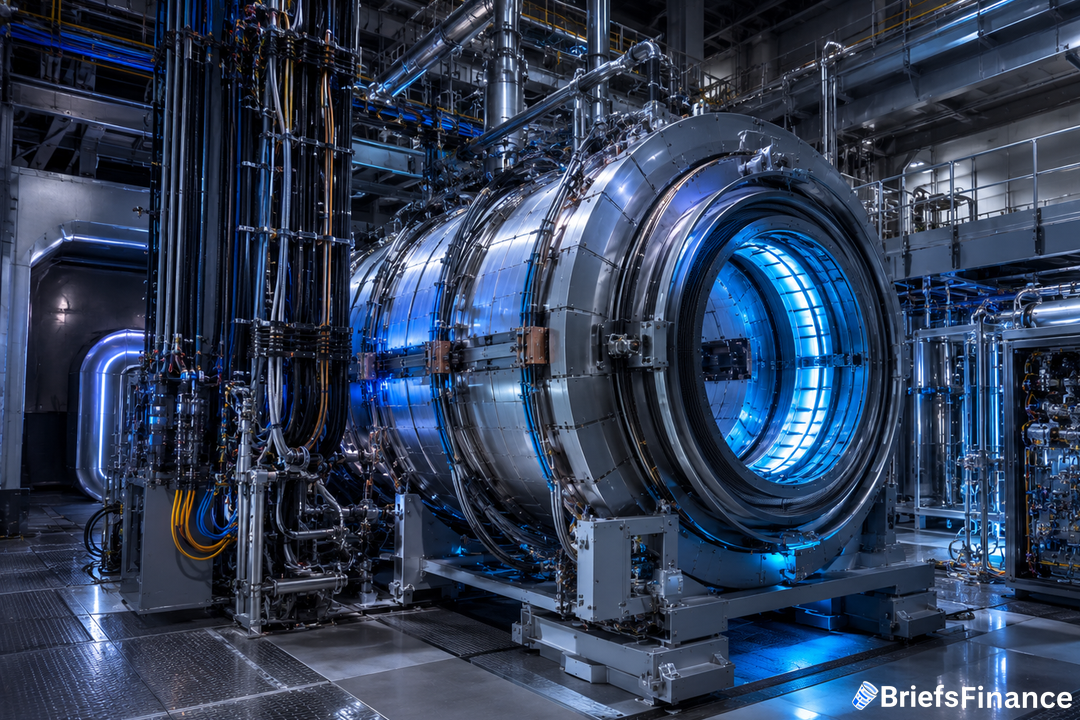
The Magnet Problem That Needed Solving
Fusion power sounds futuristic, but it has a very down-to-earth problem: the magnets are brutally expensive.
Most fusion reactor designs rely on powerful magnets to hold super-hot plasma in place. Thea Energy uses something called high-temperature superconducting magnets, or HTS magnets, which are a major chunk of the cost. The company got a $20 million grant from the Department of Energy's ARPA-E program to help cover manufacturing for those magnets.
Thea's design is a stellarator, a type of fusion reactor that looks like a twisted donut. Traditional stellarators use massive custom magnets, each one shaped differently, which makes them slow and costly to build. Thea has a different approach.
Its reactor uses only 12 large magnets, made from just four different templates. That cuts down on custom tooling and manufacturing headaches.
Get the market news that matters in a five-minute read with Market Briefs, our free daily newsletter
Then there are the smaller magnets. Thea's design has more than 300 of them, but here is the clever part - every single one is identical. Instead of building unique parts, the company uses software to control each small magnet separately, fine-tuning the plasma shape without needing different hardware.
The bottom line: Fewer unique parts means lower costs, and that is a big deal for a technology that has to prove it can be built at scale.
A Steady Stream of Funding
That kind of money is a sign that fusion investing is getting more serious. Thea aims to have a commercial-scale fusion power plant operational by the mid-2030s, using a novel magnet approach. That is still a decade or more away, which sounds slow, but for fusion energy it is aggressive.
The grant money specifically goes toward manufacturing those HTS magnets. Making them at reasonable cost is one of the biggest hurdles between fusion being a science project and fusion being a power plant. Thea is betting its modular magnet strategy - few types, software-controlled - can get it there faster than competitors.
The ARPA-E grant is part of a broader federal push to accelerate fusion energy development. The Department of Energy has committed hundreds of millions of dollars to fusion research through programs like the Fusion Energy Sciences division and the Bold Decadal Vision for Commercial Fusion Energy, which aims to demonstrate a pilot plant by the 2040s. Thea Energy's award positions it among a select group of startups receiving government support for concrete hardware advancements rather than just theoretical designs.
What This Means
Fusion energy is a long game. No fusion startup has produced net energy at commercial scale yet. Thea's mid-2030s target is optimistic, and timelines in this industry slip often.
But the flow of government and private money is a signal worth watching. The DOE is handing out grants to companies that show real engineering progress, not just PowerPoint slides.
A $20 million grant is a solid next step for the company.
Join Market Briefs, our free daily newsletter, for a quick daily rundown of the markets