Free NewsletterPro Login
S&P 500 6,287 +0.42%
DOW 44,521 -0.18%
NASDAQ 21,103 +0.71%
S&P 500 +12.4%
Briefs Finance Fund +24.8%
JOIN THE FUND →

San Francisco's Mayor Seeks Stricter Self-Driving Car Oversight After Waymo Holiday Gridlock

Published Jul 16, 2026
[tts_player]
Share:
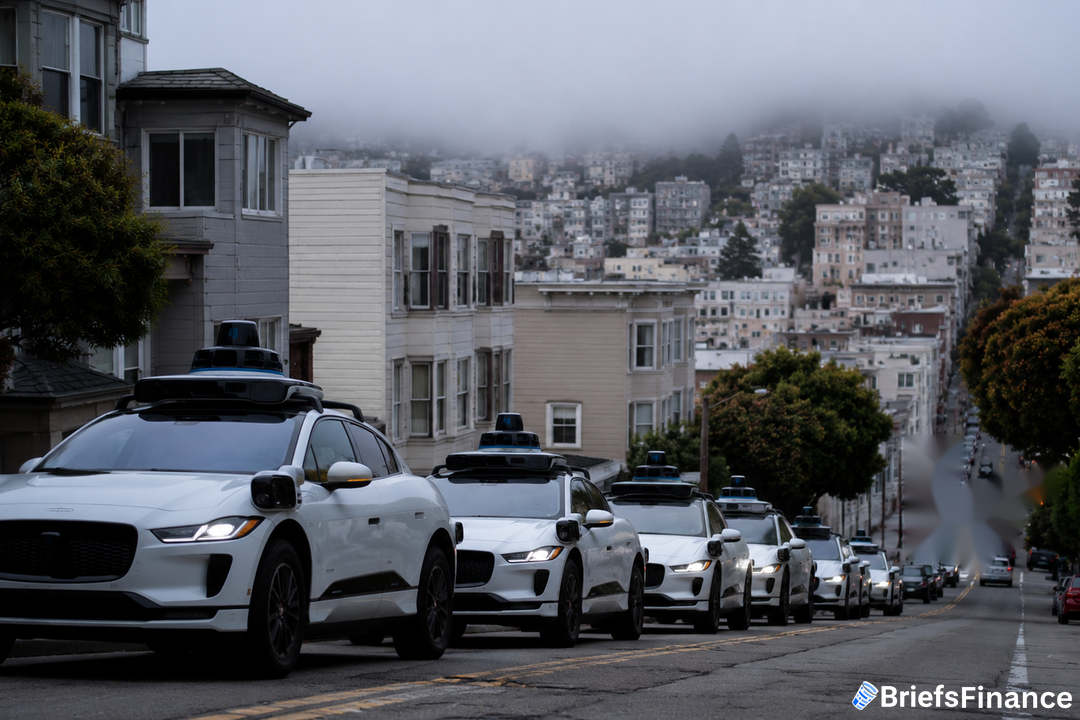
Autonomous vehicles on a foggy San Francisco street
Summary:
  • Waymo robotaxis got stuck in heavy traffic during a July 4th fireworks display, blocking major roadways for thousands of people.
  • Mayor Daniel Lurie has asked state regulators to adopt four new rules, including the ability to move cars out of active lanes and share live data during major events.
  • The proposed changes could affect companies testing or operating autonomous ride-hailing services in California, such as Waymo, Tesla, and Uber.

What Actually Happened on July 4th

It was the second time in about six months that Waymo robotaxis caused major disruptions - a widespread power outage in December had done the same, resulting in many Waymo cars stuck on roads and bringing traffic to a halt. Mayor Lurie had seen enough.

Lurie wrote to the California Department of Transportation, noting that existing regulations failed to properly cover autonomous vehicle behavior during major events. "California's current regulatory framework does not adequately address how autonomous vehicles operate during major incidents, planned or not," he wrote. "The challenge now is not just whether autonomous vehicles can operate safely under normal conditions, but also whether they can perform reliably during extraordinary ones."

Waymo is active in 11 urban areas and provides over half a million paid trips weekly. The firm currently runs roughly 1,000 self-driving taxis in the Bay Area.

Get the market news that matters in a five-minute read with Market Briefs, our free daily newsletter

These back-to-back incidents have shifted the debate from whether the technology works on clear days to whether it can handle the unpredictable nature of real-world emergencies.

The Four Rules Lurie Wants

Lurie outlined concrete requirements he would like the California DOT to adopt as rules across the state.

First, self-driving car operators must have the capability to quickly shift or pull their vehicles out of active driving lanes. Second, they must dynamically alter their paths, service zones, and boarding/alighting points.

Third, they must provide live operational information to municipal authorities, such as service outages, positions of stuck cars, and cleanup operations. Fourth, they must prove via tests that they can manage big crowds and heavy congestion.

Currently, firms wanting to run autonomous ride-hailing operations in California need to secure permits through two separate processes: one overseen by the state's DMV and another by the Public Utilities Commission. Six companies, including Nuro, Waymo, and Amazon-owned Zoox, already hold driverless testing permits. Uber is also poised to launch a premium robotaxi service in the area.

Notably, Tesla offers a robotaxi service under its own brand, yet it does not operate driverless cars and lacks the required permits for such operations. Instead, Tesla holds a charter transportation permit that authorizes its drivers to provide rides across San Francisco using vehicles with its semi-autonomous driving software rather than fully autonomous technology.

Lurie made clear he is not trying to kill the technology. "These changes will not undermine autonomous vehicles; they will strengthen them," he said. But his letter notes that voluntary actions - such as Waymo's pledge to limit operations on Independence Day around the waterfront and to station a liaison at the city's emergency operations center - proved insufficient, highlighting the sheer scale of Waymo's fleet.

Join Market Briefs, our free daily newsletter, for a quick daily rundown of the markets
Disclosure

Recent News

1 2 3 37

Get Market Briefs delivered to your inbox every morning for free!

No fluff. No noise. No politics. Just finance news you can read in 5 minutes.

Blogs

June 29, 2026
Portfolio Diversification: Why Putting All Your Eggs in One Basket Destroys Wealth
  • Real diversification means spreading investments across all 11 economic sectors plus bonds, alternatives, and cash so no single bet can sink the portfolio.
  • Different sectors perform at different times, so a diversified portfolio captures upswings while smoothing the brutal drawdowns that wipe out concentrated bets.
  • Total market index funds offer the simplest path to diversification, and annual rebalancing is what keeps the structure working over time.
Read More
June 29, 2026
Non Taxable Income: What It Is and Why It Matters
  • Non taxable income is money you receive that you don't owe income tax on.
  • The tax code treats workers, investors, and business owners very differently, and investors often come out ahead.
  • Learning how income is taxed is a quiet superpower for keeping more of what you earn.
Read More
June 29, 2026
Semiconductor Stocks: A Simple Guide for Investors
  • Semiconductor stocks are companies that design and make computer chips, the brains inside nearly every modern device.
  • The AI boom has turned chips into one of the market's most important and most watched groups.
  • They offer big growth potential, but come with high valuations and a notoriously cyclical history.
Read More
June 25, 2026
How Stocks Work: A Simple Guide for Beginners
  • A stock is a slice of ownership in a company - buy one, and you own a piece of the business.
  • You make money two ways: the share price rising over time, and dividends paid to shareholders.
  • The simplest path for most beginners is buying into the whole market through a low-cost index fund.
Read More
June 25, 2026
Stop Loss vs Stop Limit: What's the Difference?
  • A stop loss order sells your stock once it hits a trigger price, prioritizing getting you out.
  • A stop limit order only sells within a price range you set, prioritizing price over a guaranteed exit.
  • The trade-off: a stop loss almost always executes; a stop limit might not if the price moves too fast.
Read More
June 25, 2026
Energy Stocks: A Simple Guide for Investors
  • Energy stocks are companies that produce and supply the power the world runs on, from oil and gas to newer sources.
  • They make up one of the 11 sectors of the market and tend to move with energy prices and big-picture shifts.
  • Like any sector, the key is diversification and understanding the forces driving demand.
Read More
June 18, 2026
What Is a Stop Loss Order? A Simple Guide
  • A stop loss order automatically sells a stock once it falls to a price you set.
  • It's a tool to cap losses or lock in gains without watching the market all day.
  • It works best for active strategies, and can backfire if used carelessly on long-term holdings.
Read More
June 18, 2026
Best S&P 500 Index Fund: How to Choose One
  • The best S&P 500 index fund for most investors is simply the cheapest, most established one that tracks the index well.
  • Funds like VOO, IVV, and SPY all hold the same 500 companies, so the biggest difference is the fee.
  • Pick one, automate your buys, and let time do the heavy lifting.
Read More
June 17, 2026
What Are Penny Stocks? Risks and Rewards Explained
  • Penny stocks are very low-priced shares of very small companies, often trading for just a few dollars or less.
  • They promise huge gains but carry huge risks: low liquidity, high failure rates, and wild price swings.
  • Most investors are better served by quality companies and funds than by chasing cheap shares.
Read More
June 17, 2026
Best Stocks for Beginners With Little Money
  • The best stocks for beginners with little money usually aren't individual stocks at all - they're low-cost index funds.
  • You can start with $100 or less and use small, regular investments to build wealth over time.
  • Focus on diversification and consistency, not on picking the next big winner.
Read More
1 2 3 24
Share via
Copy link











