The Weapon
Russia has a new weapon in its arsenal, and it is disrupting Ukraine's shipping corridor.
It is called the Banderol, a low-cost cruise missile that has become central to Russia's attacks on Odesa's port area. Each unit costs $150,000 to $300,000, and Ukrainian officials believe Russian factories are turning out hundreds of them annually. According to officials, stricter limits on imported components might slow production.
President Volodymyr Zelenskyy's sanctions-policy commissioner, Vladyslav Vlasiuk, said the Banderol was designed to sit between cheap, slow Shahed drones and faster, more accurate Kh-101 cruise missiles. Work on it started in 2021, he said, and the current version contains many imported parts.
"This is a very dangerous gizmo," "Vlasiuk told journalists as he showed off part of a Banderol fired last year".
"The majority of strikes on the port infrastructure in Odesa are with Banderols," Vlasiuk said.
According to his team's analysis, the Banderol was used in 80% of attacks on the greater Odesa port hub, which includes Chornomorsk and Pivden. The Russian Defense Ministry offered no immediate response to questions from reporters.
The Cost Problem
Compared with Shahed drones, the Banderol carries a heavier blast: its warhead weighs 150 kilograms (330 pounds). Its flight speed lets it outrun Ukraine's latest interceptor drones. But each unit costs an estimated $150,000 to $300,000, so firing a Patriot interceptor or another expensive surface-to-air missile to stop it is a difficult call, especially since those defenses are already in short supply in Ukraine and elsewhere.
Get the market news that matters in a five-minute read with Market Briefs, our free daily newsletter
Ukrainian navy spokesman Dmytro Pletenchuk said of the weapon: "In speed and maneuverability, it's not exactly a missile."
The missile is roughly 5 meters (16 feet) long. Its box-shaped fuselage features short straight wings that fold, along with three tail fins and two guidance fins near the nose, all of which also fold.
Besides being carried by bigger long-endurance drones like Russia's Orion, the weapon has also appeared on ground-based launchers. Serhii "Flash" Beskrestnov, who advised recently dismissed Defense Minister Mykhailo Fedorov on electronic warfare, highlighted the new ground-launch configuration in a July 28 Facebook post.
Because Banderols are cheap and produced in large numbers, Russian forces can fire them in sustained attacks without quickly draining their budget. Ukrainian commanders, meanwhile, face a hard choice: spend another scarce interceptor or let the missile come in.
Impact on Ports and Grain Trade
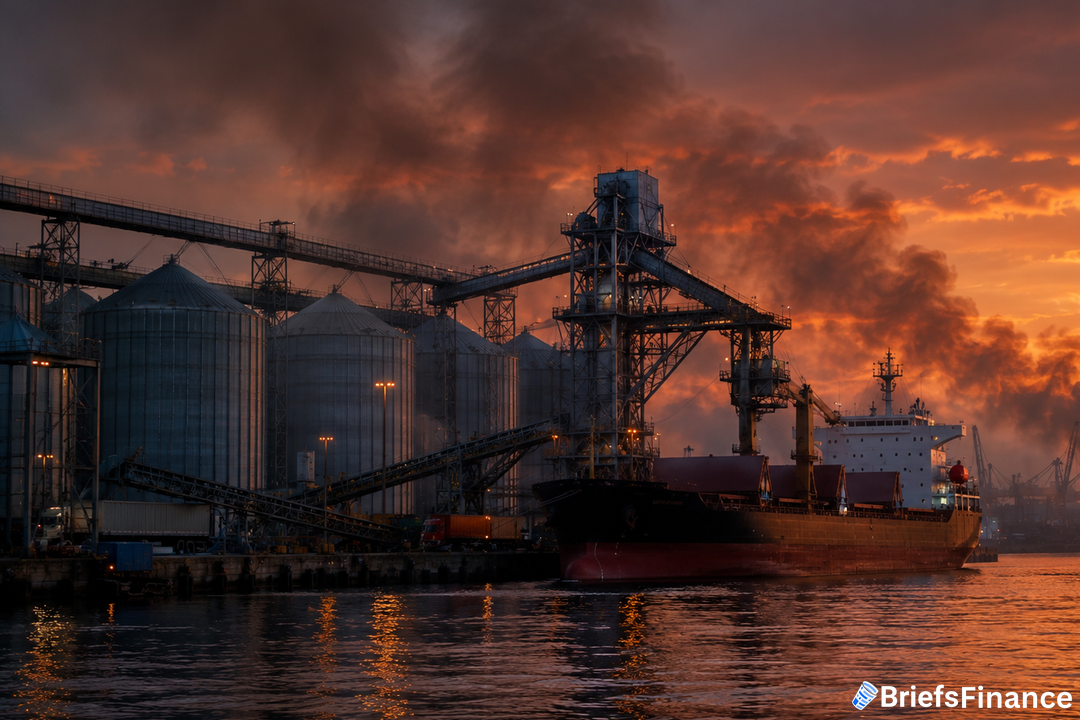
Because their range is only a few hundred kilometers, Russian forces send them toward Odesa from launch sites in Crimea. Pletenchuk described the Greater Odesa port system as "the largest gateway for Ukrainian exports, particularly grains and oilseeds."
The Greater Odesa hub is Ukraine's principal deep-water outlet for agricultural trade, and the repeated missile strikes have slowed that trade substantially.
"The work of our corridor has stopped - not entirely, but nonetheless, certainly the flow has slowed substantially. More than 20 ships have been damaged," Pletenchuk said. Pletenchuk also noted those 20 damaged merchant vessels were far fewer than the roughly 200 Russian ships Ukraine has destroyed in the Sea of Azov and the Black Sea.
Constantine Sobol, who runs the Odesa-based shipping firm Marelis Navigation, took a darker view, calling the regional harbors - Ukraine's only remaining route to the Black Sea - "98% closed."
"At the moment you can consider it the stoppage of Ukrainian deep-water export and import," Sobol said.
The Bottom Line
The Banderol is cheap to build, cheap to launch, and expensive to stop. With Ukraine's main grain export corridor under renewed pressure, the economic damage could be felt well beyond Odesa.
Join Market Briefs, our free daily newsletter, for a quick daily rundown of the markets