Free NewsletterPro Login
S&P 500 6,287 +0.42%
DOW 44,521 -0.18%
NASDAQ 21,103 +0.71%
S&P 500 +12.4%
Briefs Finance Fund +24.8%
JOIN THE FUND →

Luxury Home Market Surges While Middle-Class Buyers Struggle

Published Jul 15, 2026
[tts_player]
Share:
Summary:
  • The luxury home market is surging while middle-class buyers struggle.
  • Affordability gaps are widening across housing tiers.
  • The divergence highlights uneven market conditions.

A Market Split in Two

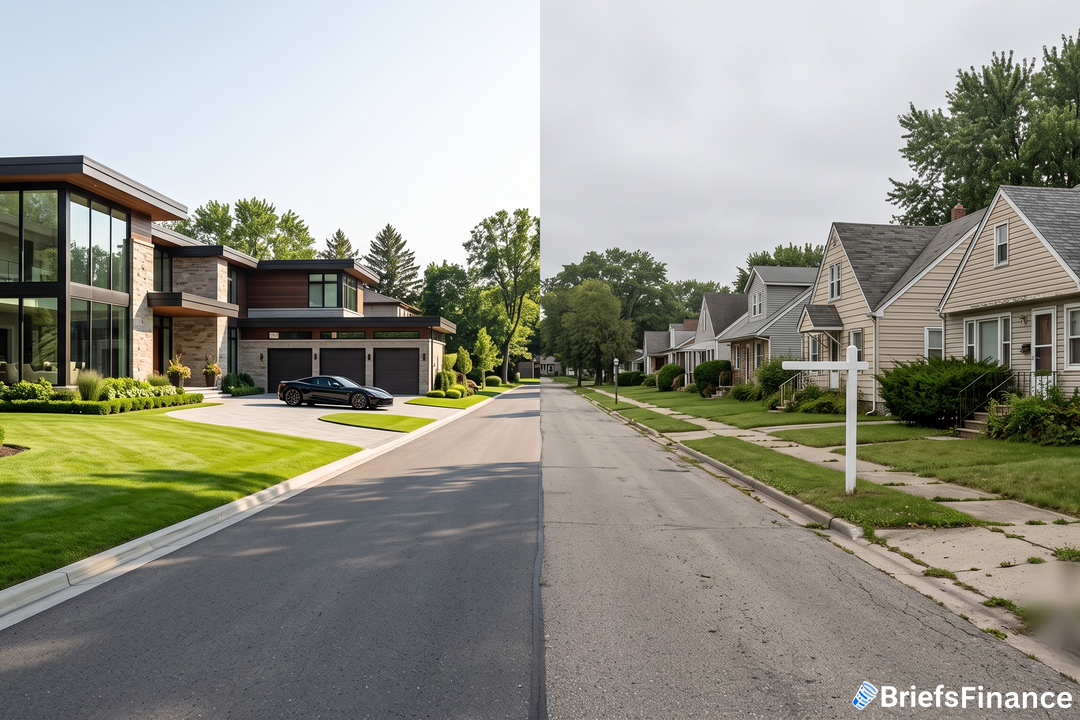
The housing market is telling two completely different stories right now.

Luxury homes - defined as the top 5% of listings by estimated value - are selling fast and getting pricier. Pending sales of those homes rose 5.2%, the biggest jump since December 2024.

Meanwhile, the rest of the market is stuck in neutral. Pending sales grew at 3.6%, a respectable number but well behind the high end.

What is causing the gap? It comes down to who can afford to buy right now. That makes high interest rates a minor inconvenience, not a deal-breaker.

Middle-income buyers face the opposite problem. Stagnant wages, high rates, and tight inventory have put homeownership further out of reach. So while the top end keeps climbing, the middle is just treading water.

Get the market news that matters in a five-minute read with Market Briefs, our free daily newsletter

According to Redfin senior economist Joel Berner, the rise in buyer activity aligns with an influx of capital from AI industry growth and recent Bay Area IPOs.

Where the Heat Is Hottest

The luxury boom is not evenly spread. A handful of metros are seeing outsized gains.

Tampa leads the pack. Pending sales for luxury homes increased by 20.8%, and closed sales rose 27.4% - second only to San Francisco.

New listings actually fell 2.9%, and active inventory dropped 0.5%. Homes are moving fast, with a median of 33 days on market. Among the ten metropolitan areas showing the largest growth in luxury pending sales, three are in Florida: West Palm Beach (18.5% increase), Miami (14.6% increase), and Tampa.

Miami is not far behind. Luxury prices rose 14.2% to a median of $4,855,331. Pending sales went up 14.6%, and closed sales rose 5.2%.

But the number of new luxury listings declined 13%, and active inventory tumbled 17.2%, marking the largest drop among all major metro areas studied. Luxury homes in Miami are taking longer to sell, though, at 150 days median on market, up 24 days from last year. A recent analysis by LuxurySoCalRealty pointed out that deals over $5 million typically require 45 to 60 days to finalize after contract signing.

San Francisco stands out for sheer velocity. Pending sales of luxury homes surged 45.9%, the largest increase nationally. Closed sales rose 46.3%, also the largest.

The median luxury price hit $6,648,922, up 6%. Homes spend just 13 days on market. During June 2026, 44 properties were purchased for $1 million or more above their final list price, resulting in $60 million in excess bids.

Inventory dropped 15.2%. The driving force behind this upswing is artificial intelligence. With over 2,000 AI firms based in San Francisco, the fast growth of companies like OpenAI and Anthropic has produced a cohort of buyers whose pay packages exceed typical tech salaries.

The bottom line: The divergence between luxury and non-luxury is not just a rich-get-richer story. It is a reflection of how different parts of the economy are performing. If your portfolio has exposure to real estate - through REITs, homebuilder stocks, or even your own home - keep an eye on where the cash is flowing. The most significant price gains are limited to a few metropolitan areas where tax policies, technology-driven wealth, and population shifts are boosting demand among the wealthy.

Join Market Briefs, our free daily newsletter, for a quick daily rundown of the markets
Disclosure

Recent News

1 2 3 36

Get Market Briefs delivered to your inbox every morning for free!

No fluff. No noise. No politics. Just finance news you can read in 5 minutes.

Blogs

June 29, 2026
Portfolio Diversification: Why Putting All Your Eggs in One Basket Destroys Wealth
  • Real diversification means spreading investments across all 11 economic sectors plus bonds, alternatives, and cash so no single bet can sink the portfolio.
  • Different sectors perform at different times, so a diversified portfolio captures upswings while smoothing the brutal drawdowns that wipe out concentrated bets.
  • Total market index funds offer the simplest path to diversification, and annual rebalancing is what keeps the structure working over time.
Read More
June 29, 2026
Non Taxable Income: What It Is and Why It Matters
  • Non taxable income is money you receive that you don't owe income tax on.
  • The tax code treats workers, investors, and business owners very differently, and investors often come out ahead.
  • Learning how income is taxed is a quiet superpower for keeping more of what you earn.
Read More
June 29, 2026
Semiconductor Stocks: A Simple Guide for Investors
  • Semiconductor stocks are companies that design and make computer chips, the brains inside nearly every modern device.
  • The AI boom has turned chips into one of the market's most important and most watched groups.
  • They offer big growth potential, but come with high valuations and a notoriously cyclical history.
Read More
June 25, 2026
How Stocks Work: A Simple Guide for Beginners
  • A stock is a slice of ownership in a company - buy one, and you own a piece of the business.
  • You make money two ways: the share price rising over time, and dividends paid to shareholders.
  • The simplest path for most beginners is buying into the whole market through a low-cost index fund.
Read More
June 25, 2026
Stop Loss vs Stop Limit: What's the Difference?
  • A stop loss order sells your stock once it hits a trigger price, prioritizing getting you out.
  • A stop limit order only sells within a price range you set, prioritizing price over a guaranteed exit.
  • The trade-off: a stop loss almost always executes; a stop limit might not if the price moves too fast.
Read More
June 25, 2026
Energy Stocks: A Simple Guide for Investors
  • Energy stocks are companies that produce and supply the power the world runs on, from oil and gas to newer sources.
  • They make up one of the 11 sectors of the market and tend to move with energy prices and big-picture shifts.
  • Like any sector, the key is diversification and understanding the forces driving demand.
Read More
June 18, 2026
What Is a Stop Loss Order? A Simple Guide
  • A stop loss order automatically sells a stock once it falls to a price you set.
  • It's a tool to cap losses or lock in gains without watching the market all day.
  • It works best for active strategies, and can backfire if used carelessly on long-term holdings.
Read More
June 18, 2026
Best S&P 500 Index Fund: How to Choose One
  • The best S&P 500 index fund for most investors is simply the cheapest, most established one that tracks the index well.
  • Funds like VOO, IVV, and SPY all hold the same 500 companies, so the biggest difference is the fee.
  • Pick one, automate your buys, and let time do the heavy lifting.
Read More
June 17, 2026
What Are Penny Stocks? Risks and Rewards Explained
  • Penny stocks are very low-priced shares of very small companies, often trading for just a few dollars or less.
  • They promise huge gains but carry huge risks: low liquidity, high failure rates, and wild price swings.
  • Most investors are better served by quality companies and funds than by chasing cheap shares.
Read More
June 17, 2026
Best Stocks for Beginners With Little Money
  • The best stocks for beginners with little money usually aren't individual stocks at all - they're low-cost index funds.
  • You can start with $100 or less and use small, regular investments to build wealth over time.
  • Focus on diversification and consistency, not on picking the next big winner.
Read More
1 2 3 24
Share via
Copy link











