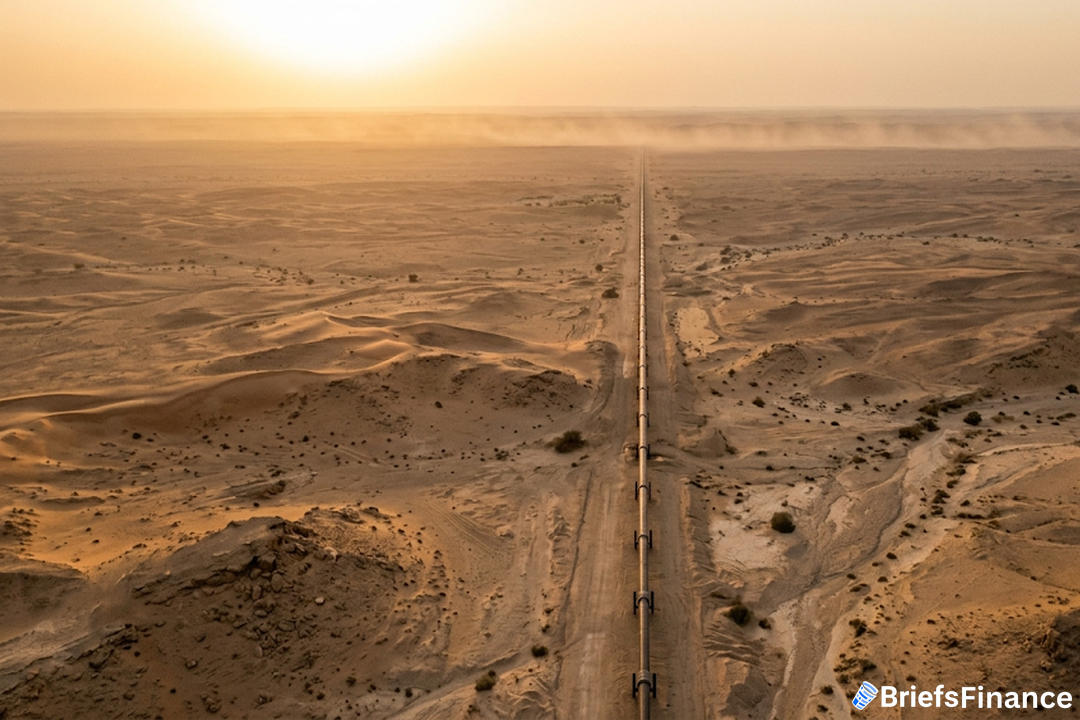
A Pipeline With a Long History
Iraq and Syria signed an agreement on July 17, 2026 to restore an oil pipeline that was damaged during the 2003 U.S. invasion of Iraq and then closed. The U.S. Energy Information Administration states the pipeline's design allows it to move 700,000 barrels daily.
The Strait of Hormuz saw disruption to tanker traffic during the U.S.-Iran war, and Iraq, because it had few pipeline options, depended heavily on its southern port of Basra on the Persian Gulf. When that route was disrupted, it lost its primary export corridor.
The signing ceremony included top energy officials from both countries. U.S. Energy Secretary Chris Wright oversaw the signing ceremony, where Bassem Abdul Karim Nasr, chief executive of Basra Oil Company, and Youssef Qablawi, chief executive of Syrian Petroleum Company, signed the agreement. Iraqi Prime Minister Ali al-Zaidi recently visited the U.S. and met President Donald Trump.
Why Every Gulf State Wants Pipeline Options
Many Gulf nations are seeking to grow their pipeline networks to lessen reliance on the Strait of Hormuz. Saudi Arabia is considering adding 2 million barrels per day of capacity to its Red Sea pipeline, according to a Reuters report from July 7, 2026, citing people close to the matter. The UAE is building an additional pipeline that terminates at Fujairah Port along the Gulf of Oman, thereby doubling its export capacity outside the strait.
Get the market news that matters in a five-minute read with Market Briefs, our free daily newsletter
Iraq's new pipeline with Syria fits the same pattern. It would allow Iraqi oil to reach the Mediterranean coast, bypassing the Strait of Hormuz entirely.
Energy Secretary Chris Wright put a broader spin on it at the signing. "There is so much room to drive improvement in Iraq, to raise oil production, to reduce dependencies on hostile neighbors, to bring freedom, prosperity and abundant energy to the nation of Iraq," he said.
The Catch: Pipelines Are Not a Cure-All
Bob McNally, founder of energy consulting firm Rapidan Energy, points out that the real threat from Iran is not just the waterway. "The problem isn't the waterway. It's that Iran can use weapons to attack loading facilities, pumping stations, the end stations, these terminals, and the storage units of these pipelines," he said.
Historical Context and Strategic Importance
The pipeline's roots trace back to the 1980s, when it was a vital artery for Iraqi crude exports to Europe via Syria. After the 2003 U.S. invasion, damage and subsequent sanctions kept it shuttered. Its revival comes as the recent U.S.-Iran war exposed the fragility of Iraq's export infrastructure.
Missile strikes and naval skirmishes near the Strait of Hormuz crippled tanker traffic, forcing Iraq to scramble for alternatives. Reopening the pipeline not only reduces Baghdad's dependence on a single chokepoint but also strengthens its leverage against future disruptions.
Join Market Briefs, our free daily newsletter, for a quick daily rundown of the markets