Free NewsletterPro Login

Poop-scooping businesses grow as entrepreneurs turn yard waste into work

Published Oct 21, 2026
Share:
Summary:
  • Scoop Soldiers, a Dallas-based franchise, lists weekly service starting at $19.99 for up to four dogs and one-time cleanings from $79.99, with franchisees setting local tiers.
  • Sweep & Go, a niche CRM for scoopers launched in 2019, handled about $6,900 in its first year, $56.2 million in 2025, and targets $100 million in 2026.
  • Swoop Scoop, launched in late 2020 in Coeur d'Alene, Idaho, now spans seven locations, logged more than $9 million in sales through August 2026, and projects $3 million this year.

Why more entrepreneurs are picking up dog waste

After roughly 26 years in pet-waste removal, Kandra Witkowski now holds the title of business development director at Scoop Soldiers, a nationwide franchise based in Dallas. Working remotely from Missouri, she puts it simply: "I have always loved scooping." She adds, "I find it very enjoyable," noting many veterans of the business prefer the office, but she still likes being in the yard.

The niche exists because plenty of dog owners let pets go in the yard, and for reasons ranging from mobility limits to time pressure, they do not always handle cleanup. The internet and social platforms have made the service easier to discover, while the broader trend toward outsourcing chores has kept demand steady and brought more operators into the game.

There is still white space. Jeremy Brook, who opened Mastiff Mounds in Brandon, Florida, in July 2025, says, "On one hand, you have this evolving of the internet and more people, entrepreneurs, business owners, seeing the opportunity for this business, but yet, at the same time, a lot of people are still very unaware of this service."

How small operations scale and where the money shows up

A number of founders say the barrier to entry is low. William Milliken co-founded Swoop Scoop in Coeur d'Alene, Idaho, in late 2020 after his wife, while pregnant, hired a service because he was not keeping up with their dogs' mess. He had run an electrical business and brought digital marketing experience; his high school friend wanted to start a home-services venture but did not have a trade like HVAC or plumbing. Milliken remembered that scooper and saw an opening.

Early growth came the scrappy way. Milliken's partner secured the first 10 to 15 clients by knocking on doors and posting in Facebook groups. Once ad spend kicked in, the customer list jumped from roughly 20 to above 300 in under three months and kept accelerating.

The company now operates seven locations across the Pacific Northwest. Per documents reviewed by CNBC Make It, Swoop Scoop generated more than $9 million in sales from October 2020 through August 2026, and Milliken says it is on track for $3 million in 2026.

Milliken's team also built a community to seed the market. On Skool, an online education platform, their Poop Scoop Millionaire group has 600 members paying $69 a month to swap playbooks with Swoop Scoop's founders and other would-be operators.

Small businesses reinvent simple services all the time, so get clear daily context with our free Market Briefs newsletter

The tech stack is maturing too. Sweep & Go, a customer relationship tool built specifically for scoopers, went live in 2019. Documents reviewed by CNBC Make It indicate that in its first year it processed roughly $6,900 in card volume for animal waste removal companies.

By 2025 that tally reached $56.2 million, and the company expects to handle $100 million of transactions in 2026. Founder Ogy Nikolic says he worried in 2020 that the idea might fizzle because people staying home could clean their own yards, but six years on he and others say demand has surged.

What running the business actually looks like

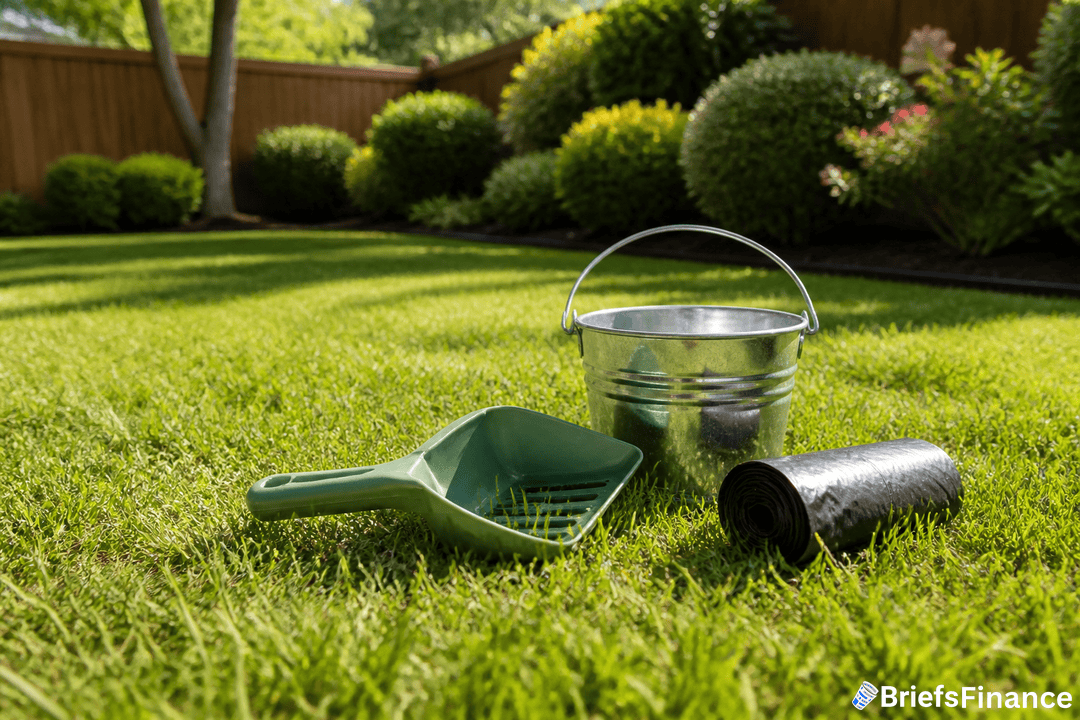
The toolkit is basic. Pros typically bring along a rake, a dustpan outfitted with a trash bag, and a garden sprayer used to sanitize their equipment between appointments. Owners set their own prices, usually factoring in yard size, how many dogs live there, and whether the client wants ongoing service.

Scoop Soldiers' listed pricing starts at $19.99 per week for weekly visits covering as many as four dogs, and $79.99 for a single cleanup. Rates differ by market and franchisees choose their own tiers, Witkowski says. For solo operators, clustering clients tightly helps squeeze in more stops each day.

The work itself is simple, but the company-building is not. Witkowski says the headaches are familiar to any service business: technicians ding mailboxes, call in sick, occasionally get bitten, and some customers delay payment. She adds that "not everyone should be a business owner," especially a franchisor responsible for multiple locations. Scoop Soldiers itself has more than a dozen locations across the country.

Even with competition, collaboration shows up. Cheresee Rehart, who has run Yard Guards on Doody in Riverview, Florida, for 23 years, says, "One success is everybody's success," noting that she and Brook are direct rivals and still work well together.

What this means for your portfolio

Here is the through-line for investors: low startup costs, clear pricing levers, and specialized software are turning an overlooked chore into a repeatable local-service business. Sweep & Go's move from about $6,900 in first-year volume to $56.2 million in 2025 and a $100 million target for 2026 signals infrastructure forming around these operators.

Watch the ecosystem. You have franchises like Scoop Soldiers with published price anchors and more than a dozen locations, growth chains such as Swoop Scoop reporting more than $9 million in cumulative sales since late 2020 and scaling to seven locations, and purpose-built software processing tens of millions in payments. That is where convenience spending is showing up.

Whether you follow entrepreneurship or local services, stay informed every morning by signing up for Market Briefs

Disclosure

Recent News

1 2 3 … 107

Get Market Briefs delivered to your inbox every morning for free!

No fluff. No noise. No politics. Just finance news you can read in 5 minutes.

Blogs

October 16, 2026
How Boring Math Makes You Rich: The Briefs Money Spreadsheet, Explained
  • Briefs Money shows you what to do with every paycheck, and in what order: how much to spend, save, and invest, when to build an emergency fund, and which debt to pay off first.
  • The Climb to Wealth course walks you through the system step by step, and the Personal Finance Spreadsheet is where you track your own numbers.
  • Investing is one piece of building wealth. The system that gets money to your investments, and keeps it there, decides the outcome.
Read More
October 16, 2026
Common Investing Mistakes: Why a Stock Grade Is One Tool, Not the Whole Toolkit
  • The Briefs Score shows growth, income, and wealth preservation investors how well a stock fits their goal, with a separate letter grade for each one.
  • The most common mistake is treating the letter as an instruction. An A tells you a stock scores well for one goal, not that you should buy today.
  • Research works best as one input in a process you own. The grade shows how a stock stacks up. You supply the goal, the timeline, and the rules for being wrong.
Read More
October 16, 2026
How to Read a Company's Numbers Without a Finance Degree (Using Briefs Terminal)
  • Briefs Terminal lets you size up any public company in about ten minutes: what the stock costs, what it earns, how fast sales are growing, and what it pays you, all on one page.
  • It lines those numbers up against the company's closest competitors for you, so you can tell if a number is impressive or just average.
  • Below that are the income statement, balance sheet, and cash flow statement from the company's SEC filings, the latest news, and transcripts of its earnings calls.
Read More
October 16, 2026
What Type of Investor Am I? The Three Investor Archetypes, Explained
  • Briefs sorts its stock grades and monthly reports by three investor goals: growth, income, and wealth preservation. Pick yours and you know which report and which grade to read first.
  • Growth investors want stocks that beat the S&P 500. Income investors want to get paid in cash. Wealth preservation investors want stocks that hold up when the market drops.
  • The same stock can score an A- for one goal and a D- for another, so picking your goal comes before picking any stock.
Read More
October 16, 2026
How to Build a Stock Watchlist That Isn't Just Stocks You Heard About
  • A watchlist on Briefs Terminal lets you group stocks by the idea you're tracking and follow each one's price, one-day move, and 52-week high and low in one place.
  • Each list has its own name and description, so you always know why a stock is on it, and you can make as many lists as you have ideas.
  • The monthly growth, income, and wealth preservation reports under the Briefs Research tab hand you new themes to track that you didn't hear about online.
Read More
October 16, 2026
How to Choose an ETF That Matches Your Idea (Using the ETF Planning Tool)
  • The ETF planning tool takes an idea like "I want to invest in fast food companies," asks what you mean, and finds the ETFs that match, with the reasons, the holdings, and the sources.
  • Build a Plan then shows what your money could grow to in those ETFs over the years you choose, with conservative, expected, and optimistic estimates next to the S&P 500.
  • It gets you from an idea to an actual plan without researching dozens of companies one at a time.
Read More
October 16, 2026
Is This Stock a Good Buy? How to Use the Briefs Score to Tell If a Stock Fits the Way You Invest
  • The Briefs Score shows growth, income, and wealth preservation investors how well a stock fits their goal, with a separate letter grade for each one.
  • One stock can score very differently for each. Nvidia showed an A- for growth and a D- for income, because it grows fast and pays almost no dividend.
  • Seven sub scores under each grade show what earned the letter, so you can see exactly where a stock is strong or weak for your goal.
Read More
October 16, 2026
How to Tell an Asset From a Liability: The One Question to Ask Before You Buy Anything
  • The typical American household earned more in 2025 than in any year on record, yet only 30% of Americans say they could pay a surprise $1,000 bill from savings, so the problem isn't income but what the income gets spent on.
  • An asset puts money in your pocket and a liability takes money out, and the wealthy buy assets first, then let the assets pay for the fun stuff.
  • Before you buy anything, ask one question: does this put money in my pocket, or take money out of my pocket? Then you need a plan for the money you keep.
Read More
October 16, 2026
How to Build Your First $2,000 Emergency Fund and Wipe Out Every Debt Over 10%
  • Your first money goal isn't investing, it's $2,000 in its own account named Do Not Touch, built by moving 10% of every paycheck into it automatically.
  • More than a third of American adults couldn't cover a $400 surprise bill with cash or savings, according to the Federal Reserve, and that's how one bad day turns into years of credit card payments.
  • Once the $2,000 is there, attack every debt charging more than 10% interest, highest rate first, because you can't out-invest a 22% credit card so paying it off is the investment.
Read More
October 16, 2026
How to Invest Through a Crash: 3 Rules From the Worst-Timed Investor Alive
  • Meet Bunty, a fictional investor with the worst timing in history: he put $100,000 into the market in four chunks right before four crashes, never sold, and by 2025 it had grown to more than $500,000.
  • Investors who jump in and out of the market miss its best days, and missing just a handful of those days can cut your final result roughly in half.
  • The fix is ABB, Always Be Buying: you buy on a schedule through booms, crashes and scary headlines, which matches the market, and beating it takes knowing where the money is moving first.
Read More
1 2 3 … 29
Share via
Copy link










