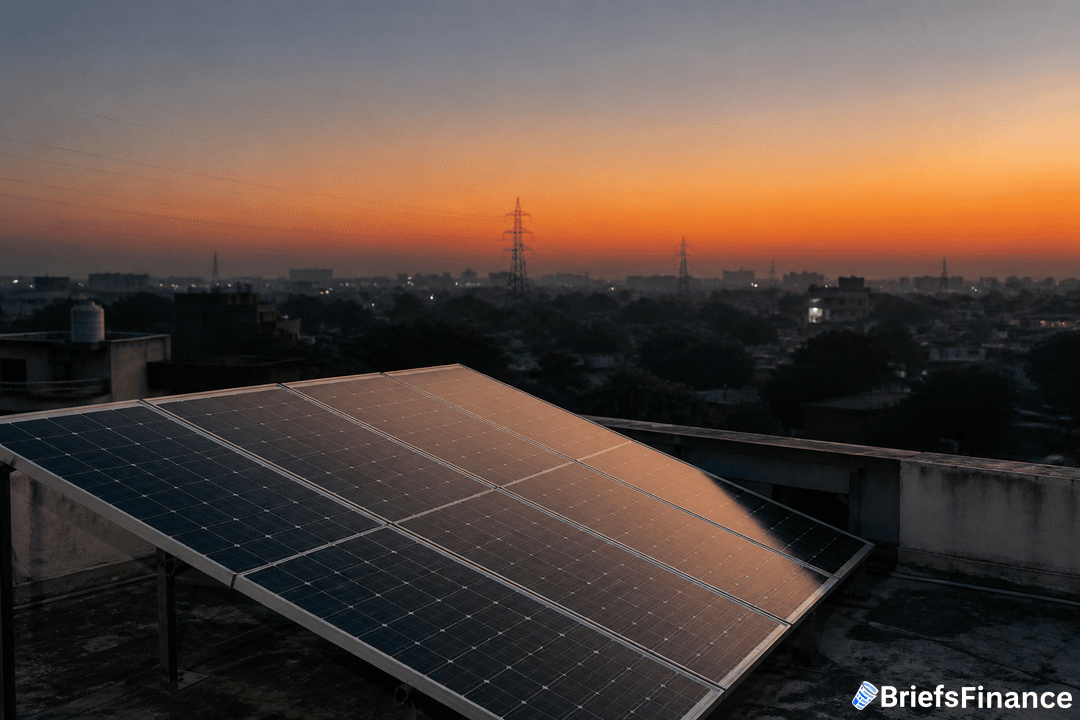
The surprising shift in who is powering Cuba's lights
Here is the twist: even as Washington tightens the screws, US goods are helping Cubans keep basic power flowing. US Census data show that by July, Cuba had received $6.3 million of US solar cells and modules, a 1,070% jump from the full 2025 tally of $538,000. China remains the heavyweight supplier, but its pace has cooled.
By the end of July, Chinese exports totaled $19.5 million, an 83% drop versus its 2025 full-year figure, according to data compiled by BloombergNEF. Beijing also sent a new donation of 5,000 solar systems in September.
The shipping lanes tell the story. Seaborne exports from the US to Cuba have already topped $650 million this year, with nearly half routed through Port Everglades in Florida. John Kavulich, president of the US-Cuba Trade and Economic Council, observed that ports in Florida, Texas and Louisiana are taking on a bigger share of moving solar hardware to the island, a shift he considers noteworthy. "It's sort of ironic that Cuba could become a substantial renewable export market for US companies," he said, adding that this comes "given the less than supportive view from the White House on renewables." He also noted that roughly 40% of the crude required for the country's power plants is produced domestically, and that Cuba has been making progress in refining a larger portion of it.
At the same time, the policy backdrop is tough. The Trump administration has tightened sanctions and pursued what critics describe as a de-facto fuel blockade, a policy that has helped alienate allies including Venezuela and Mexico. That dovetails with a broader effort to reassert US influence in the hemisphere and check China and Russia. Yet a carve-out still allows shipments to Cuban entrepreneurs, and the resulting flow from American ports has both cushioned a deeper humanitarian spiral and increased Cuba's reliance on US suppliers.
Cuba's energy math: more solar, not enough juice
Blackouts and fuel shortages have pushed Cuba hard toward solar. President Miguel Díaz-Canel said last month that the country's 144 solar parks generate 1,418 megawatts, roughly one fifth of national electricity, and that private businesses now produce 20% of their own power. "Despite the blackouts, this is an area where we've made great strides," he said.
But the grid is still fragile and rationing is severe. Deputy Foreign Minister Carlos Fernández de Cossío said that over the past eight months he typically had electricity at home only two or three hours a day. The US pressure campaign, he argued, "has successfully intimidated the whole world so it doesn't export fuel and other products" to Cuba, calling it "an aberration."
Energy researcher Jorge Piñon of the University of Texas Energy Institute said Cuba is adding solar in a way that undercuts its usefulness. With virtually no utility-scale batteries, most parks only help during daylight and are not well integrated into the grid. He added that given Cuba's size, solar will never cover baseload needs, so large thermoelectric plants remain essential.
Cheap solar is changing the energy map in places the grid has failed. Market Briefs covers that transition free every weekday.
A Havana business owner shows how ordinary Cubans are coping
When the lights went out across Cuba for the seventh time this year, the celebration at La Campana in Havana rolled on. Owner Ramiro Llovet, 52, and his wife had long relied on a small, noisy generator to keep their 15-year-old event business running. As outages worsened, he pieced together a solar setup instead.
Last year he found 5 kilowatt-hour lithium batteries on Amazon.com, shipped them to a relative in Miami, and used CubaMax to forward them to Havana. After investing around $10,000, La Campana now runs almost entirely on self-generated power, hosting everything from intimate gatherings of 15 to large events of up to 350 people. "It was a big investment, but it was obvious that this isn't a problem that is going to be resolved in the near future," he said.
Day to day, the squeeze is real. Amid diesel and fuel shortages, Llovet swapped his car for an electric tricycle that has become a common sight in Havana. He is also working to comply with new local rules so he can personally bring in the party supplies he needs.
What he really wants is simpler: "I would really like for everyday life to be just normal," he said. "We've had that in the past and everything went well. We just need things to go back to normal, one way or another."
The bigger picture for your money
Cuba's crunch has opened a niche market: small solar kits, batteries and parts for homes and mom-and-pop businesses. US exporters have already moved more volume this year, and the port data underscore that demand. But the island's structural limits still loom large. There is little grid-scale storage, thermoelectric generation and fuel remain necessary, and the population of 9.4 million has fallen 16% in a decade. As Kavulich put it, "The reason Cuba hasn't stopped and collapsed and halted is because the economy has shrunk almost equal to the magnitude of the fuel that they were importing." For anyone tracking real-world demand for distributed energy gear, Cuba is a live case study in where the orders show up and where they hit a wall.
Where panels go when a power system collapses is its own kind of economics. Join Market Briefs free and follow the story.