Free NewsletterPro Login

Warning: Undefined variable $stocks in /var/www/briefs.co/htdocs/wp-content/plugins/oxygen/component-framework/components/classes/code-block.class.php(133) : eval()'d code on line 448

Warning: foreach() argument must be of type array|object, null given in /var/www/briefs.co/htdocs/wp-content/plugins/oxygen/component-framework/components/classes/code-block.class.php(133) : eval()'d code on line 448

Warning: Undefined variable $funds in /var/www/briefs.co/htdocs/wp-content/plugins/oxygen/component-framework/components/classes/code-block.class.php(133) : eval()'d code on line 472

Warning: foreach() argument must be of type array|object, null given in /var/www/briefs.co/htdocs/wp-content/plugins/oxygen/component-framework/components/classes/code-block.class.php(133) : eval()'d code on line 472
/* the link was here */
Free Live Investor Workshop
The dollar is losing value. Here’s how investors can still profit. Click Here to Save Your Seat →         

Meta Will Start Installing Its Own AI Chips in Data Centers Next Year

Published Sep 15, 2026
[tts_player]
Share:
Summary:
  • Meta plans to start rolling out a new in-house AI chip to its data centers in the first half of next year to cut costs and power use for AI workloads.
  • The next chip in the lineup, the 500 series known as Astrid, is slated to finish design in about a month and begin going into data centers at the close of 2027, with broader use expected after that.
  • On an energy basis, Meta plans to deploy over a gigawatt's worth of these chips within a 12-month span and aims to speed up beyond that if AI demand remains strong.

What Meta is building and when

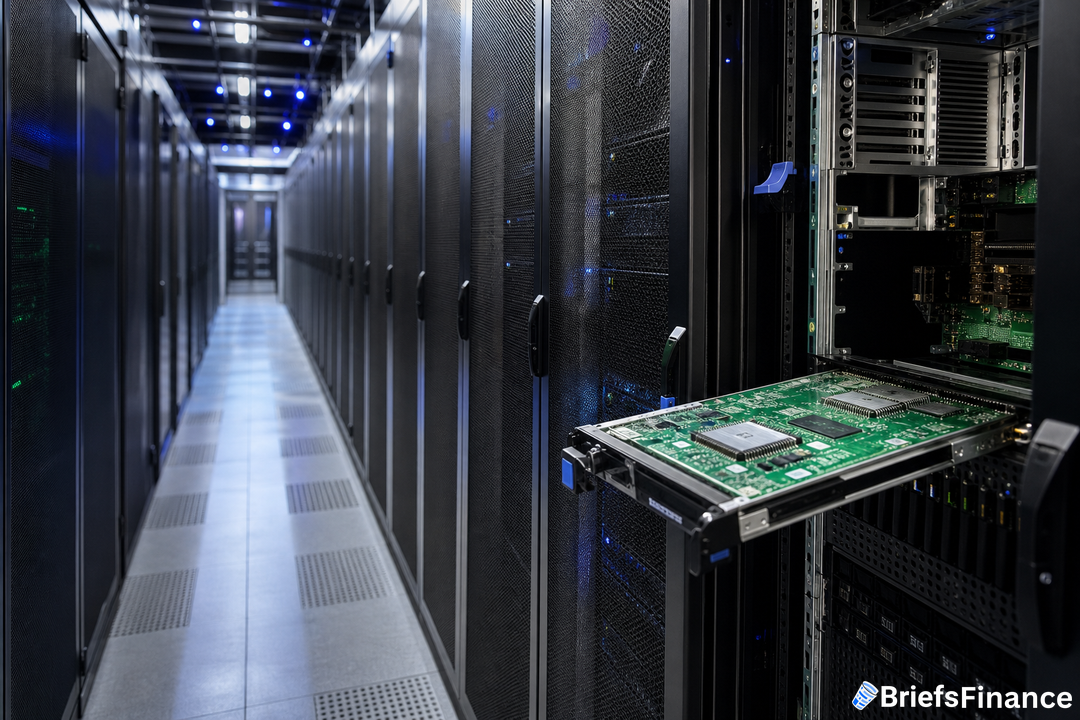
Meta first laid out its custom AI silicon plans in 2023 and is now preparing to place a new internally developed chip in its data centers in the first half of next year. The company is currently testing the third generation of the family, called MTIA 450 and code-named Arke. The follow-on, MTIA 500, known as Astrid, is about a month away from design completion and is planned to start appearing in Meta's data centers at the close of 2027, with even wider deployment to follow.

How the chips were tested and who is involved

A dozen of the new chips reached Meta from Taiwan Semiconductor Manufacturing Co. on Sept. 1, and their performance landed within 2% to 3% of internal simulation targets. On day one, Meta used the processors to run its own models as well as models from DeepSeek and Alibaba Group Holding Ltd., and early testing indicated no design issues. There is still a few months of trialing and tuning ahead while the factory scales up.

Meta is building this silicon as part of a big push to expand its AI infrastructure. It is collaborating with Broadcom on chip design and with TSMC on manufacturing - a strategy intended to reduce reliance on Nvidia processors. Meta Superintelligence Labs, the AI division, is feeding insights about upcoming models and inference needs to refine the chips. Yee Jiun Song, who leads Meta's custom silicon as its vice president of engineering, said the tight feedback loop lets the hardware run inference for AI models more efficiently than "whatever Nvidia is currently shipping."

When companies invest in new technology, investors benefit from planning for change. Join Briefs Finance CEO Jaspreet Singh on September 29th for a FREE live investor workshop, How to Profit From A Dollar That's Losing its Value, where he shows how we're spotting investment opportunities as the dollar falls. Save your spot.

Why Meta is doing this and what the chips are for

Song said each generation takes on more technical risk and delivers stronger performance, including better output per watt and per dollar spent. Using energy consumption as the yardstick, a key data center metric, Meta intends to roll out in excess of a gigawatt's capacity of these chips across a 12-month period and then accelerate thereafter, provided AI markets and demand don't slump.

All four generations rely heavily on high-bandwidth memory and are not built for the ultrafast inference segment where responses need to be near instantaneous. As Song put it, "These are the workhorse chips that we're going to use for general-purpose inference."

Meta had previously scoped a chip called Olympus that would handle both training and inference and was expected around 2028 or 2029, but the company canceled it to focus on inference, citing cost. "When you start to build up gigawatts and gigawatts of capacity, you really care about cost," Song said, adding that if a combined chip is potentially 30% pricier, that becomes "completely unacceptable." After Astrid, Meta plans to push for higher speed and throughput in future models, with fiber-optic technologies expected to help lift performance. "We have a very robust road map," Song said. "For the next few years, we expect to continue to build chips that are competitive with what our vendors are building for us."

What this means for your portfolio

Meta, which owns Facebook, Instagram and WhatsApp, is shifting from mainly buying third-party processors to building and deploying its own at scale. That could reshape its spending profile and operating efficiency as the chips roll into production and deployment timelines extend through 2027 and beyond. The bigger picture for investors: if Meta's in-house silicon consistently delivers better performance per watt and per dollar for inference, it could lower its long-term AI operating costs while dialing in performance to its own models.

Steady saving and thoughtful choices help your portfolio weather technological shifts. Our CEO Jaspreet Singh is hosting a FREE live investor workshop, How to Profit From A Dollar That's Losing its Value, on September 29th. Sign up free to join him live.

Disclosure

Recent News

1 2 3 76

Get Market Briefs delivered to your inbox every morning for free!

No fluff. No noise. No politics. Just finance news you can read in 5 minutes.

Blogs

September 14, 2026
Why RAM Prices Are Soaring - and Where the Money Is Moving
  • Memory chips - the RAM inside phones, laptops, fridges, and trucks - are in a shortage Tim Cook called a 100-year flood, and some memory prices have climbed about 90% in a single quarter.
  • Four forces hit at once: AI demand, a production shutdown in 2023, build times that push any fix to 2028 at the earliest, and a bombed helium plant in Qatar.
  • The last two supply shocks ended in aggressive Fed rate hikes and market drops of around 45% and 20%, and this time Washington is spending heavily to bring memory production home.
Read More
September 11, 2026
How Is the Economy Doing? Washington Says It's Fixed, but the Numbers Don't Agree
  • Treasury Secretary Scott Bessent says the economy is fixed because lower earners' incomes are now rising faster than top earners'.
  • The Atlanta Fed and Bank of America show different numbers, and Hilton, Marriott, and McDonald's can't agree on what they're seeing either.
  • Whichever side is right, the economy is built to make investors rich, and inflation is how it does it.
Read More
September 10, 2026
US National Debt Hits $40 Trillion: Why the Economy Hasn't Collapsed Yet
  • The US national debt crossed $40 trillion in 2026 and is growing faster than the economy. The debt to GDP ratio now sits at 125%, the highest outside the pandemic and higher than World War II.
  • On September 9, 2026, Treasury Secretary Scott Bessent rolled out an emergency plan for the government to lend money to itself. Ray Dalio now says the dollar has roughly three years before real pain.
  • Empires rarely default. They debase. Since 1971, median household income grew about 8x while houses grew 17x and the S&P 500 grew 360x, so investors got richer while workers fell behind.
Read More
September 9, 2026
Your 401k Is Fueling the AI Bubble
  • About $10 trillion of 401k money sits in a $77 trillion stock market, mostly through target date funds and S&P 500 funds. Roughly 30% of every S&P 500 dollar lands in five AI-heavy tech stocks.
  • Four bubble signals run hotter today than before the 2000 crash: top-ten concentration, tech's share of the index, the Buffett Indicator, and how much of the market index funds own.
  • You only lock in an AI bubble loss if you sell. The 2022, 2020, 2008, and 2000 crashes were all buying windows for long-term investors, and the US-China AI race means government money could keep flowing in.
Read More
September 9, 2026
What Is Wealth Preservation? How To Protect Your Money From Anything
  • Wealth preservation is an investing strategy built around keeping the money you've already made instead of chasing growth.
  • It leans on assets that hold steady when markets fall - gold, Treasury bonds, and companies that keep earning through wars, crashes, and pandemics.
  • The tradeoff is real: you give up some upside, and the two key numbers to check are maximum drawdown and correlation to the market.
Read More
September 8, 2026
Why Is Everything So Expensive? Why Prices May Never Come Back Down
  • Official inflation is 3.4% and prices are up 32% since 2020, but rent (41%), gas (47%), car insurance (64%) and ground beef (79%) all outran the 28% median wage.
  • The Federal Reserve targets 2% inflation on purpose. Rising prices push extra dollars to investors and shrink the real cost of a $40 trillion national debt.
  • Investors who simply owned the S&P 500 gained about 150% over the same six years, and the Fed's September 16 decision will show whether it protects the dollar or the economy first.
Read More
September 7, 2026
The U.S. Housing Market Just Flipped: Renting a Home Now Beats Buying One
  • The US is in a buyer's market in 41 of the 50 largest metro areas, but prices sit near record highs and mortgage rates are close to 7%.
  • The same median house costs 27% more than it did in 2021 while the monthly payment costs 90% more, and incomes rose a little more than 10%.
  • A 2008-style crash is not showing up in the data, so the pressure is landing on buyers instead of prices.
Read More
September 4, 2026
An Interest Rate Hike in 2026? The Fed Just Broke Its Own Script
  • The Federal Reserve spent a year signaling cheaper money, and its new chairman just warned that an interest rate hike may be coming instead.
  • The Fed is stuck between high inflation and a weak job market, and fixing one makes the other worse.
  • Higher rates also reprice roughly a third of America's $40 trillion national debt this year, which is why Washington wants cuts so badly.
Read More
September 3, 2026
5 Passive Income Ideas That Pay You Whether You Work or Not
  • School teaches one formula: work, earn, spend. Stop working and the money stops, so the wheel never ends.
  • Five assets pay you without your labor - dividends, rent, interest, royalties, and the things you already own.
  • $80,000 a year of cash flow takes about $1 million invested at 8%, or roughly 20 years of $1,000 a month.
Read More
September 2, 2026
The Best Way to Invest 10k: Three Options To Transform 10K into 10 Million
  • Passive investing in stocks or real estate targets around 10% a year, and time in the market matters more than the price you get in at.
  • Active investing means putting your time in alongside your money, which raises the target to roughly 20% a year and raises the risk of losing it all.
  • Investing in yourself has no ceiling, because a new skill can create a new income that no market return can match.
Read More
1 2 3 26
Share via
Copy link










