Free NewsletterPro Login

Warning: Undefined variable $stocks in /var/www/briefs.co/htdocs/wp-content/plugins/oxygen/component-framework/components/classes/code-block.class.php(133) : eval()'d code on line 448

Warning: foreach() argument must be of type array|object, null given in /var/www/briefs.co/htdocs/wp-content/plugins/oxygen/component-framework/components/classes/code-block.class.php(133) : eval()'d code on line 448

Warning: Undefined variable $funds in /var/www/briefs.co/htdocs/wp-content/plugins/oxygen/component-framework/components/classes/code-block.class.php(133) : eval()'d code on line 472

Warning: foreach() argument must be of type array|object, null given in /var/www/briefs.co/htdocs/wp-content/plugins/oxygen/component-framework/components/classes/code-block.class.php(133) : eval()'d code on line 472
/* the link was here */

Rain-Soaked Brazil Pushes Arabica Coffee Prices Upward

Published Aug 23, 2026
Share:
Summary:
  • Heavy rains in Brazil's Cerrado Mineiro region have damaged the arabica crop, reducing the supply of high-quality beans.
  • Coffee futures have climbed about 35% since June, and top Brazilian coffee is trading at a premium.
  • The upcoming harvest may produce a surplus, but quality issues could widen the gap between premium and everyday coffee.

Your morning cup of coffee is about to get more complicated.

The problem starts in Brazil, which grows about 45% of the world's arabica beans - the mild, kind that premium roasters love. And this year, the rain just will not stop.

Too Much Rain in the Wrong Place

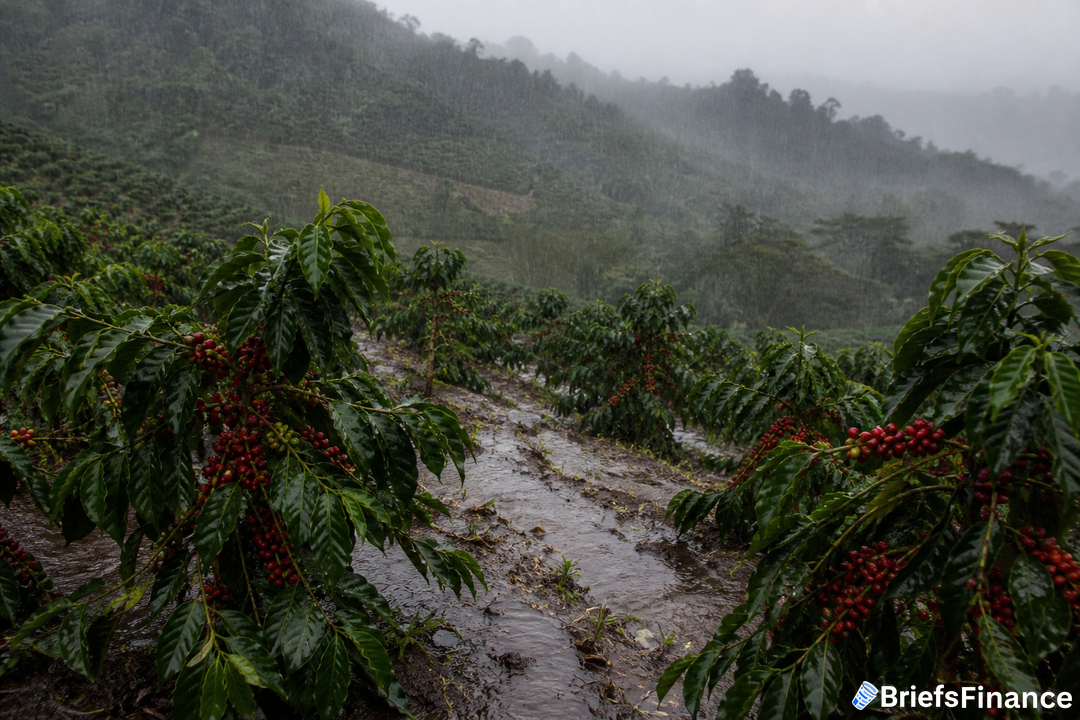
Brazil's Cerrado Mineiro region, located some 600 kilometers north of São Paulo, experienced heavy downpours during June and July. Rainfall in coffee areas ran 250% to 500% above normal, and some spots saw eight times their usual amount.

That sounds like good news for thirsty plants. It is not.

Coffee cherries that get knocked off the trees by heavy rain end up sitting on waterlogged soil. Some stayed wet for days. Beans that linger in that dampness start to ferment and develop defects, which ruins the delicate flavors that make fine arabica worth paying for.

"The vast majority of the fastest beans end up developing quality problems, resulting in coffee with a higher grade of fermentation, which significantly affects the beverage," said Simão de Lima, head of a coffee cooperative.

Rising coffee costs are a reminder to invest regularly, so get the free Always Be Buying E-Book for steady wealth

In a normal year, about 5% to 7% of the cherry crop falls to the ground. Lima expects losses around 20% this year. And an extra round of rain in July hit coffee that was already drying, forcing producers to start the drying process all over again.

"You have coffee that's already drying on the ground, then more rain falls on that coffee and you have to start staging all over again," Lima said.

What This Means for Prices

The damage is not just about quantity. It is about quality. Exchange-grade coffee - the stuff that can be traded on futures markets - has to pass professional tasters. It must be sound, not stale or unwashed, with good roasting characteristics and the right size and color.

Normally, about 30% to 35% of Brazil's coffee qualifies for those exchange standards. Lima estimates that this year, only 10% to 15% will make the cut.

That scarcity is showing up in the physical market, where top Brazilian coffee is fetching up to 15 cents per pound more than the New York futures price. Stockpiles in U.S. and European warehouses are shrinking, with global inventories near their lowest levels since the turn of the century.

The catch: even buyers who usually blend different coffee sources are competing for a smaller pool of premium beans. Companies like Starbucks and Lavazza have options - they can raise prices for their premium lines or mix in more lower-grade coffee. But there is only so much high-quality arabica to go around.

What It Means for Your Wallet

The upcoming harvest is expected to produce a bumper crop. That sounds reassuring, but it does not solve the quality problem.

Cristina Scoccella points out that some of the price increase is driven by market dynamics, not just quality issues. She said that well-funded farmers are not desperate to sell, which pushes prices higher.

Brazil's dominant position in the global arabica market means that even a modest drop in high-quality output can shift prices worldwide. When the supply of premium beans shrinks, roasters who need them for top-shelf offerings must compete aggressively, driving up costs for the most desirable lots.

For you, the buyer, this plays out in two ways. Premium coffee could get pricier as roasters pay up for scarce high-grade beans.

The good news is that the market is working. Higher prices encourage farmers to protect their crops and invest in better drying equipment. But for now, if you have a favorite specialty roast, it might be worth locking in a bag or two before the next harvest proves what this season's rain really cost.

Heavy rain in Brazil hurts coffee, but you can build wealth anyway with the Always Be Buying E-Book

Disclosure

Recent News

1 2 3 … 97

Get Market Briefs delivered to your inbox every morning for free!

No fluff. No noise. No politics. Just finance news you can read in 5 minutes.

Blogs

October 5, 2026
What Is the Briefs Connector? A Simple Guide
  • The Briefs Connector lets your favorite AI read Briefs research, like Pro reports and the Briefs Score.
  • Without it, an AI asked about investing can give answers that sound right but aren't backed by that research.
  • It explains the research, but it won't tell you what to buy or sell.
Read More
October 5, 2026
Is a Recession Coming? What the Last Five Rate Hiking Cycles Say
  • The Fed has started raising rates again, and in the last five hiking cycles going back to 1994, a recession never started while the hikes were underway.
  • The pain showed up where there was a bubble to pop - housing in 2008, dot-coms in 2000, the pandemic money-printing boom in 2022 - and usually after the hikes ended.
  • Private equity and private credit are feeling this cycle first, and how far the pain spreads depends on how high rates go and how long they stay there.
Read More
October 2, 2026
Fed Interest Rates May Rise Again in 2026 - and the Newest Culprit Is AI
  • Fed Governor Barr told a meeting our head of investing research attended that higher rates are likely in 2026, lower inflation may not come soon, and AI is now pushing prices up.
  • The same week, President Trump asked the biggest AI companies to police themselves under an accord that's morally but not legally binding, because the White House sees AI as a race with China.
  • Higher rates put downward pressure on asset prices and squeeze borrowers, but the way through hasn't changed: own investments, buy on a schedule, and treat downturns as discounts.
Read More
October 1, 2026
Housing Market 2026: Why Office Buildings Are Cracking Before Houses Do
  • Office buildings are selling for 80% to 95% off because their five-year loans are resetting at much higher rates while half-empty floors have gutted the income those buildings are valued on.
  • Housing is under pressure, not cracking: a $400,000 mortgage costs $975 more a month than at 3%, but six of every seven mortgages are still under 6% and those owners are staying put.
  • Whether pressure turns into cracks is a race between unaffordability and the economy, and either way Jaspreet's rule is to treat your house as a liability and buy only what you can afford.
Read More
September 30, 2026
Dividend Investing vs. Growth Investing: Why the Slower Portfolio Can End Up Bigger
  • "What stock should I buy?" is the wrong first question. Growth, income, or wealth preservation comes first, and the goal changes which stocks even make sense.
  • At $500 a month for 30 years, 13% growth builds about $1.75 million. 10% growth plus a reinvested 4% dividend builds a little more than $2.2 million and pays a little more than $80,000 a year.
  • Income investors have US dividend ETFs, REITs, and international dividend funds to study. Growth investors have the Nasdaq 100, AI and chip funds, and small caps. None of it is a recommendation.
Read More
September 29, 2026
Why Is Gold Going Down? A 5.2% Treasury Yield Just Took Its Job
  • President Trump rejected Iran's deal to reopen the Strait of Hormuz, oil prices jumped back up, and gold fell instead of rising.
  • Treasury yields hit their highest level in more than 20 years, so investors sold gold and bought Treasuries that pay interest.
  • Higher Treasury yields make the national debt, mortgages, car loans, and credit cards more expensive, with the Fed's next rate decision due October 28.
Read More
September 28, 2026
The Strategic Bitcoin Reserve: Why the Government Wants Bitcoin to Explode
  • The US government holds about 328,000 Bitcoin, worth roughly $25 billion, and since a 2025 executive order it keeps seized coins instead of selling them.
  • Washington wants a bigger pile of assets so its $40 trillion national debt looks smaller next to them, which lets it keep borrowing and spending.
  • Bitcoin's wild price swings, and a government holding a coin built to escape governments, are the two risks investors need to watch.
Read More
September 25, 2026
BRIEFS EXCLUSIVE: 43% Of Respondents Say Bills Outran Their Income Over Past Two Years
  • 43% of the 494 Market Briefs readers surveyed said their bills grew faster than their income over the past two years, even though 79% could cover a surprise $5,000 expense tomorrow.
  • Half of readers own gold or crypto, the two classic bets against a weaker dollar, and only 13% bought nothing at all in the last 12 months.
  • The median reader says it takes $150,000 a year to feel financially secure, about $62,000 above the U.S. median household income.
Read More
September 25, 2026
The Economy Is Booming. So Why Did Stocks and Bonds Fall Together?
  • S&P Global says the US economy is growing at its fastest rate since 2021, with corporate profits up 28.9% in a year, almost four times the historical average.
  • Stocks and bonds fell at the same time, which is not how the two markets normally behave, because Treasury yields above 5% now compete with stocks for investors' money.
  • Jaspreet Singh lays out three ways to invest through a shift like this: always be buying, buy the crash, or follow the money before it hits the headlines.
Read More
September 24, 2026
The 2026 Economic Reset Is Starting: Are We in a Recession, or Is the Pain Still Ahead?
  • The Federal Reserve has flipped from stimulating the economy to fighting inflation with higher interest rates, while the White House still wants growth at almost any cost.
  • The national debt tops $40 trillion, has outgrown the entire U.S. economy, and its interest payments are now the government's fastest-growing expense.
  • Higher rates bring pain for private equity, private credit, and speculative assets, but they open opportunities for investors holding cash, treasuries, and value assets.
Read More
1 2 3 … 28
Share via
Copy link










