Free NewsletterPro Login
S&P 500 6,287 +0.42%
DOW 44,521 -0.18%
NASDAQ 21,103 +0.71%

Warning: Undefined variable $funds in /var/www/briefs.co/htdocs/wp-content/plugins/oxygen/component-framework/components/classes/code-block.class.php(133) : eval()'d code on line 491

Warning: foreach() argument must be of type array|object, null given in /var/www/briefs.co/htdocs/wp-content/plugins/oxygen/component-framework/components/classes/code-block.class.php(133) : eval()'d code on line 491
/* the link was here */

U.S. Sanctions Worsen Fuel Shortages Behind Cuba's New Wave of Blackouts

Published Aug 3, 2026
[tts_player]
Share:
Summary:
  • Sunday night's grid failure was the fourth island-wide outage in a month.
  • President Miguel Díaz-Canel says seven months have brought just one fuel tanker and blames U.S. sanctions for the shortage.
  • Cuban officials say more than 70% of hotels are closed and more than 25,000 jobs are at risk.

The Grid Collapses Again

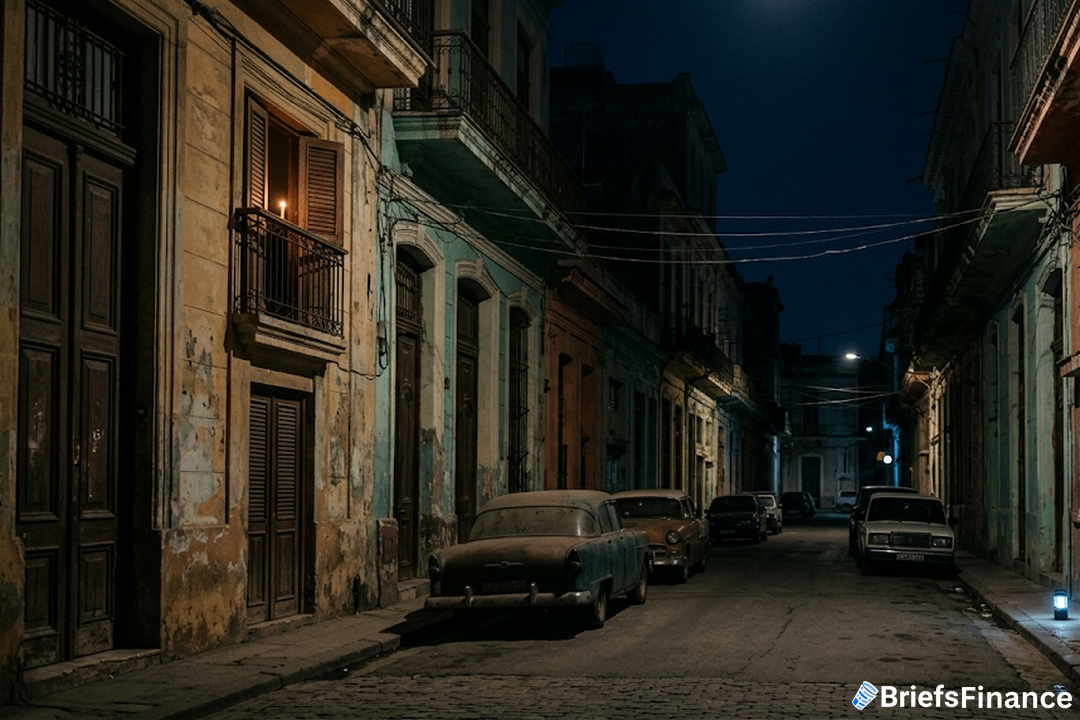
Shortly before 11 p.m. Sunday, Cuba's power grid gave out once more. The island also suffered full outages before Trump took office, but in recent weeks the blackouts have become far more frequent.

On Monday, Havana's energy ministry said three power plants had been restarted, but it has yet to explain what caused the latest failure. Earlier outages were attributed by the government to U.S. sanctions choking off fuel and spare parts, as well as to outdated infrastructure.

Sunday's failure was the fourth time in a month that the national grid went down. The rapid sequence of failures shows how vulnerable Cuba's electricity system has become as fuel imports dwindle and aging plants fail. Cuban officials have said fuel deliveries have all but stopped.

Outages on this scale were rare until recently. Cuba's electricity system depends heavily on imported fuel and has little capacity to absorb supply shocks. When tankers do not arrive, generators cannot run, and the grid loses stability across the island.

Get the market news that matters in a five-minute read with Market Briefs, our free daily newsletter

Cuba's current energy troubles are rooted in the same pressures: the island depends on imported fuel, its plants have not been able to get enough spare parts, and much of the infrastructure is outdated. The government says these conditions, made worse by sanctions, have left the grid with no margin for missed tanker deliveries.

Sanctions and Fuel Shortages

The United States followed up with a warning that any country shipping oil to Cuba would face punitive tariffs. The strategy includes blocking large fuel shipments meant for the Cuban government. After that, President Trump and Secretary of State Marco Rubio intensified their sanctions campaign, aiming to loosen the Communist Party's decades-long hold on power.

"The economic and social implications of this collective punishment are not humanly bearable," Díaz-Canel wrote on X.

Secretary of State Marco Rubio told Fox News this weekend: "They actually are an influence and espionage superpower."

Separate from the sanctions push, in May the Justice Department charged former Cuban President Raúl Castro with murder in connection with the 1996 downing of civilian aircraft. The State Department also said last month that Havana had long sought to foment anti-American sentiment inside the United States and elsewhere.

Hotels Closed and Jobs at Risk

Cuba's economy is being battered by the lack of electricity. According to Cuban officials, more than 70 percent of hotels on the island are closed and more than 25,000 jobs are at risk. Most of those positions depend on hotels, which cannot function without steady electricity.

Cuba introduced more than 175 pro-market reforms in June, but U.S. officials were skeptical that the government would truly change direction. Díaz-Canel and his government insist the island's political system is not negotiable.

The government has repeatedly blamed the sanctions for the fuel shortage, saying the policy amounts to collective punishment against ordinary Cubans. Cuban officials say seven months have brought just one fuel tanker, leaving the island without enough fuel to keep its economy running. With hotels closed, the tourism sector is absorbing much of the economic pain caused by the blackouts.

Join Market Briefs, our free daily newsletter, for a quick daily rundown of the markets
Disclosure

Recent News

1 2 3 47

Get Market Briefs delivered to your inbox every morning for free!

No fluff. No noise. No politics. Just finance news you can read in 5 minutes.

Blogs

June 29, 2026
Portfolio Diversification: Why Putting All Your Eggs in One Basket Destroys Wealth
  • Real diversification means spreading investments across all 11 economic sectors plus bonds, alternatives, and cash so no single bet can sink the portfolio.
  • Different sectors perform at different times, so a diversified portfolio captures upswings while smoothing the brutal drawdowns that wipe out concentrated bets.
  • Total market index funds offer the simplest path to diversification, and annual rebalancing is what keeps the structure working over time.
Read More
June 29, 2026
Non Taxable Income: What It Is and Why It Matters
  • Non taxable income is money you receive that you don't owe income tax on.
  • The tax code treats workers, investors, and business owners very differently, and investors often come out ahead.
  • Learning how income is taxed is a quiet superpower for keeping more of what you earn.
Read More
June 29, 2026
Semiconductor Stocks: A Simple Guide for Investors
  • Semiconductor stocks are companies that design and make computer chips, the brains inside nearly every modern device.
  • The AI boom has turned chips into one of the market's most important and most watched groups.
  • They offer big growth potential, but come with high valuations and a notoriously cyclical history.
Read More
June 25, 2026
How Stocks Work: A Simple Guide for Beginners
  • A stock is a slice of ownership in a company - buy one, and you own a piece of the business.
  • You make money two ways: the share price rising over time, and dividends paid to shareholders.
  • The simplest path for most beginners is buying into the whole market through a low-cost index fund.
Read More
June 25, 2026
Stop Loss vs Stop Limit: What's the Difference?
  • A stop loss order sells your stock once it hits a trigger price, prioritizing getting you out.
  • A stop limit order only sells within a price range you set, prioritizing price over a guaranteed exit.
  • The trade-off: a stop loss almost always executes; a stop limit might not if the price moves too fast.
Read More
June 25, 2026
Energy Stocks: A Simple Guide for Investors
  • Energy stocks are companies that produce and supply the power the world runs on, from oil and gas to newer sources.
  • They make up one of the 11 sectors of the market and tend to move with energy prices and big-picture shifts.
  • Like any sector, the key is diversification and understanding the forces driving demand.
Read More
June 18, 2026
What Is a Stop Loss Order? A Simple Guide
  • A stop loss order automatically sells a stock once it falls to a price you set.
  • It's a tool to cap losses or lock in gains without watching the market all day.
  • It works best for active strategies, and can backfire if used carelessly on long-term holdings.
Read More
June 18, 2026
Best S&P 500 Index Fund: How to Choose One
  • The best S&P 500 index fund for most investors is simply the cheapest, most established one that tracks the index well.
  • Funds like VOO, IVV, and SPY all hold the same 500 companies, so the biggest difference is the fee.
  • Pick one, automate your buys, and let time do the heavy lifting.
Read More
June 17, 2026
What Are Penny Stocks? Risks and Rewards Explained
  • Penny stocks are very low-priced shares of very small companies, often trading for just a few dollars or less.
  • They promise huge gains but carry huge risks: low liquidity, high failure rates, and wild price swings.
  • Most investors are better served by quality companies and funds than by chasing cheap shares.
Read More
June 17, 2026
Best Stocks for Beginners With Little Money
  • The best stocks for beginners with little money usually aren't individual stocks at all - they're low-cost index funds.
  • You can start with $100 or less and use small, regular investments to build wealth over time.
  • Focus on diversification and consistency, not on picking the next big winner.
Read More
1 2 3 24
Share via
Copy link











