Free NewsletterPro Login
S&P 500 6,287 +0.42%
DOW 44,521 -0.18%
NASDAQ 21,103 +0.71%
S&P 500 +12.4%
Briefs Finance Fund +24.8%
JOIN THE FUND →

Moscow Weighs Putting Weapons on Grain Ships to Counter Drone Threats

Published Jul 28, 2026
[tts_player]
Share:
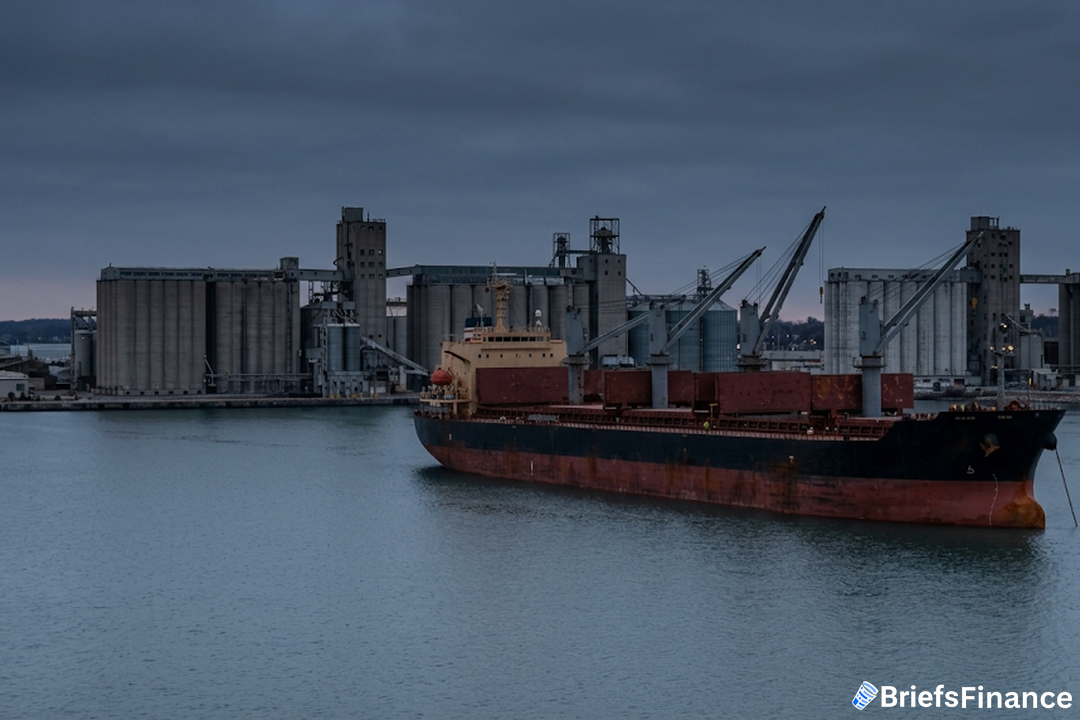
Bulk grain cargo ship anchored in a harbor at overcast dusk beside grain silos
Summary:
  • Russia intends to outfit grain ships with light firearms and portable anti-aircraft systems, along with naval escorts, to counter drone attacks.
  • Commercial grain shipments in the Sea of Azov have been halted since July 10, driving wheat prices to a two-year high.
  • Monthly Russian grain exports could drop by 0.5 to 1.5 million metric tons if Azov restrictions continue.

Armed Escorts for Grain Ships

Approximately one-fourth of Russia's grain exports pass through the Sea of Azov under normal conditions. But that trade has come to a complete stop.

That is roughly two weeks of silence in a waterway that moves millions of tons of food.

Now Russian officials are floating an unusual solution: arm the ships themselves. Representatives of the defense and transport ministries are in discussions with grain companies and shipping lines about equipping commercial vessels with small arms and portable anti-aircraft systems, along with arranging navy escorts.

Kremlin spokesman Dmitry Peskov said, "Russia's navy can protect commercial ships," and added that President Vladimir Putin "views attacks on merchant vessels as piracy." According to analytics firm Logistic OS, vessel movements at Russian ports on the Azov Sea are at a standstill.

Get the market news that matters in a five-minute read with Market Briefs, our free daily newsletter

Meanwhile, the strikes are not one-sided. Ukraine's own grain shipments from its Black Sea ports in Odesa were also halted last week after Russian attacks. Both sides have been hitting each other's commercial ships and port infrastructure in the Black Sea for the past two weeks.

Wheat Prices Jump as Supply Fears Grow

Russia is one of the world's biggest wheat exporters. When a quarter of its grain route shuts down, the world feels it. Moscow has already labeled the Black Sea as hazardous for maritime traffic and is offering rail subsidies to divert shipments toward alternative harbors.

The proposed arming of grain ships is getting a skeptical reception from the people who would have to pay for it. Some shippers and traders question whether mounting machine guns on a cargo vessel is a realistic solution. They also warn it could get expensive.

Broader Impact and Alternatives

To mitigate the disruption, Russia's rail subsidies aim to reroute grain to alternative ports such as those on the Black Sea ports. However, shifting large volumes overland is costly and time-consuming, and port capacity elsewhere is limited. The dual nature of the conflict - with both sides striking commercial shipping - raises fears of a prolonged standoff in the Black Sea basin, which could further squeeze global wheat supplies and keep prices elevated.

The Sea of Azov has been a flashpoint since the start of the broader war. Ukraine has targeted Russian vessels in retaliation for Russia's blockade of Ukrainian ports, and the recent escalation marks a dangerous phase where commercial shipping is directly in the crosshairs. This tit-for-tat pattern risks disrupting global food supply chains far beyond the immediate region.

The conflict in the Black Sea region has escalated since Russia's invasion of Ukraine in 2022, with both sides using naval drones and missiles to strike maritime targets. The recent focus on grain vessels threatens a key global food supply corridor, recalling earlier disruptions from the collapse of the Black Sea Grain Initiative. Without a diplomatic solution, the standoff could persist, keeping markets on edge.

The proposal to militarize merchant vessels, while novel, introduces complex legal and insurance challenges that have yet to be addressed by international maritime authorities. Any escalation could further destabilize an already fragile global food supply chain, especially for nations dependent on Russian wheat imports.

Join Market Briefs, our free daily newsletter, for a quick daily rundown of the markets
Disclosure

Recent News

1 2 3 44

Get Market Briefs delivered to your inbox every morning for free!

No fluff. No noise. No politics. Just finance news you can read in 5 minutes.

Blogs

June 29, 2026
Portfolio Diversification: Why Putting All Your Eggs in One Basket Destroys Wealth
  • Real diversification means spreading investments across all 11 economic sectors plus bonds, alternatives, and cash so no single bet can sink the portfolio.
  • Different sectors perform at different times, so a diversified portfolio captures upswings while smoothing the brutal drawdowns that wipe out concentrated bets.
  • Total market index funds offer the simplest path to diversification, and annual rebalancing is what keeps the structure working over time.
Read More
June 29, 2026
Non Taxable Income: What It Is and Why It Matters
  • Non taxable income is money you receive that you don't owe income tax on.
  • The tax code treats workers, investors, and business owners very differently, and investors often come out ahead.
  • Learning how income is taxed is a quiet superpower for keeping more of what you earn.
Read More
June 29, 2026
Semiconductor Stocks: A Simple Guide for Investors
  • Semiconductor stocks are companies that design and make computer chips, the brains inside nearly every modern device.
  • The AI boom has turned chips into one of the market's most important and most watched groups.
  • They offer big growth potential, but come with high valuations and a notoriously cyclical history.
Read More
June 25, 2026
How Stocks Work: A Simple Guide for Beginners
  • A stock is a slice of ownership in a company - buy one, and you own a piece of the business.
  • You make money two ways: the share price rising over time, and dividends paid to shareholders.
  • The simplest path for most beginners is buying into the whole market through a low-cost index fund.
Read More
June 25, 2026
Stop Loss vs Stop Limit: What's the Difference?
  • A stop loss order sells your stock once it hits a trigger price, prioritizing getting you out.
  • A stop limit order only sells within a price range you set, prioritizing price over a guaranteed exit.
  • The trade-off: a stop loss almost always executes; a stop limit might not if the price moves too fast.
Read More
June 25, 2026
Energy Stocks: A Simple Guide for Investors
  • Energy stocks are companies that produce and supply the power the world runs on, from oil and gas to newer sources.
  • They make up one of the 11 sectors of the market and tend to move with energy prices and big-picture shifts.
  • Like any sector, the key is diversification and understanding the forces driving demand.
Read More
June 18, 2026
What Is a Stop Loss Order? A Simple Guide
  • A stop loss order automatically sells a stock once it falls to a price you set.
  • It's a tool to cap losses or lock in gains without watching the market all day.
  • It works best for active strategies, and can backfire if used carelessly on long-term holdings.
Read More
June 18, 2026
Best S&P 500 Index Fund: How to Choose One
  • The best S&P 500 index fund for most investors is simply the cheapest, most established one that tracks the index well.
  • Funds like VOO, IVV, and SPY all hold the same 500 companies, so the biggest difference is the fee.
  • Pick one, automate your buys, and let time do the heavy lifting.
Read More
June 17, 2026
What Are Penny Stocks? Risks and Rewards Explained
  • Penny stocks are very low-priced shares of very small companies, often trading for just a few dollars or less.
  • They promise huge gains but carry huge risks: low liquidity, high failure rates, and wild price swings.
  • Most investors are better served by quality companies and funds than by chasing cheap shares.
Read More
June 17, 2026
Best Stocks for Beginners With Little Money
  • The best stocks for beginners with little money usually aren't individual stocks at all - they're low-cost index funds.
  • You can start with $100 or less and use small, regular investments to build wealth over time.
  • Focus on diversification and consistency, not on picking the next big winner.
Read More
1 2 3 24
Share via
Copy link











