Free NewsletterPro Login
S&P 500 6,287 +0.42%
DOW 44,521 -0.18%
NASDAQ 21,103 +0.71%
S&P 500 +12.4%
Briefs Finance Fund +24.8%
JOIN THE FUND →

Five States Offer to Host Spent Fuel Sites as Nuclear Revival Gains Steam

Published Jul 29, 2026
[tts_player]
Share:
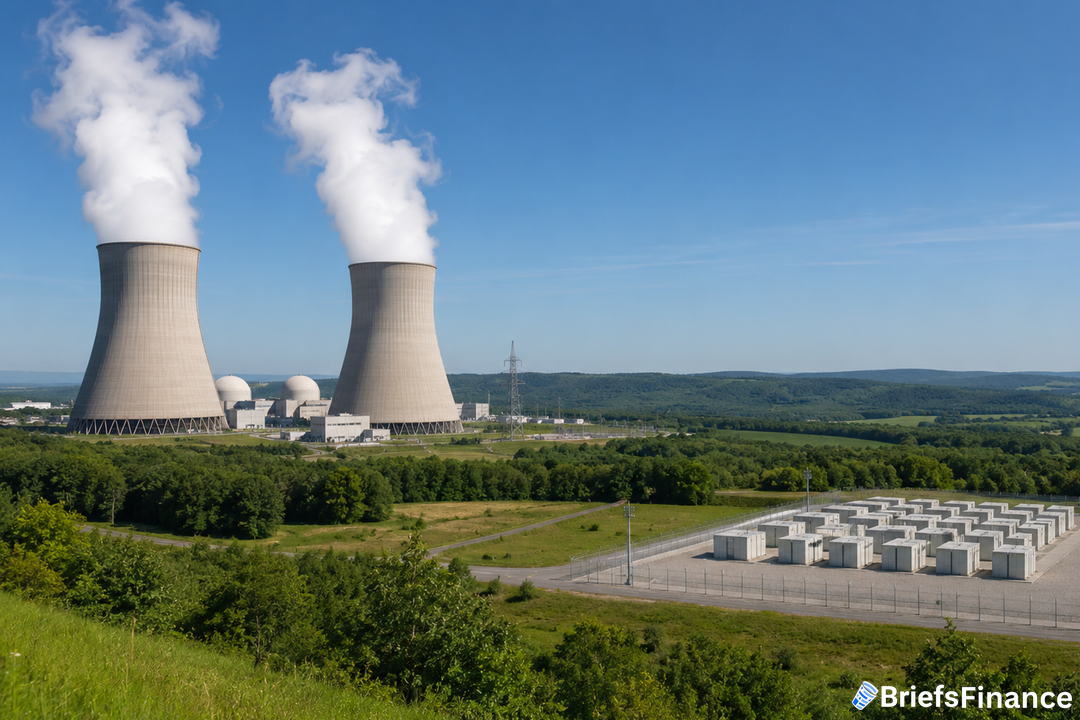
Nuclear plant cooling towers venting steam beside a fenced dry cask storage pad
Summary:
  • Tennessee, Utah, Louisiana, Idaho, and Oklahoma have volunteered to host nuclear waste campuses in exchange for federal support.
  • The U.S. currently stores over 95,000 metric tons of spent reactor fuel, a volume expected to nearly double in the coming decades.
  • These planned centers could attract private capital of up to $50 billion and produce around $10 billion in tax income for states and localities.

The Waste Problem That Won't Go Away

Nuclear power plants produce waste.

The problem is that there is no permanent home for any of it.

In 1987, Congress selected Yucca Mountain in Nevada as the country's permanent storage site for nuclear waste. Yet political resistance over many years has blocked that project. Since then, spent fuel has been kept at reactor sites in cooling pools and dry casks - a temporary fix that the government has long sought to replace.

Now the government is trying a different approach. Five states - Tennessee, Utah, Louisiana, Idaho, and Oklahoma - have offered to host nuclear waste on their own soil.

Ted Garrish, assistant secretary for nuclear energy at the Energy Department, called it "a new way of thinking about nuclear."

Get the market news that matters in a five-minute read with Market Briefs, our free daily newsletter

What's in It for the Host States

The idea is to make waste storage more appealing by bundling it with things states actually want: jobs, tax revenue, and a piece of the nuclear energy revival.

Energy Secretary Chris Wright said the campuses "will be massive generators of economic growth, create thousands of high-paying jobs, and be crucial to unleashing America's nuclear renaissance."

There is also a national push on the table.

The Catch: Laws and Limits

Here is where the plan gets tricky. A 1987 federal law dictates that commercial nuclear waste may be disposed of only at Yucca Mountain. To implement these state-level agreements, Congress must pass new legislation that overrides that restriction.

There is also the question of what to do with the waste once it arrives. The U.S. does not have any commercial-scale fuel reprocessing facilities currently operating, though several companies want to build them.

Edwin Lyman, a nuclear safety specialist at the Union of Concerned Scientists, said the plan is "an attempt to try and package the unpalatable task of trying to find a radioactive waste disposal site for all the country's spent fuel by packaging it with other activities that are more appealing." He argued that "there is not an alternative for safe disposal of spent nuclear fuel other than a mined geological repository."

The agreements are non-binding. As per the agreement, each state would establish a Nuclear Lifecycle Innovation Campus, encompassing waste storage along with uranium enrichment, reprocessing of spent fuel, and fuel production. Additionally, these campuses could accommodate advanced reactor rollouts, electricity generation, and data center operations.

Currently, the nation holds more than 95,000 metric tons of used reactor fuel spread across 30 states, and the Energy Department projects that figure will almost double over the next few decades. That growing stockpile gives added urgency to finding a long-term solution.

Join Market Briefs, our free daily newsletter, for a quick daily rundown of the markets
Disclosure

Recent News

1 2 3 44

Get Market Briefs delivered to your inbox every morning for free!

No fluff. No noise. No politics. Just finance news you can read in 5 minutes.

Blogs

June 29, 2026
Portfolio Diversification: Why Putting All Your Eggs in One Basket Destroys Wealth
  • Real diversification means spreading investments across all 11 economic sectors plus bonds, alternatives, and cash so no single bet can sink the portfolio.
  • Different sectors perform at different times, so a diversified portfolio captures upswings while smoothing the brutal drawdowns that wipe out concentrated bets.
  • Total market index funds offer the simplest path to diversification, and annual rebalancing is what keeps the structure working over time.
Read More
June 29, 2026
Non Taxable Income: What It Is and Why It Matters
  • Non taxable income is money you receive that you don't owe income tax on.
  • The tax code treats workers, investors, and business owners very differently, and investors often come out ahead.
  • Learning how income is taxed is a quiet superpower for keeping more of what you earn.
Read More
June 29, 2026
Semiconductor Stocks: A Simple Guide for Investors
  • Semiconductor stocks are companies that design and make computer chips, the brains inside nearly every modern device.
  • The AI boom has turned chips into one of the market's most important and most watched groups.
  • They offer big growth potential, but come with high valuations and a notoriously cyclical history.
Read More
June 25, 2026
How Stocks Work: A Simple Guide for Beginners
  • A stock is a slice of ownership in a company - buy one, and you own a piece of the business.
  • You make money two ways: the share price rising over time, and dividends paid to shareholders.
  • The simplest path for most beginners is buying into the whole market through a low-cost index fund.
Read More
June 25, 2026
Stop Loss vs Stop Limit: What's the Difference?
  • A stop loss order sells your stock once it hits a trigger price, prioritizing getting you out.
  • A stop limit order only sells within a price range you set, prioritizing price over a guaranteed exit.
  • The trade-off: a stop loss almost always executes; a stop limit might not if the price moves too fast.
Read More
June 25, 2026
Energy Stocks: A Simple Guide for Investors
  • Energy stocks are companies that produce and supply the power the world runs on, from oil and gas to newer sources.
  • They make up one of the 11 sectors of the market and tend to move with energy prices and big-picture shifts.
  • Like any sector, the key is diversification and understanding the forces driving demand.
Read More
June 18, 2026
What Is a Stop Loss Order? A Simple Guide
  • A stop loss order automatically sells a stock once it falls to a price you set.
  • It's a tool to cap losses or lock in gains without watching the market all day.
  • It works best for active strategies, and can backfire if used carelessly on long-term holdings.
Read More
June 18, 2026
Best S&P 500 Index Fund: How to Choose One
  • The best S&P 500 index fund for most investors is simply the cheapest, most established one that tracks the index well.
  • Funds like VOO, IVV, and SPY all hold the same 500 companies, so the biggest difference is the fee.
  • Pick one, automate your buys, and let time do the heavy lifting.
Read More
June 17, 2026
What Are Penny Stocks? Risks and Rewards Explained
  • Penny stocks are very low-priced shares of very small companies, often trading for just a few dollars or less.
  • They promise huge gains but carry huge risks: low liquidity, high failure rates, and wild price swings.
  • Most investors are better served by quality companies and funds than by chasing cheap shares.
Read More
June 17, 2026
Best Stocks for Beginners With Little Money
  • The best stocks for beginners with little money usually aren't individual stocks at all - they're low-cost index funds.
  • You can start with $100 or less and use small, regular investments to build wealth over time.
  • Focus on diversification and consistency, not on picking the next big winner.
Read More
1 2 3 24
Share via
Copy link











