Free NewsletterPro Login

Warning: Undefined variable $stocks in /var/www/briefs.co/htdocs/wp-content/plugins/oxygen/component-framework/components/classes/code-block.class.php(133) : eval()'d code on line 448

Warning: foreach() argument must be of type array|object, null given in /var/www/briefs.co/htdocs/wp-content/plugins/oxygen/component-framework/components/classes/code-block.class.php(133) : eval()'d code on line 448

Warning: Undefined variable $funds in /var/www/briefs.co/htdocs/wp-content/plugins/oxygen/component-framework/components/classes/code-block.class.php(133) : eval()'d code on line 472

Warning: foreach() argument must be of type array|object, null given in /var/www/briefs.co/htdocs/wp-content/plugins/oxygen/component-framework/components/classes/code-block.class.php(133) : eval()'d code on line 472
/* the link was here */
×
Free investor livestream — Nov 17

How To Use ChatGPT & Claude To Research Stocks Like A Pro

01
The prompt we use to break down any stock
02
How to fact-check what AI tells you
03
How to compare two stocks in minutes

Heating oil surge is squeezing Maine households as winter nears

Published Nov 14, 2026
Share:
Summary:
  • National heating oil averaged $5.91 a gallon on Nov. 9, up $2.19 year over year, a 59% jump.
  • Maine averaged $5.83 a gallon, up $2.49, roughly 75% higher than a year ago.
  • About half of Maine homes use heating oil, magnifying the hit to budgets.

Prices up, cushions thin

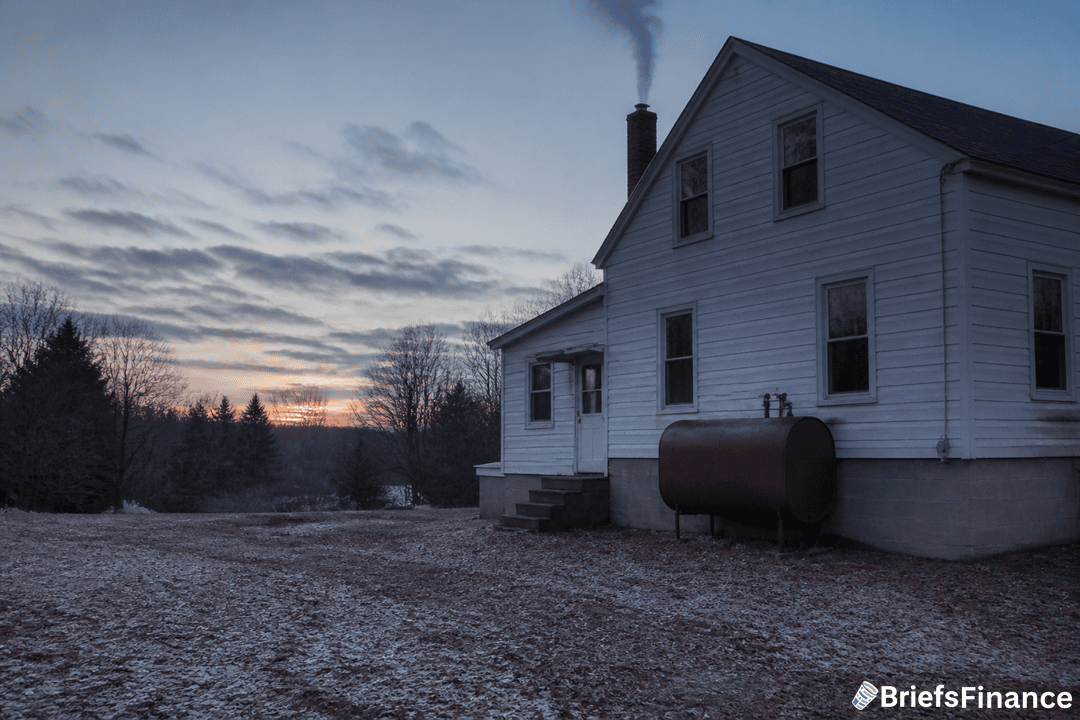
Heating oil users are staring at steeper winter tabs. The U.S. Energy Information Administration put the national average at $5.91 per gallon on Nov. 9, up $2.19 from a year earlier, a 59% leap. Maine sat at $5.83, up $2.49, or about 75%, and roughly 50% of homes there rely on oil heat.

Jason Parent, CEO of AVEC Community Action in Presque Isle, said the spike "is crushing folks," with some facing empty tanks or resorting to unsafe backup heat. He added that years of broad inflation have already squeezed budgets: "The cost of living has made it impossible for households who had been figuring out how to get by without [financial help]." Contributing factors include constrained worldwide supplies of products such as heating oil and diesel, disruptions linked to the Iran war and the Russia Ukraine war, depleted stockpiles, and too little refining capability, all of which are lifting prices, the Federal Reserve Bank of Kansas City noted in recent research. The EIA expects a warmer Northeast winter to curb usage, which would help offset higher prices.

Deliveries and the aid pipeline

Oil heat is delivered in bulk, not metered like electricity or natural gas, and some dealers set minimums or add fees for small drops. The Maine attorney general's office says a standard 275 gallon tank can typically avoid a surcharge by ordering at least 100 gallons. At current prices, that is about $600.

In its October outlook, the EIA projected that a typical oil heated home would face $2,115 in costs between November and March, roughly 21% above last winter. Nationally, homes mainly using natural gas are projected to spend $640, down 9%, propane users $1,246, down 3%, and electricity users $1,196, up 4%.

About 4.1 million U.S. households primarily heat with oil, and close to 3.4 million are in the Northeast. In Maine, AVEC delivers Home Energy Assistance Program aid across three of the state's 16 counties. HEAP draws money from the federal Low Income Home Energy Assistance Program administered by the U.S. Health and Human Services Department, with state agencies supervising partnerships with local groups such as AVEC.

Eligibility is based primarily on income and household size. Its Energy Crisis Intervention Program assists eligible households during emergencies, for example when electricity is about to be disconnected or the oil tank is empty and there's no way to refill it. AVEC began taking crisis calls on Nov. 2.

"In the first hour alone, there were 150 voicemail messages on our emergency fuel line," Parent said. "People were in crisis before the program opened up."

When costs bite household budgets, investors look for smarter tools to stay prepared. We're hosting our first ever investor livestream on 11/17 to show you how to use ChatGPT and Claude to invest like a pro, hosted by Briefs Finance CEO Jaspreet Singh. Save your seat.

Households on the edge

For Catherine Lafleche of Hersey, Maine, AVEC has been a lifeline. Now 65, she cares for two grandchildren who are 11 and 6, and after shattering her upper arm in April - an injury that led to reverse shoulder replacement surgery - she relies largely on about $1,100 per month from Social Security together with state guardianship assistance. Before the fall, she had jobs as a substitute teacher and a bookkeeper. "I'm $6,000 short of income at this point in the year," she said.

Hersey sits in Aroostook County, where January and February average highs are in the 20s and lows in the single digits, and last winter brought brutal stretches - for instance, on Jan. 24 the day's high was 2 degrees Fahrenheit below zero. In August, Lafleche submitted a HEAP application via AVEC, yet a backlog could have pushed her appointment to November. She ran out of oil in early October and used a small wood stove, burning Amazon boxes from neighbors because she lacked firewood.

Late in October, a staffer from AVEC phoned and explained that a charitable gift would pay for 100 gallons. "When the oil man came, I cried," Lafleche said.

Policy moves and what could change

Outgoing Republican Sen. Susan Collins said that, in October, Maine and tribal grantees received about $38 million through LIHEAP. Parent noted that AVEC manages about $4 million of those funds via HEAP, while local fundraising also helps residents pay for heat. This season, the typical HEAP award distributed by AVEC comes to about $750 per household this season, an increase from roughly $550 a year ago, though it stretches to fewer gallons at current prices. Payments typically go directly to fuel suppliers as a credit, and funds can be depleted.

The impact hinges on how quickly it is distributed, said Jonathan Rubin of the University of Maine. A one month release could be about 10% to 12% of that month's supply, whereas, spread across the season, the total would be roughly one and a half percent. "I would say that this is a modest short term buffer," he said.

Lawmakers are also pressing for more LIHEAP dollars. Dozens of House members, mostly Democrats, sought an additional $3 billion via a letter dated Oct. 14 to the House Appropriations Committee, following an Oct. 1 letter from Democratic senators and Sen. Bernie Sanders, I Vt., to Health and Human Services Secretary Robert F. Kennedy Jr. asking for at least $3 billion more.

What this means for your money

In plain English: higher per gallon prices plus bulk delivery rules mean lumpier, bigger bills. The EIA pegs an average $2,115 winter for oil heated homes, while a 100 gallon minimum order in Maine runs about $600. Aid is flowing, but AVEC's early surge of crisis calls and Parent's warning on funding limits point to timing and scale as real constraints. Energy prices, weather, and policy moves like LIHEAP funding and the Northeast reserve release will shape regional spending and could ripple through companies tied to refined fuels, utilities, and Northeast consumer demand.

Understanding trends and using better tools can help investors protect and grow capital. On 11/17, our CEO Jaspreet Singh goes live for our first ever investor livestream on how to use ChatGPT and Claude to invest like a pro. Register to join him.

Disclosure

Recent News

1 2 3 … 127

Get Market Briefs delivered to your inbox every morning for free!

No fluff. No noise. No politics. Just finance news you can read in 5 minutes.

Blogs

November 14, 2026
Nvidia News: Jensen Huang Is Out, and the "Bank" Behind American AI Just Lost Its Founder
  • Jensen Huang is out at Nvidia over affairs with multiple people, and the company he founded has been the bank of American AI, with about $30 billion into OpenAI and $10 billion into Anthropic.
  • A hotter-than-expected inflation report has Fed officials talking about a possible 0.5% hike in December, and gold, silver, and bitcoin fell on the news.
  • President Trump said the US may not need a deal with Iran, keeping oil prices and inflation risk high. Jaspreet Singh breaks down what it all means for AI stocks and your portfolio.
Read More
November 14, 2026
Record Highs, a 57-Year Low in Jobless Claims, and a Stock Market Bubble: Inside the Weirdest Market in History
  • Stocks are booming at the fastest pace in years, jobless claims just hit a 57-year low, and most investors still feel like nobody is hiring.
  • The Fed is protecting the dollar over the economy, oil swings on every Iran headline, and a few AI companies are carrying an S&P 500 where four of five stocks sit in a correction.
  • Jaspreet Singh explains why circular financing between Nvidia, OpenAI, Anthropic, and SpaceX rhymes with 2008's house of cards, and how his three investing pillars handle a stock market bubble.
Read More
November 14, 2026
Is a Recession Coming? The Fed Just Made a U-Turn It Has Only Made Twice in 60 Years
  • The Fed has raised rates, cut them, then raised them again only twice in the last 60 years, and both times the economy fell into a recession and stocks crashed.
  • The same stop-and-go cycle is playing out now, with one big difference: US debt is 125% of GDP today versus about 30% in 1980.
  • In the 1970s gold rose roughly 24x, real estate 157%, stocks lagged, and cash lost half its value. Jaspreet Singh lays out five assets to consider before the next flip.
Read More
November 14, 2026
The 2027 Tax Brackets Are Out: How Some Investors Can Earn $135,300 and Pay $0
  • The IRS 2027 tax plan keeps the same seven rates but widens every bracket and lifts the married-filing-jointly standard deduction to $33,200.
  • The 0% long-term capital gains bracket rises to $102,100, so a household living on $135,300 of investment income could owe $0 in federal income tax.
  • C corporations still pay 21%, small businesses keep the 20% QBI deduction, and the 401(k) limit climbs to $25,500 with an $8,500 catch-up for investors over 50.
Read More
November 14, 2026
Rare Earth Stocks: Why China's January 2027 Ban Could Be the Opportunity of the Decade
  • China plans to block rare earth exports to the US on January 10, 2027, and the US produces effectively zero of the 17 metals that go into phones, cars, dishwashers, and missiles.
  • When China cut off Japan in 2010 and squeezed Germany from 2015, some rare earth prices jumped 18x and 15x, and one rare earth company went bankrupt while another soared.
  • Washington is already putting billions into MP Materials, Vulcan, and a stockpile called Project Vault, and Jaspreet Singh walks through how investors can get exposure to rare earth stocks and ETFs.
Read More
November 14, 2026
Divided Government Just Changed Where the Money Moves: 5 Market Shifts After the Midterms
  • Democrats took control of Congress, setting up a divided government with a Republican White House, and the biggest spender in the economy is about to change where it spends.
  • The day after the election the market had one of its best days of 2026 while AI stocks, Tesla, and SpaceX fell and clean energy, healthcare, treasuries, gold, and silver rose.
  • Jaspreet Singh maps the five places money is already moving and the history that says stocks rose in the 12 months after each of the last 19 midterms.
Read More
November 14, 2026
Buy the Dip or Run? What the Market's Worst Day in Years Is Telling Investors
  • The stock market posted its worst day in years one day after its best day of 2026, splitting investors into a buy-the-dip camp and a this-time-is-different camp.
  • The Fed rescued markets in 2000, 2008, and 2020, but inflation is already a problem and the Fed has committed to protecting the dollar instead of the stock market.
  • Jaspreet Singh explains why nothing material changed in 48 hours and lays out a phased way to buy the dip without betting everything at once.
Read More
November 14, 2026
The AI Bubble Isn't Jamie Dimon's Biggest Worry. The Credit Crisis Behind It Is.
  • Jamie Dimon, CEO of America's biggest bank, told Bloomberg his real concern isn't the AI bubble but the borrowing behind it, because the market "will ask for more and more and more."
  • Credit spreads sit near 1.5%, a level last seen in February 2007 and January 2000, right before the last two bubbles burst.
  • Credit crises move in five stages, from boom to pullback, and Briefs Finance CEO Jaspreet Singh maps where 2026 sits and how investors can prepare.
Read More
November 3, 2026
How to Budget Every Payday: 5 Moves So You Never Worry About Money
  • A median earner could make about $4.7 million over a career, yet most retire with closer to $13,000 in the bank because of a keeping problem, not an income problem.
  • Audit your money, save $2,000, pay off credit card debt, then automate a 75/15/10 split across three bank accounts.
  • Earn more only after your system is in place, then protect what you build with an accountant, attorneys, the right insurance, and an estate plan.
Read More
November 3, 2026
How to Invest in Stocks: 5 Things to Do Before You Invest Your First Dollar
  • Paying off credit card debt at around 22% interest beats the stock market's roughly 10% average, and even Warren Buffett's 19%.
  • Save $2,000 in a separate emergency fund, learn to research with AI, and decide whether you're a growth, income, or wealth preservation investor.
  • Write down a plan for buying during market crashes, which have happened 25 times in the last 100 years.
Read More
1 2 3 … 32
Share via
Copy link