Free NewsletterPro Login

Warning: Undefined variable $stocks in /var/www/briefs.co/htdocs/wp-content/plugins/oxygen/component-framework/components/classes/code-block.class.php(133) : eval()'d code on line 448

Warning: foreach() argument must be of type array|object, null given in /var/www/briefs.co/htdocs/wp-content/plugins/oxygen/component-framework/components/classes/code-block.class.php(133) : eval()'d code on line 448

Warning: Undefined variable $funds in /var/www/briefs.co/htdocs/wp-content/plugins/oxygen/component-framework/components/classes/code-block.class.php(133) : eval()'d code on line 472

Warning: foreach() argument must be of type array|object, null given in /var/www/briefs.co/htdocs/wp-content/plugins/oxygen/component-framework/components/classes/code-block.class.php(133) : eval()'d code on line 472
/* the link was here */

Paris's Wildest Roundabout Becomes a Real-World Exam for Robot Drivers

Published Oct 17, 2026
Share:
Summary:
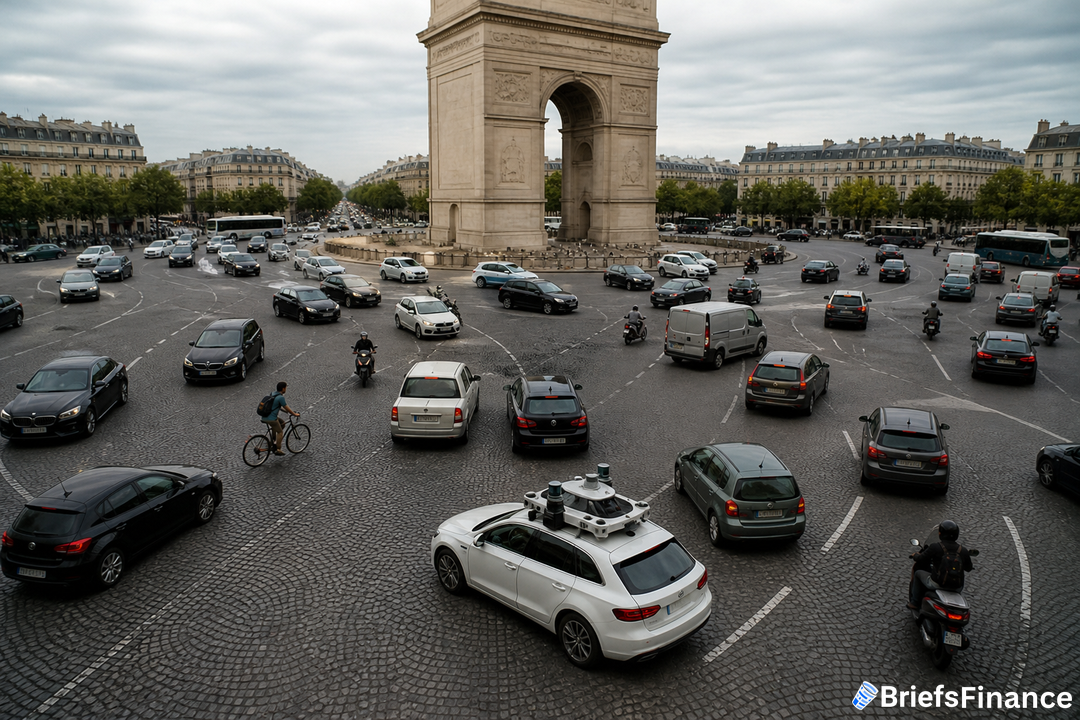
  • Paris's Arc de Triomphe rotary funnels traffic from 12 avenues and gives priority to vehicles entering the swirl, a recipe that tests any driver-assist system.
  • Three demo drives showed contrasts: a Jaecoo 7 with Momenta's R7 handled a complex, roughly hour-long route without a takeover, Tesla's supervised tech needed one intervention on an eight minute tryout, and Xpeng's LO3 ran the most by-the-book.
  • Europe is edging toward driverless service more slowly than the US and China, with limited trials under way and key systems still waiting on approvals.

Why this Paris circle breaks brains - human and machine

The traffic circle flanking the Arc de Triomphe pulls in a dozen avenues and lets newcomers entering the flow go first, while lane lines vanish and every kind of vehicle hunts for openings. That mix of squeeze plays, start and stop moves, and surprise cyclists is exactly where automation gets stretched, because local rules and lived reality do not always match what a map or model anticipates.

Against that backdrop, a Jaecoo 7 SUV using Momenta Global's automated driving tech slipped through the mess, looped the circle, and chose an exit without asking for help.

What each system did on Paris streets

These were separate drives around the Paris Motor Show, not a lab test, and the routes varied. Still, the differences were clear.

Chery Automobile's Jaecoo 7 ran Momenta's R7 driving model and took on the Arc de Triomphe during the busiest part of the route. It finished the longer, more complex outing without a single intervention. Not perfect, though.

Without countdown timers, it sometimes jabbed the brakes at lights, and when a car blocked its lane, it skirted around late in a way that felt clumsy. Chery's setup with Momenta also allowed speeds about 10 percent over the posted limit to better match the flow.

Tesla's Assisted Driving got the shortest and simplest assignment at about eight minutes. The ride was smooth, it eased off well before pedestrians and yielded to a cyclist coming up from behind. But it misread a flashing amber for a right turn, missing a specific French rule, then hit the brakes sharply instead of inching ahead with caution, which triggered a takeover. At the show, Tesla also put its Cybercab robotaxi on display, underscoring that the region is inching toward fully driverless service.

When complex stories intersect with markets, stay confidently informed by signing up for the free Market Briefs

Xpeng's Navigation Guided Pilot running LO3 behaved like a model citizen. It stayed within limits, slowed for yellow lights, left room for cyclists before reds, and braked lightly before settling into a firm stop. It shifted to the side in a tunnel to let quicker traffic by, and it dealt with construction and roundabouts cleanly.

The flip side: on tighter streets it dropped below the 30 kilometer, 19 miles, cap and felt pokey. According to Xpeng, the next-generation NGP is slated for a European rollout beginning in 2027, pending regulatory approval.

The road to approval and who is testing what now

The drives suggest advanced driver assistance can shoulder a lot of urban workload and reduce fatigue, even in cities where traffic is messy and rules get intricate. They also show how much tuning is needed for each place, from surprise cyclists to blocked lanes.

Tesla's supervised system is still awaiting approval in the European Union. For Chinese brands growing in Europe such as Chery, pairing advanced software with competitively priced EVs is part of the pitch, but Chery has not set a timeline and is continuing testing and validation.

On fully driverless service, Europe trails the US and China. Trials are limited to select cities, including Zagreb, where Pony.ai, Uber Technologies and Verne are operating a limited pilot that runs vehicles with no safety driver onboard. Wayve and Waymo are conducting tests in designated areas in London and Munich. Liu Xianming, who leads Xpeng's General Intelligence unit overseeing the self-driving technologies, put it this way: "The only metrics to gauge whether an autonomous driving system is successful is whether or not it fit to the local environment and whether or not local people want to use it."

What that means for your portfolio

The bottom line: software that can handle Paris rush hour is a selling point for any automaker, but revenue timing still rides on local approval and acceptance. Watch who gets EU clearance for supervised systems, where driverless pilots expand beyond limited runs, and which brands can adapt quickly to Europe's street-level quirks.

If you want clear, bite-sized context on economic and market implications, subscribe to the Market Briefs newsletter today

Disclosure

Recent News

1 2 3 … 103

Get Market Briefs delivered to your inbox every morning for free!

No fluff. No noise. No politics. Just finance news you can read in 5 minutes.

Blogs

October 16, 2026
How Boring Math Makes You Rich: The Briefs Money Spreadsheet, Explained
  • Briefs Money shows you what to do with every paycheck, and in what order: how much to spend, save, and invest, when to build an emergency fund, and which debt to pay off first.
  • The Climb to Wealth course walks you through the system step by step, and the Personal Finance Spreadsheet is where you track your own numbers.
  • Investing is one piece of building wealth. The system that gets money to your investments, and keeps it there, decides the outcome.
Read More
October 16, 2026
Common Investing Mistakes: Why a Stock Grade Is One Tool, Not the Whole Toolkit
  • The Briefs Score shows growth, income, and wealth preservation investors how well a stock fits their goal, with a separate letter grade for each one.
  • The most common mistake is treating the letter as an instruction. An A tells you a stock scores well for one goal, not that you should buy today.
  • Research works best as one input in a process you own. The grade shows how a stock stacks up. You supply the goal, the timeline, and the rules for being wrong.
Read More
October 16, 2026
How to Read a Company's Numbers Without a Finance Degree (Using Briefs Terminal)
  • Briefs Terminal lets you size up any public company in about ten minutes: what the stock costs, what it earns, how fast sales are growing, and what it pays you, all on one page.
  • It lines those numbers up against the company's closest competitors for you, so you can tell if a number is impressive or just average.
  • Below that are the income statement, balance sheet, and cash flow statement from the company's SEC filings, the latest news, and transcripts of its earnings calls.
Read More
October 16, 2026
What Type of Investor Am I? The Three Investor Archetypes, Explained
  • Briefs sorts its stock grades and monthly reports by three investor goals: growth, income, and wealth preservation. Pick yours and you know which report and which grade to read first.
  • Growth investors want stocks that beat the S&P 500. Income investors want to get paid in cash. Wealth preservation investors want stocks that hold up when the market drops.
  • The same stock can score an A- for one goal and a D- for another, so picking your goal comes before picking any stock.
Read More
October 16, 2026
How to Build a Stock Watchlist That Isn't Just Stocks You Heard About
  • A watchlist on Briefs Terminal lets you group stocks by the idea you're tracking and follow each one's price, one-day move, and 52-week high and low in one place.
  • Each list has its own name and description, so you always know why a stock is on it, and you can make as many lists as you have ideas.
  • The monthly growth, income, and wealth preservation reports under the Briefs Research tab hand you new themes to track that you didn't hear about online.
Read More
October 16, 2026
How to Choose an ETF That Matches Your Idea (Using the ETF Planning Tool)
  • The ETF planning tool takes an idea like "I want to invest in fast food companies," asks what you mean, and finds the ETFs that match, with the reasons, the holdings, and the sources.
  • Build a Plan then shows what your money could grow to in those ETFs over the years you choose, with conservative, expected, and optimistic estimates next to the S&P 500.
  • It gets you from an idea to an actual plan without researching dozens of companies one at a time.
Read More
October 16, 2026
Is This Stock a Good Buy? How to Use the Briefs Score to Tell If a Stock Fits the Way You Invest
  • The Briefs Score shows growth, income, and wealth preservation investors how well a stock fits their goal, with a separate letter grade for each one.
  • One stock can score very differently for each. Nvidia showed an A- for growth and a D- for income, because it grows fast and pays almost no dividend.
  • Seven sub scores under each grade show what earned the letter, so you can see exactly where a stock is strong or weak for your goal.
Read More
October 16, 2026
How to Tell an Asset From a Liability: The One Question to Ask Before You Buy Anything
  • The typical American household earned more in 2025 than in any year on record, yet only 30% of Americans say they could pay a surprise $1,000 bill from savings, so the problem isn't income but what the income gets spent on.
  • An asset puts money in your pocket and a liability takes money out, and the wealthy buy assets first, then let the assets pay for the fun stuff.
  • Before you buy anything, ask one question: does this put money in my pocket, or take money out of my pocket? Then you need a plan for the money you keep.
Read More
October 16, 2026
How to Build Your First $2,000 Emergency Fund and Wipe Out Every Debt Over 10%
  • Your first money goal isn't investing, it's $2,000 in its own account named Do Not Touch, built by moving 10% of every paycheck into it automatically.
  • More than a third of American adults couldn't cover a $400 surprise bill with cash or savings, according to the Federal Reserve, and that's how one bad day turns into years of credit card payments.
  • Once the $2,000 is there, attack every debt charging more than 10% interest, highest rate first, because you can't out-invest a 22% credit card so paying it off is the investment.
Read More
October 16, 2026
How to Invest Through a Crash: 3 Rules From the Worst-Timed Investor Alive
  • Meet Bunty, a fictional investor with the worst timing in history: he put $100,000 into the market in four chunks right before four crashes, never sold, and by 2025 it had grown to more than $500,000.
  • Investors who jump in and out of the market miss its best days, and missing just a handful of those days can cut your final result roughly in half.
  • The fix is ABB, Always Be Buying: you buy on a schedule through booms, crashes and scary headlines, which matches the market, and beating it takes knowing where the money is moving first.
Read More
1 2 3 … 29
Share via
Copy link










