Free NewsletterPro Login
S&P 500 6,287 +0.42%
DOW 44,521 -0.18%
NASDAQ 21,103 +0.71%

Warning: Undefined variable $funds in /var/www/briefs.co/htdocs/wp-content/plugins/oxygen/component-framework/components/classes/code-block.class.php(133) : eval()'d code on line 491

Warning: foreach() argument must be of type array|object, null given in /var/www/briefs.co/htdocs/wp-content/plugins/oxygen/component-framework/components/classes/code-block.class.php(133) : eval()'d code on line 491
/* the link was here */

Chipmaker Backs OpenAI's Ohio Campus With $105B in Credit and Hardware

Published Aug 17, 2026
[tts_player]
Share:
Summary:
  • Nvidia is committing up to $105 billion in credit and compute for a planned OpenAI data center in Ohio.
  • The first phase will have 4.25 gigawatts of capacity, with 3.75 gigawatts of potential expansion, starting in 2028.
  • Nvidia is investing $1.5 billion in SB Energy, which will build and run the site with SoftBank.

What Nvidia Is Actually Doing

Nvidia is backing up to $105 billion in credit and computing support for a massive OpenAI project in Ohio, according to a securities filing made public Monday. The deal covers the hardware that powers AI, and it is another sign of how much money is flowing into the AI buildout.

Nvidia, best known for making AI chips, is acting like a financial backer, not just a parts supplier.

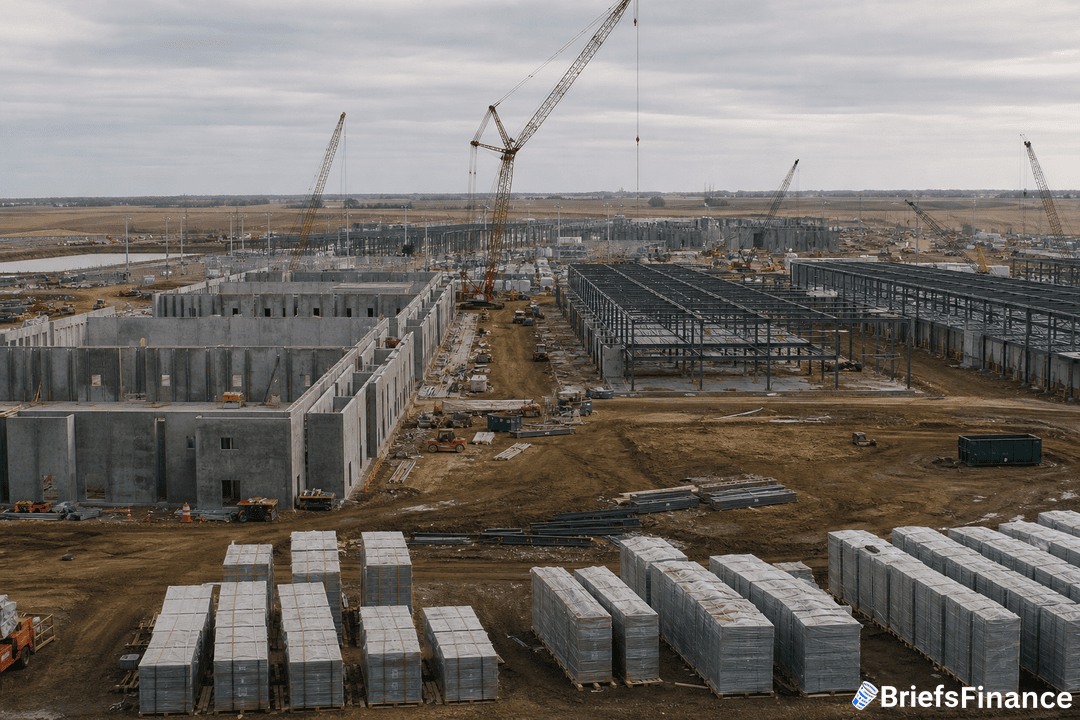
The facility will start with 4.25 gigawatts of computing capacity and can expand by another 3.75 gigawatts later. The first phase is expected to come online starting in 2028. SB Energy will construct and run the data center at the Pike Tech Center in Ohio.

OpenAI has agreed to lease the site for two decades. SB Energy and SoftBank are building power generation for the site, including 10 gigawatts of total energy support and at least $4.2 billion in regional grid upgrades. OpenAI says the buildout will support 35,000 construction jobs through 2032 and about 2,500 long-term roles once it is running.

The Financing Structure

CNBC reported that Nvidia had considered backstopping up to $250 billion in debt for a 10-gigawatt data center on the same Ohio campus. The Wall Street Journal said last week that figure was cut to less than $120 billion. The current filing lands at $105 billion.

Get the free Always Be Buying eBook and learn the simple system for building wealth on any income

This is not just about selling chips. Nvidia is effectively guaranteeing financing so OpenAI can build the massive infrastructure its models need. The arrangement lets OpenAI borrow against the power and compute capacity being created, while Nvidia locks in demand for its GPUs. In exchange, Nvidia ties OpenAI more tightly to its own hardware ecosystem.

Such arrangements have drawn investor scrutiny because one company can appear to be financing another company's purchases. Nvidia records more sales when it helps its own customers pay for Nvidia products. The concern is not new, but this scale makes it harder to ignore.

The Bigger Pattern

This deal is one more example of how the chipmaker has been moving beyond just selling chips. Last week, Nvidia teamed up with six large asset managers to create financing platforms aimed at putting $500 billion of outside money to work in data centers.

Jensen Huang, Nvidia's chief executive, said the company is locking in long-lived infrastructure so OpenAI can keep upgrading its AI factories with newer chips. Sam Altman's OpenAI sees this project as a way to secure the computing power its systems depend on. OpenAI President Greg Brockman said on CNBC, "Compute is becoming the scarce resource of the AI era."

The arrangement also involves ties that are easy to notice. OpenAI owns a piece of SB Energy, and Altman was an early investor in the company. So Nvidia is effectively backing a project where the customer has a financial stake in the builder. That type of setup is not unusual in this corner of tech, but it does mean a lot of parts are moving within one circle.

These large financing arrangements have grown as AI projects require billions in upfront capital before any revenue is generated. Nvidia's willingness to help fund the infrastructure both secures future chip orders and exposes it to more risk if the buildout slows.

What It Means for Investors

For everyday investors, the important thread is how deep these companies are weaving together. Nvidia is not just selling chips anymore. It is helping finance the buildings that will use them, which keeps its customers coming back but also risks tying its fortunes more closely to one another.

Here is how to frame it: bigger AI data centers mean more demand for Nvidia's chips, which should help its revenue. But the circular setup - Nvidia backstopping loans that buy Nvidia chips - is the kind of thing investors should watch closely. If AI demand slows, those commitments could get messy.

For investors, the key number is still the size of the prize. Compute is becoming the resource that factories, hospitals, and everyday apps quietly rely on, and that demand is not shrinking anytime soon. The companies building the physical backbone are seeing real money flow measured in billions, not millions. Big numbers make for big headlines, but big headlines do not always mean smooth sailing.

Download the free Always Be Buying eBook and start putting your money to work today
Disclosure

Recent News

1 2 3 55

Get Market Briefs delivered to your inbox every morning for free!

No fluff. No noise. No politics. Just finance news you can read in 5 minutes.

Blogs

June 29, 2026
Portfolio Diversification: Why Putting All Your Eggs in One Basket Destroys Wealth
  • Real diversification means spreading investments across all 11 economic sectors plus bonds, alternatives, and cash so no single bet can sink the portfolio.
  • Different sectors perform at different times, so a diversified portfolio captures upswings while smoothing the brutal drawdowns that wipe out concentrated bets.
  • Total market index funds offer the simplest path to diversification, and annual rebalancing is what keeps the structure working over time.
Read More
June 29, 2026
Non Taxable Income: What It Is and Why It Matters
  • Non taxable income is money you receive that you don't owe income tax on.
  • The tax code treats workers, investors, and business owners very differently, and investors often come out ahead.
  • Learning how income is taxed is a quiet superpower for keeping more of what you earn.
Read More
June 29, 2026
Semiconductor Stocks: A Simple Guide for Investors
  • Semiconductor stocks are companies that design and make computer chips, the brains inside nearly every modern device.
  • The AI boom has turned chips into one of the market's most important and most watched groups.
  • They offer big growth potential, but come with high valuations and a notoriously cyclical history.
Read More
June 25, 2026
How Stocks Work: A Simple Guide for Beginners
  • A stock is a slice of ownership in a company - buy one, and you own a piece of the business.
  • You make money two ways: the share price rising over time, and dividends paid to shareholders.
  • The simplest path for most beginners is buying into the whole market through a low-cost index fund.
Read More
June 25, 2026
Stop Loss vs Stop Limit: What's the Difference?
  • A stop loss order sells your stock once it hits a trigger price, prioritizing getting you out.
  • A stop limit order only sells within a price range you set, prioritizing price over a guaranteed exit.
  • The trade-off: a stop loss almost always executes; a stop limit might not if the price moves too fast.
Read More
June 25, 2026
Energy Stocks: A Simple Guide for Investors
  • Energy stocks are companies that produce and supply the power the world runs on, from oil and gas to newer sources.
  • They make up one of the 11 sectors of the market and tend to move with energy prices and big-picture shifts.
  • Like any sector, the key is diversification and understanding the forces driving demand.
Read More
June 18, 2026
What Is a Stop Loss Order? A Simple Guide
  • A stop loss order automatically sells a stock once it falls to a price you set.
  • It's a tool to cap losses or lock in gains without watching the market all day.
  • It works best for active strategies, and can backfire if used carelessly on long-term holdings.
Read More
June 18, 2026
Best S&P 500 Index Fund: How to Choose One
  • The best S&P 500 index fund for most investors is simply the cheapest, most established one that tracks the index well.
  • Funds like VOO, IVV, and SPY all hold the same 500 companies, so the biggest difference is the fee.
  • Pick one, automate your buys, and let time do the heavy lifting.
Read More
June 17, 2026
What Are Penny Stocks? Risks and Rewards Explained
  • Penny stocks are very low-priced shares of very small companies, often trading for just a few dollars or less.
  • They promise huge gains but carry huge risks: low liquidity, high failure rates, and wild price swings.
  • Most investors are better served by quality companies and funds than by chasing cheap shares.
Read More
June 17, 2026
Best Stocks for Beginners With Little Money
  • The best stocks for beginners with little money usually aren't individual stocks at all - they're low-cost index funds.
  • You can start with $100 or less and use small, regular investments to build wealth over time.
  • Focus on diversification and consistency, not on picking the next big winner.
Read More
1 2 3 24
Share via
Copy link











