Free NewsletterPro Login
S&P 500 6,287 +0.42%
DOW 44,521 -0.18%
NASDAQ 21,103 +0.71%
S&P 500 +12.4%
Briefs Finance Fund +24.8%
JOIN THE FUND →

Bundesbank Reports Slight Q2 Growth Despite Global Tensions

Published Jul 29, 2026
[tts_player]
Share:
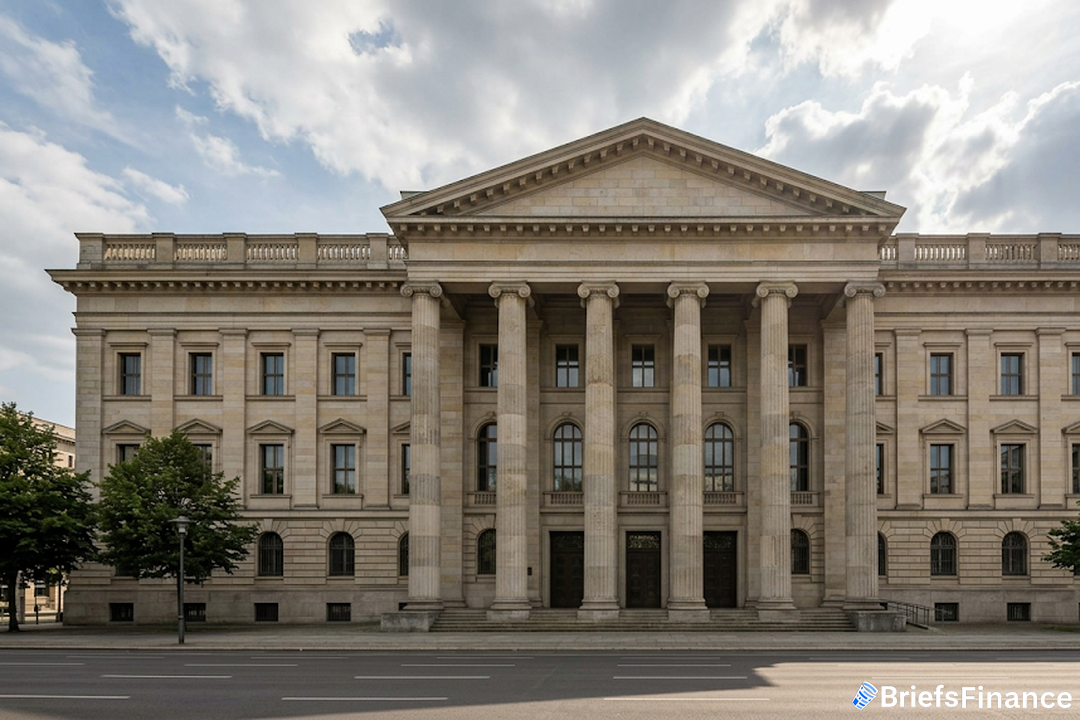
Grand German neoclassical bank building with stone columns
Summary:
  • Germany's central bank says the economy likely grew slightly in the second quarter of 2026 and should keep expanding through the third quarter.
  • Full-year growth is forecast at just 0.5%, with second-quarter GDP expected to rise only 0.1% according to a Bloomberg analyst poll.
  • The Bundesbank also found that bureaucratic red tape now costs German companies 7% of annual revenue, up from 5% in recent years.

A Modest Step Forward in a Tough Year

The German central bank, the Bundesbank, said Tuesday that output between April and June is likely to have "increased slightly." This represents an improvement from the earlier forecast of no growth, but the pace of expansion in the July-September period is expected to moderate.

The official first estimate of second-quarter GDP is due on Thursday. Bloomberg's survey of analysts anticipates a decline in growth to 0.1% compared to 0.3% in the prior quarter.

"Overall, the current set of indicators points to a slightly higher underlying economic-growth rate than anticipated," the Bundesbank stated in its monthly report, referencing its June forecast.

This projection highlights how Germany's economy has held up well against the Middle East turmoil and its impact on energy costs, although growth is slowing relative to the unexpectedly robust first quarter.

The central bank and the government both project only 0.5% growth for all of 2026, disappointing Chancellor Friedrich Merz, who had hoped for a "year of growth" after a prolonged slump.

Get the market news that matters in a five-minute read with Market Briefs, our free daily newsletter

Lately, positive developments have been observed. In July, a prominent gauge of corporate sentiment improved by more than analysts had predicted, and various polls indicate that private-sector output is once again expanding.

According to the Bundesbank, manufacturers are seeing gains from robust overseas orders and export growth, and households appear largely unconcerned about elevated energy prices. Meanwhile, increased government spending on infrastructure and defense is bolstering economic activity.

The Merz-led coalition has additionally unveiled changes to pensions, income taxes, and bureaucratic processes.

The modest 0.5% growth forecast for the full year underscores the gap between political ambitions and economic reality, with energy costs and regulatory drag continuing to mute the recovery. While the Bundesbank's assessment is more upbeat than its previous outlook, structural headwinds remain a key concern for policymakers.

The Hidden Drag on Growth

On inflation, the Bundesbank indicated a modest uptick from the current inflation rate of 2.4% is likely in the months ahead.

The Bundesbank's research further revealed that administrative burdens have risen sharply, with German firms now spending 7% of annual revenue on compliance and paperwork, compared to 5% just a few years earlier. This increase adds to the cost pressures already weighing on business investment and hiring.

What It Means for the Broader Outlook

Germany's economy has been navigating a complex landscape of high energy prices, geopolitical instability, and domestic regulatory hurdles. Chancellor Merz's coalition has introduced tax reforms and pension adjustments aimed at stimulating activity, but the impact of those measures will take time to materialize.

Meanwhile, the ongoing conflict in the Middle East continues to inject uncertainty into energy markets, even though German households have so far absorbed higher costs without major distress. Export-oriented manufacturers are benefiting from overseas demand, but domestic consumption remains tepid. The combination of these factors means that while the second quarter may show a modest gain, the overall trajectory for 2026 is still one of sluggish performance, with structural challenges like red tape and an aging workforce persisting as long-term drags.

Join Market Briefs, our free daily newsletter, for a quick daily rundown of the markets
Disclosure

Recent News

1 2 3 44

Get Market Briefs delivered to your inbox every morning for free!

No fluff. No noise. No politics. Just finance news you can read in 5 minutes.

Blogs

June 29, 2026
Portfolio Diversification: Why Putting All Your Eggs in One Basket Destroys Wealth
  • Real diversification means spreading investments across all 11 economic sectors plus bonds, alternatives, and cash so no single bet can sink the portfolio.
  • Different sectors perform at different times, so a diversified portfolio captures upswings while smoothing the brutal drawdowns that wipe out concentrated bets.
  • Total market index funds offer the simplest path to diversification, and annual rebalancing is what keeps the structure working over time.
Read More
June 29, 2026
Non Taxable Income: What It Is and Why It Matters
  • Non taxable income is money you receive that you don't owe income tax on.
  • The tax code treats workers, investors, and business owners very differently, and investors often come out ahead.
  • Learning how income is taxed is a quiet superpower for keeping more of what you earn.
Read More
June 29, 2026
Semiconductor Stocks: A Simple Guide for Investors
  • Semiconductor stocks are companies that design and make computer chips, the brains inside nearly every modern device.
  • The AI boom has turned chips into one of the market's most important and most watched groups.
  • They offer big growth potential, but come with high valuations and a notoriously cyclical history.
Read More
June 25, 2026
How Stocks Work: A Simple Guide for Beginners
  • A stock is a slice of ownership in a company - buy one, and you own a piece of the business.
  • You make money two ways: the share price rising over time, and dividends paid to shareholders.
  • The simplest path for most beginners is buying into the whole market through a low-cost index fund.
Read More
June 25, 2026
Stop Loss vs Stop Limit: What's the Difference?
  • A stop loss order sells your stock once it hits a trigger price, prioritizing getting you out.
  • A stop limit order only sells within a price range you set, prioritizing price over a guaranteed exit.
  • The trade-off: a stop loss almost always executes; a stop limit might not if the price moves too fast.
Read More
June 25, 2026
Energy Stocks: A Simple Guide for Investors
  • Energy stocks are companies that produce and supply the power the world runs on, from oil and gas to newer sources.
  • They make up one of the 11 sectors of the market and tend to move with energy prices and big-picture shifts.
  • Like any sector, the key is diversification and understanding the forces driving demand.
Read More
June 18, 2026
What Is a Stop Loss Order? A Simple Guide
  • A stop loss order automatically sells a stock once it falls to a price you set.
  • It's a tool to cap losses or lock in gains without watching the market all day.
  • It works best for active strategies, and can backfire if used carelessly on long-term holdings.
Read More
June 18, 2026
Best S&P 500 Index Fund: How to Choose One
  • The best S&P 500 index fund for most investors is simply the cheapest, most established one that tracks the index well.
  • Funds like VOO, IVV, and SPY all hold the same 500 companies, so the biggest difference is the fee.
  • Pick one, automate your buys, and let time do the heavy lifting.
Read More
June 17, 2026
What Are Penny Stocks? Risks and Rewards Explained
  • Penny stocks are very low-priced shares of very small companies, often trading for just a few dollars or less.
  • They promise huge gains but carry huge risks: low liquidity, high failure rates, and wild price swings.
  • Most investors are better served by quality companies and funds than by chasing cheap shares.
Read More
June 17, 2026
Best Stocks for Beginners With Little Money
  • The best stocks for beginners with little money usually aren't individual stocks at all - they're low-cost index funds.
  • You can start with $100 or less and use small, regular investments to build wealth over time.
  • Focus on diversification and consistency, not on picking the next big winner.
Read More
1 2 3 24
Share via
Copy link











