Free NewsletterPro Login

Spirit Airlines Negotiates Takeover Talks with Castlelake Amid Bankruptcy

A stylized illustration of a cylindrical cup with blue arrows and lines indicating a swirling or rotational motion inside the cup.
Published Jan 22, 2026
Share:
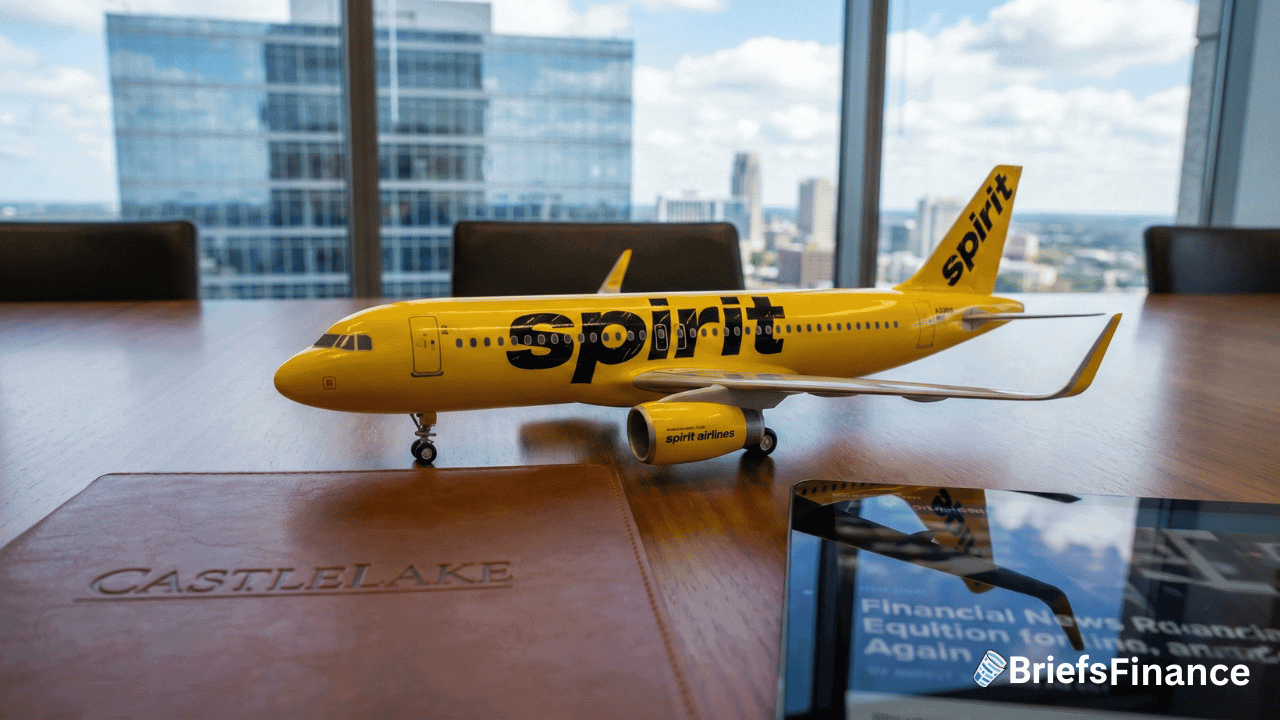
A model Spirit Airlines airplane sits on a conference table next to a CASTLELAKE folder and a tablet displaying financial news, with a city skyline visible through the window.
Summary:

  • Spirit Airlines is in discussions with Castlelake for a potential takeover as it seeks a way out of Chapter 11 bankruptcy.
  • The airline filed for Chapter 11 bankruptcy protection in August 2025 for the second time within a year due to an unsuccessful turnaround plan.
  • Frontier Airlines had previously explored a merger with Spirit but did not finalize a deal.

Current Negotiations

Spirit Airlines is currently in talks with Castlelake, an alternative investment firm, regarding a possible takeover.

This move is part of Spirit's efforts to navigate out of Chapter 11 bankruptcy protection, which it entered in August 2025 for the second time within a year.

Bankruptcy and Financial Struggles

The airline's previous turnaround strategy failed to yield results, prompting the bankruptcy filing. Spirit had hoped to recover from its financial woes, but ongoing challenges persisted.

Notably, the airline's difficulties were intensified by a recall of Pratt & Whitney engines that grounded dozens of its Airbus aircraft beginning in 2023.

Funding and Restructuring Efforts

To support its restructuring, Spirit Airlines amended its agreement with creditors in mid-December 2025, securing an additional $50 million in funding.

This funding is contingent on the airline making further progress towards a standalone reorganization plan or reaching a strategic deal. Spirit noted that it is actively negotiating on both fronts.

Previous Merger Talks with Frontier Airlines

Before engaging with Castlelake, Spirit Airlines had been in discussions with Frontier Airlines regarding a potential merger.

However, these talks did not result in a finalized agreement. Frontier Airlines had previously attempted to merge with Spirit, but a deal was called off four years ago after JetBlue Airways made a competing offer.

Operational Changes and Job Cuts

In an effort to cut costs, Spirit Airlines has reduced its flight schedules, downsized its fleet, and implemented job cuts.

Unions representing pilots and flight attendants agreed to pay reductions amounting to $100 million to help the airline stabilize financially. These measures are part of Spirit's broader strategy to regain profitability in a challenging market.

Looking Ahead for Spirit Airlines

As Spirit Airlines continues to negotiate with Castlelake and seeks to recover from its financial difficulties, the outcome of these discussions remains uncertain.

The airline aims to adapt to changing market conditions and customer preferences while competing against larger carriers that have more financial resources. Spirit's future will depend on successfully navigating these negotiations and restructuring efforts.

Disclosure

Get Market Briefs delivered to your inbox every morning for free!

No fluff. No noise. No politics. Just finance news you can read in 5 minutes.

Blogs

May 30, 2026
Financial Literacy Books That Actually Build Wealth
  • The best financial literacy books don't just teach budgeting, they shift how you think about money.
  • Two classics stand out: The Intelligent Investor for valuing investments, and Rich Dad Poor Dad for the owner's mindset.
  • Reading is only step one. The real wealth comes from acting on what you learn.
Read More
May 30, 2026
What Is a Roth Conversion? A Simple Guide
  • A Roth conversion moves money from a traditional retirement account into a Roth account.
  • You pay taxes on the money now, in exchange for tax-free growth and withdrawals later.
  • It can pay off if you expect higher taxes or more income in the future, but the timing and tax hit matter a lot.
Read More
May 30, 2026
Trailing Stop Loss: How to Protect Your Gains
  • A trailing stop loss is an order that automatically sells a stock if it falls a set percentage from its recent high.
  • As the stock rises, the sell point rises with it, locking in gains while capping losses.
  • It's most useful for active strategies like momentum investing, not for long-term buy-and-hold.
Read More
May 30, 2026
5 Types of Wealth: Why Money Is Only One of Them
  • Real wealth is more than a bank balance. It spans your finances, health, mind, purpose, and freedom.
  • Money is powerful, but it amplifies the life you already have rather than fixing a broken one.
  • True financial wealth means your cash flow covers your expenses, so your money works while you live.
Read More
May 30, 2026
How to Invest in Private Equity: A Beginner's Guide
  • Private equity means investing in companies that aren't listed on the stock market.
  • Traditional private equity is built for experienced, high-net-worth investors with large amounts to invest.
  • New rules have opened more accessible paths, like startup crowdfunding and real estate deals, often starting around $100.
Read More
May 30, 2026
What Is a Call Option? A Simple Guide With Examples
  • A call option gives you the right to buy a stock at a set price by a set date.
  • Investors buy calls when they expect a stock to rise, using less money than buying the shares outright.
  • The most you can lose buying a call is the premium, but time works against you, so it's an advanced tool.
Read More
May 30, 2026
EBITDA Formula: How to Calculate It Step by Step
  • EBITDA stands for Earnings Before Interest, Taxes, Depreciation, and Amortization, a measure of a company's core profit.
  • The formula adds those four items back to net income to show what the underlying business earns.
  • Investors use EBITDA to compare companies and to judge how many times earnings a stock is selling for.
Read More
May 30, 2026
What Is a Stock Option? A Plain-English Guide
  • A stock option is a contract giving you the right, but not the obligation, to buy or sell a stock at a set price by a set date.
  • There are two types: calls (the right to buy) and puts (the right to sell).
  • Options are powerful but risky, so they suit investors who already have the basics down.
Read More
May 30, 2026
Put Option: What It Is and How It Works
  • A put option gives you the right to sell a stock at a set price by a set date.
  • Investors use puts to bet a stock will fall, or as insurance to protect shares they own.
  • The most you can lose buying a put is the premium you paid, which makes it a defined-risk tool.
Read More
May 30, 2026
Operating Margin: What It Is and How to Calculate It
  • Operating margin shows how much profit a company keeps from its core business after paying its running costs.
  • The formula is operating income divided by revenue, shown as a percent.
  • A strong, steady operating margin signals a well-run business that controls its costs.
Read More
1 2 3 22
Share via
Copy link









