Free NewsletterPro Login
S&P 500 6,287 +0.42%
DOW 44,521 -0.18%
NASDAQ 21,103 +0.71%
S&P 500 +12.4%
Briefs Finance Fund +24.8%
JOIN THE FUND →

United Is Cutting Flights and Buying 120 New Planes at the Same Time

A stylized illustration of a cylindrical cup with blue arrows and lines indicating a swirling or rotational motion inside the cup.
Published Mar 22, 2026
[tts_player]
Share:
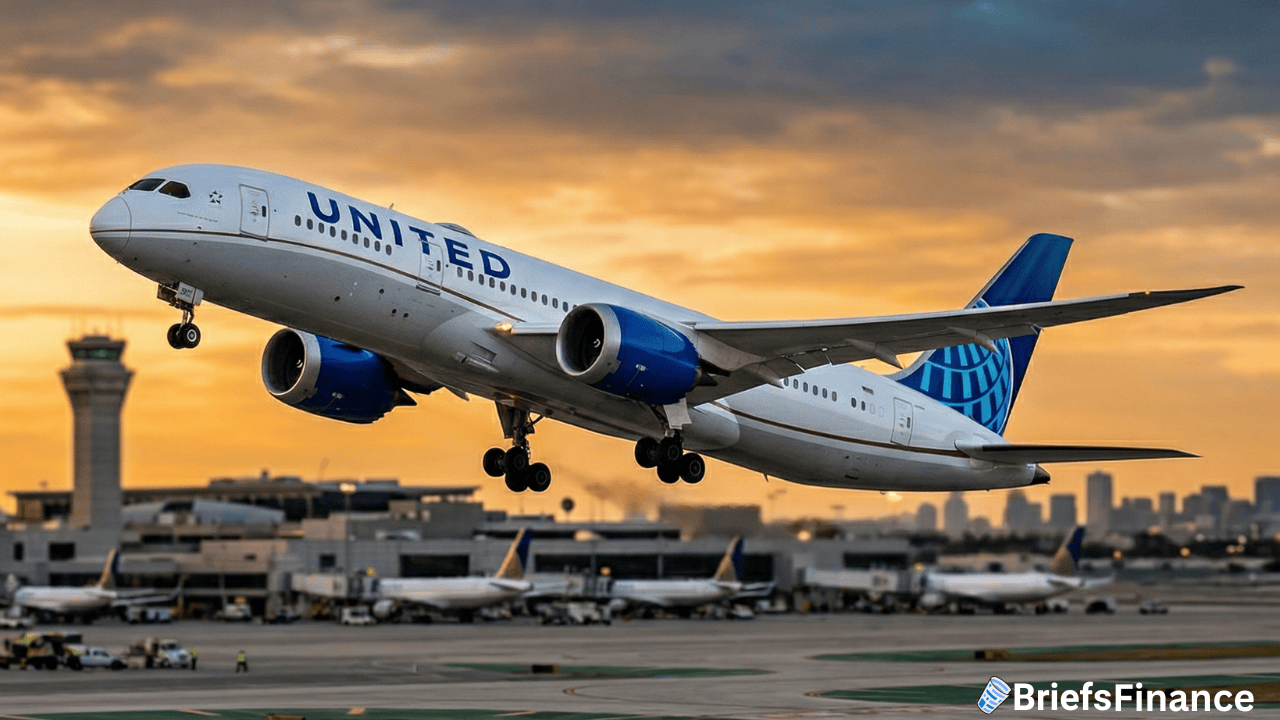
A United jet takes off from an airport runway at sunset, with an air traffic control tower, other planes, and busy flights in the background.
Summary:
  • United will drop about 5% of its planned flights this year - mostly off-peak routes, midweek service, and red-eyes - as jet fuel costs spike from the Iran war.
  • CEO Scott Kirby is planning for oil above $100 a barrel through 2027, with a worst case near $175. At those prices, United's fuel tab jumps by $11 billion a year.
  • Demand hasn't flinched. The airline's last 10 weeks were its 10 strongest booking weeks ever, and recently booked fares are running 15% to 20% higher than before.

Shrink Now, Grow Later

The airline is pulling about 3% of flying from its weakest time slots - think Tuesday flights, Saturday departures, and overnight routes nobody loves - during the second and third quarters.

It's also trimming a point of capacity at O'Hare and keeping Tel Aviv and Dubai flights grounded. 

At the same time, United is still taking delivery of around 120 new planes this year, including 20 widebody 787s. Another 130 are on the way by early 2028.

CEO Scott Kirby told staff the airline isn't furloughing anyone or pulling back on future spending.

So then, what’s going on?

The Math That’s Mathing

Fuel is the second-biggest bill airlines pay - right behind labor. 

And right now, it's a bill that just doubled.

The cost of filling up a commercial jet has essentially doubled in under a month, driven by the Iran war's disruption of global energy flows. 

Kirby's internal planning assumes oil could climb as high as $175 a barrel, though he acknowledged it probably won't get that high.

If it did, United would be staring at $11 billion in extra fuel costs per year. 

For context, the airline made less than $5 billion in what Kirby called its best year on record last year.

Travelers that keep booking and keep paying more are offsetting these costs..

United said fares on tickets sold in the past week alone were 15% to 20% higher than where they were before the spike. 

The industry has already tacked on two rounds of price bumps - roughly $10 per leg each time - and analysts at Melius Research think another 5% to 7% is still on the table.

Airlines Are Flying Together

United isn't alone - Delta raised its first-quarter revenue outlook this week and said it can pull capacity if fuel stays high.

While plenty of airlines in Europe and Asia lock in prices ahead of time, major U.S. airlines take the hit in real time and try to make it up through pricing and discipline. 

It's riskier when demand cracks - but right now, demand is doing the opposite.

Low-fare carriers are in a tighter spot - Their business models already run on thin margins, and rising labor costs were squeezing them before fuel joined the party. 

A doubling in jet fuel is harder to absorb when your average ticket price is $79.
Disclosure

Recent News

1 2 3 27

Get Market Briefs delivered to your inbox every morning for free!

No fluff. No noise. No politics. Just finance news you can read in 5 minutes.

Blogs

June 18, 2026
What Is a Stop Loss Order? A Simple Guide
  • A stop loss order automatically sells a stock once it falls to a price you set.
  • It's a tool to cap losses or lock in gains without watching the market all day.
  • It works best for active strategies, and can backfire if used carelessly on long-term holdings.
Read More
June 18, 2026
Best S&P 500 Index Fund: How to Choose One
  • The best S&P 500 index fund for most investors is simply the cheapest, most established one that tracks the index well.
  • Funds like VOO, IVV, and SPY all hold the same 500 companies, so the biggest difference is the fee.
  • Pick one, automate your buys, and let time do the heavy lifting.
Read More
June 17, 2026
What Are Penny Stocks? Risks and Rewards Explained
  • Penny stocks are very low-priced shares of very small companies, often trading for just a few dollars or less.
  • They promise huge gains but carry huge risks: low liquidity, high failure rates, and wild price swings.
  • Most investors are better served by quality companies and funds than by chasing cheap shares.
Read More
June 17, 2026
Best Stocks for Beginners With Little Money
  • The best stocks for beginners with little money usually aren't individual stocks at all - they're low-cost index funds.
  • You can start with $100 or less and use small, regular investments to build wealth over time.
  • Focus on diversification and consistency, not on picking the next big winner.
Read More
June 16, 2026
Tech Stocks: A Simple Guide for New Investors
  • Tech stocks are companies in the information technology and related sectors, from software to chips to the internet giants.
  • They've driven much of the market's growth, but they can be volatile and richly valued.
  • The smart approach is to understand what you own and not let one sector run your whole portfolio.
Read More
June 16, 2026
What Is a Joint Stock Company? A Simple Guide
  • A joint stock company is a business owned by many people, each holding shares of stock that represent a slice of ownership.
  • It's the basic idea behind every public company you can buy on the stock market today.
  • Owning a share makes you a part-owner, entitled to a piece of the profits and growth.
Read More
June 16, 2026
Capital Gains Tax in California: A Simple Guide
  • Capital gains tax is what you owe when you sell an investment for more than you paid for it.
  • How long you held it matters: long-term gains are taxed more gently than short-term gains at the federal level.
  • Smart investors lower the bill with tools like tax-loss harvesting and holding for the long run.
Read More
June 15, 2026
Top Covered Call ETFs: How to Compare Them
  • Top covered call ETFs are income funds that own stocks and sell call options against them to generate steady cash.
  • The best one for you is the fund whose income, holdings, and fees fit your goals, not simply the one with the flashiest yield.
  • They all share one trade-off: more income today, less upside in a big rally.
Read More
June 15, 2026
What Are Stock Options? A Plain-English Guide
  • Stock options are contracts that give you the right, but not the obligation, to buy or sell a stock at a set price by a set date.
  • There are two kinds: calls (the right to buy) and puts (the right to sell).
  • Options can multiply gains or wipe out your money fast, so they suit investors who already know the basics.
Read More
June 15, 2026
EBITDA Margin: What It Is and How to Calculate It
  • EBITDA margin measures how much core profit a company keeps from each dollar of sales, before interest, taxes, and accounting deductions.
  • The formula is EBITDA divided by revenue, shown as a percent.
  • A higher, steadier EBITDA margin usually signals a more efficient, more durable business.
Read More
1 2 3 23
Share via
Copy link










