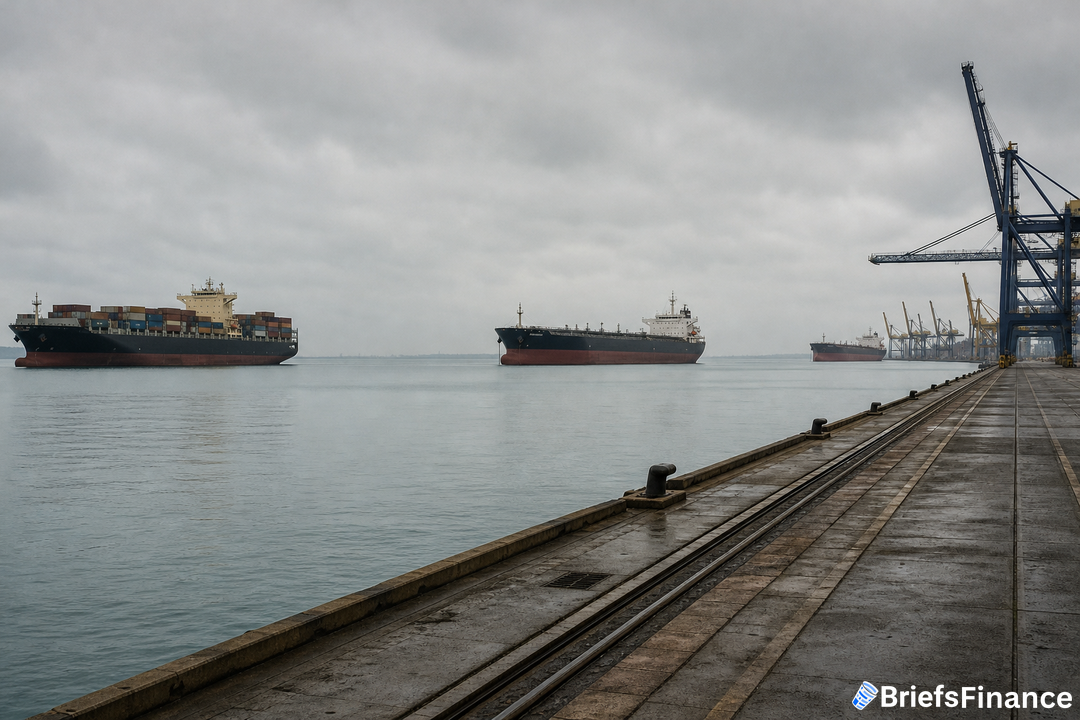
Dealmaking slumps from 2025 highs
Coming off 2025's exuberance - showcased by Electronic Arts Inc.'s $55 billion sale - Gulf deal value slipped to roughly $5 billion during the third quarter. That is the lowest since 2022 and a sharp drop from $69 billion a year before, according to Bloomberg data. The slowdown has deepened into the fourth quarter, with values so far more than 90% below last year.
Even with the pullback, the region's totals still sit above their five-year average, suggesting a cooldown from an exceptional year rather than a retreat. Wall Street firms have been adding to local teams to capture that pipeline.
Worldwide, the early-year strength has waned, with the Iran war and trade frictions fueling inflation and reviving the risk of another rate-hiking cycle. Even so, overall deal values have risen around 15% this year to $4.4 trillion and are poised to surpass $5 trillion for just the second time, although second-half volumes are roughly 7% lower than a year earlier.
Boards tap brakes, timelines stretch
The Iran war is prompting boards to revisit M&A and governments to spend heavily on infrastructure to bypass the Strait of Hormuz and bolster domestic economies. That matters worldwide because Gulf entities have long served as financiers to the world, helping finance signature transactions, including the Warner Bros. Discovery Inc. combination valued at $110 billion.
"First, boards paused at the start of the disruption to assess the impact on their own businesses, pushing back M&A and divestment plans," said James Jarvis, a Dubai-based partner at Lumina Capital Advisers. "Second, live deals are taking longer," he said. "Diligence is more robust, investment committees are asking more questions and structures are more complex as risk is rebalanced between buyers and sellers, pushing out completion dates."
Jarvis added that strong assets still find buyers, pointing to Apollo Global Management Inc.'s investment in Abu Dhabi's Mubadala Capital. A Lumina survey found 73% of Gulf dealmakers were active during the war, and about 43% were planning or considering a transaction.
Washington's swing resets risk calculus
Politics are now part of the term sheet. With Democrats' midterm win giving them control of both chambers of Congress, US President Donald Trump's agenda has been weakened, and regulators may take a harder look at areas that draw significant capital from the Gulf. Deals tied to artificial intelligence and data centers are likely to feel this most.
When deal activity cools, informed investors look for smarter ways to find opportunity. We're hosting our first ever investor livestream on 11/17 to show you how to use ChatGPT and Claude to invest like a pro, hosted by Briefs Finance CEO Jaspreet Singh. Save your seat.
There is recent precedent. In the closing phase of the Biden administration, the Committee on Foreign Investment in the United States reviewed several multibillion-dollar deals tied to Middle Eastern wealth funds. A few months later, during Trump's tenure, the US announced plans to create a fast track for reviewing foreign investments. The prospect of tighter scrutiny is also creating urgency in some boardrooms as companies weigh transformational deals while regulators viewed as M&A friendly remain in place.
The region's growing weight in strategic tech is still showing up. On Monday, Ardian SAS said that investors from the Middle East and North Africa made up roughly 40% of the €1 billion it secured for its first semiconductor fund.
Capital still on the move - and why it matters
The deal mix is shifting rather than disappearing. Yet sovereign investors remain active: Abu Dhabi's three wealth funds, which manage about $2 trillion combined, helped fund a UK acquisition, provided support to a Chinese coffee chain, and delisted a major local ports company.
Saudi Arabia's $905 billion Public Investment Fund is prioritizing higher-return plays like AI and logistics, and it bought a mobile gaming studio valued at $6 billion. Even Qatar and Kuwait, which have taken the biggest economic hit from the Iran war, continued to strike deals in AI and data centers, while Kuwait secured a record $16 billion infrastructure partnership in foreign direct investment.
Global SWF says that, at this run rate, funds from the Middle East and North Africa are on track to commit roughly $136 billion in 2026 across 327 deals. That would be the second-highest deal count on record, skewing toward smaller, more frequent technology investments. Or as Mubadala Investment Co. deputy CEO Waleed Al Muhairi put it: "We're still deploying capital, we're still looking for the best risk-reward globally, and we're still doing so through partnership."
The bottom line: fewer megadeals and longer closings, but steady flows into AI, data centers, logistics and infrastructure. For your portfolio, that points to persistent capital behind strategic tech and supply chain assets, even as headline volumes cool.
Using new tools to spot shifts can help investors stay calm and prepared. On 11/17, our CEO Jaspreet Singh goes live for our first ever investor livestream on how to use ChatGPT and Claude to invest like a pro. Register to join him.