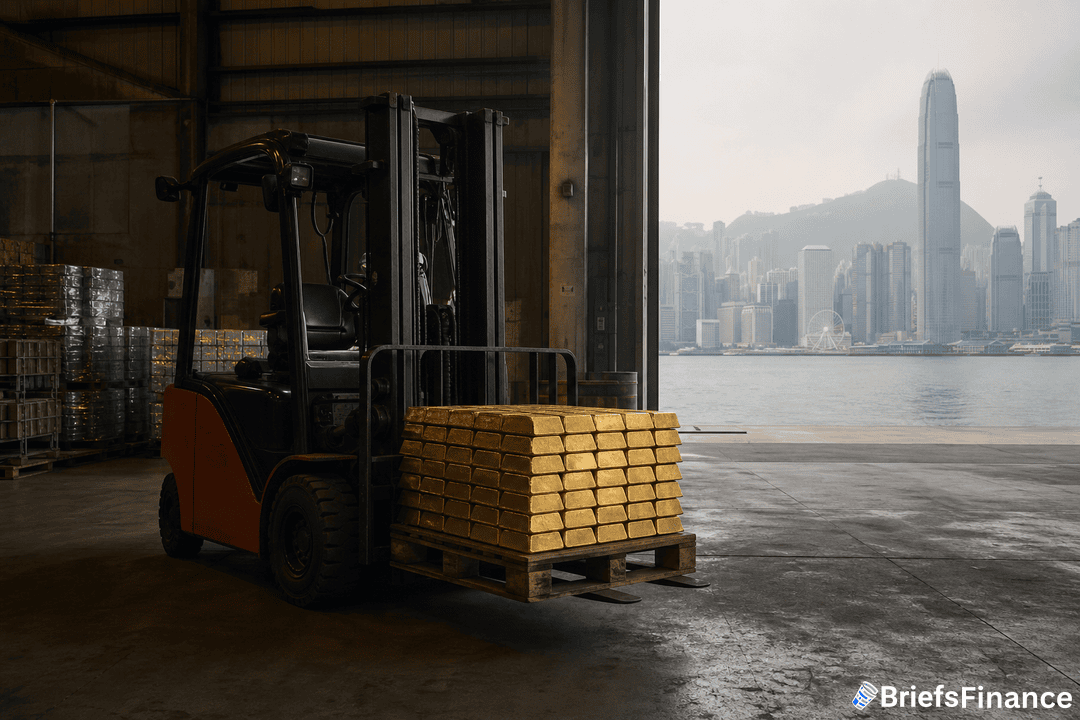
The surge and how big it is
Hong Kong logged 112.7 tonnes of Russian-origin bullion from January through July 2026, based on BullionVault's read of Hong Kong Census and Statistics Department data. That haul has already set a new annual record, beating the 92.1 tonnes taken in 2025, and is a world away from the 3.3 tonnes recorded in 2021, prior to Russia's invasion of Ukraine.
The mix has flipped fast.
Why the flow changed
Since the full-scale invasion in 2022, Russia's gold has been shunned in the West, and trade routes have adjusted. The U.S., U.K. and other Western governments then rolled out curbs on Russian gold, shutting off key destinations that had previously taken large volumes.
Before the war, London was central to Russia's bullion business. BullionVault estimates that, between 2019 and 2021, exports to the U.K. amounted to roughly two-thirds of Russia's mine output. Said Adrian Ash - BullionVault's director of research - "The fact that Hong Kong's official data clearly shows a steep rise in imports of Russian gold reflects the kind of support and bilateral trade for which Putin has repeatedly thanked Xi." He added, "Russian exports of gold to the UK and other Western-sanction nations of course collapsed."
Gold flows redraw themselves whenever sanctions redraw trade routes. Market Briefs tracks the metal and the money free every weekday.
Hong Kong's role and the buildout
Hong Kong is a logical rerouting point. It has long funneled bullion into mainland China, the world's biggest gold buyer, and it is scaling up storage, clearing and trading capabilities. "Hong Kong has emerged as an important hub for Russia-China trade since the full-scale invasion," said Vita Spivak of Gatehouse Advisory Partners, where she is a senior consultant. "Most gold goes to Mainland China as it hasn't placed sanctions on Russian gold," she told CNBC.
"Hong Kong has always been an important entre-pot for gold going into China," said Rhona O'Connell, StoneX's head of EMEA and Asia market analysis. She noted that Shanghai has taken share, and that Hong Kong is now "in a race with Singapore for hub supremacy and is about six months ahead in terms of infrastructure." Historically, Hong Kong handled most of China's gold imports, but S&P Global notes Beijing later authorized other entry points, including Shenzhen and Beijing, which has diluted the city's share.
China's gold appetite and why it matters
This reroute is landing as China is buying more gold across the board. Beijing has labeled gold a "strategic mineral" and promoted physical holdings for households as a way to preserve savings, and the People's Bank of China has kept increasing its reserves. S&P Global data show that in the first half of 2026 China's official reserves increased by over 40 tonnes, more than twice the rise seen a year earlier. "We do know that whether it's the PBOC or if it's the Chinese consumers, they've all been buying quite a bit of gold," said S&P Global Ratings' Greater China corporates country lead, Charles Chang. "In times of high uncertainty, consumers tend to want to protect their savings, and they find gold as one vehicle for that."
For everyday investors, the takeaway is simple: when supply lines and demand centers move, pricing power moves with them. If you own jewelry, coins, or funds tied to bullion, Asia's growing pull on the market is part of what sets the backdrop for your returns.
Where bullion physically moves tells you how trade is actually working. Join Market Briefs free and follow the route.