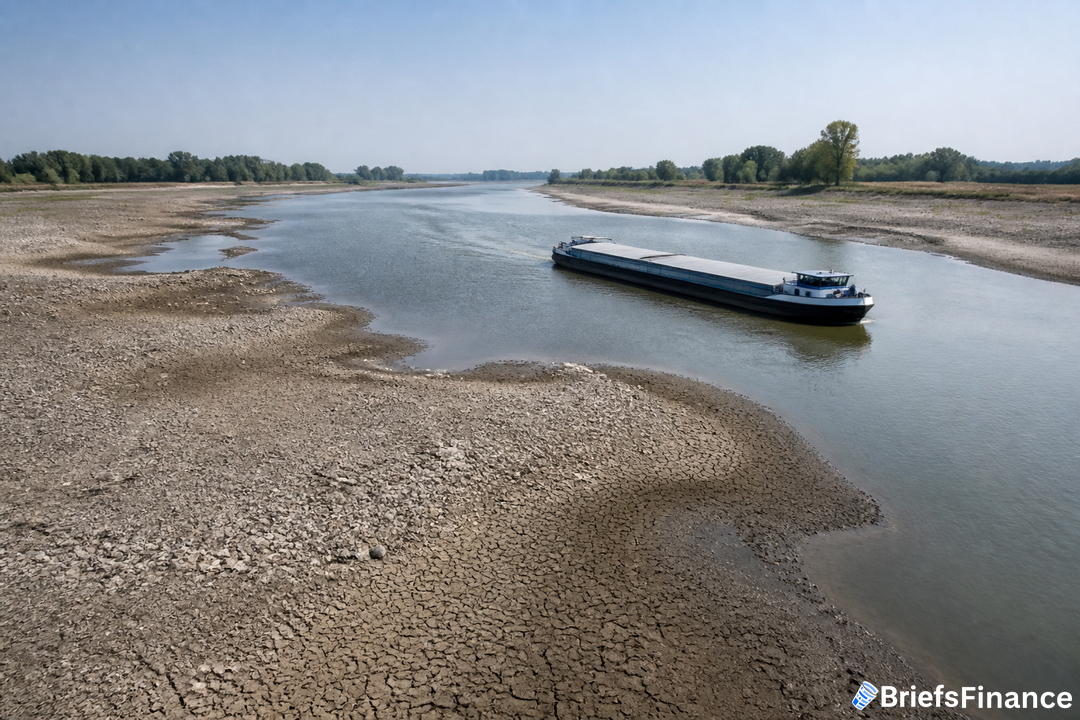
What happened on the river
A key pinch point on the Rhine at Kaub hit 4 centimeters on Thursday, setting a new all-time low in records dating back to 1880. That undercuts the trough reached in August, when Western Europe endured its hottest summer on record and waterways shrank. After a short reprieve, dryness returned, and government and commercial forecasters say the Rhine and other main arteries started autumn at critically low levels.
Copernicus Climate Change Service data since 1992 show the Rhine, Danube and Vistula at their weakest seasonal flows on record. The Rhine's upper basin suffered especially hard: France logged its hottest summer on record, Switzerland had its hottest and driest April-to-August since 1901, and in Germany it was the second-hottest summer since 1881, with rainfall roughly 28% below average. All of this matters because the Rhine serves as a key route moving coal, fuel and other industrial materials throughout central Europe.
How shipping and power are feeling it
The Kaub reading is not the depth to the riverbed. It is the number ship owners use to calculate how much weight they can carry without risking damage or running aground. Volt Power Analytics tallied 74 days with levels below 78 centimeters, the point at which barge shippers must trim loads by 30% to pass. That far tops the 41-day run seen during the 2022 energy crisis.
Those constraints are lifting transport costs. As dryness lingered, the tariff to ship diesel from Rotterdam to Karlsruhe jumped 15% on Monday, on the heels of an increase of more than 100% earlier in the month. Power markets are feeling it too: dry conditions have reduced hydro generation by 37% in Germany and 28% in France compared with the 2019-2025 period.
When conditions change, steady financial habits help protect and grow your savings. Join Briefs Finance CEO Jaspreet Singh on September 29th for a FREE live investor workshop, How to Profit From A Dollar That's Losing its Value, where he shows how we're spotting investment opportunities as the dollar falls. Save your spot.
What comes next and why it matters
MetDesk meteorologist Richard Martin-Barton expects a stubborn high-pressure setup to hang over large parts of continental Europe into month end, which would keep Rhine and other big river flows under strain. Forecasts from the German Federal Institute of Hydrology suggest Kaub could slip further in the coming days, while German forecasters and MetDesk see the odds of rain improving in early October.
Looking further out, Volt Power Analytics' head of fundamentals and hydrology, Silje Eriksen Holmen, sees a repeating pattern as Europe warms: "This will be the impact for every summer going forward," she said. "That's not a bold guess. That's how it will be." For your wallet, the practical takeaway is simple: when waterways run low, it can ripple into freight costs, fuel logistics and power availability. Watch the late-September weather and those early-October rain chances for clues on how quickly those pressures might ease.
Preparing for uncertainty lets you preserve capital and pursue long term gains. Our CEO Jaspreet Singh is hosting a FREE live investor workshop, How to Profit From A Dollar That's Losing its Value, on September 29th. Sign up free to join him live.