Free NewsletterPro Login

U.S. Natural Gas Just Hit A Record Negative Streak While Europe's Doubled

Published Apr 29, 2026
Share:
Summary:
  • Waha Hub cash prices in the Permian Basin hit a record low of -$9.53 per MMBtu on April 15.
  • European TTF gas nearly doubled to over €60/MWh by mid-March.
  • About 20% of global LNG flows through the Strait of Hormuz, where shipping has slowed since February 28.

Producers in West Texas are paying buyers to haul off their natural gas. Factories in Germany are paying record prices for the same thing.

The Iran war just split the global gas market into two systems. Buyers trying to play this need to know which one they are standing in.

Why U.S. Gas Is Going Negative

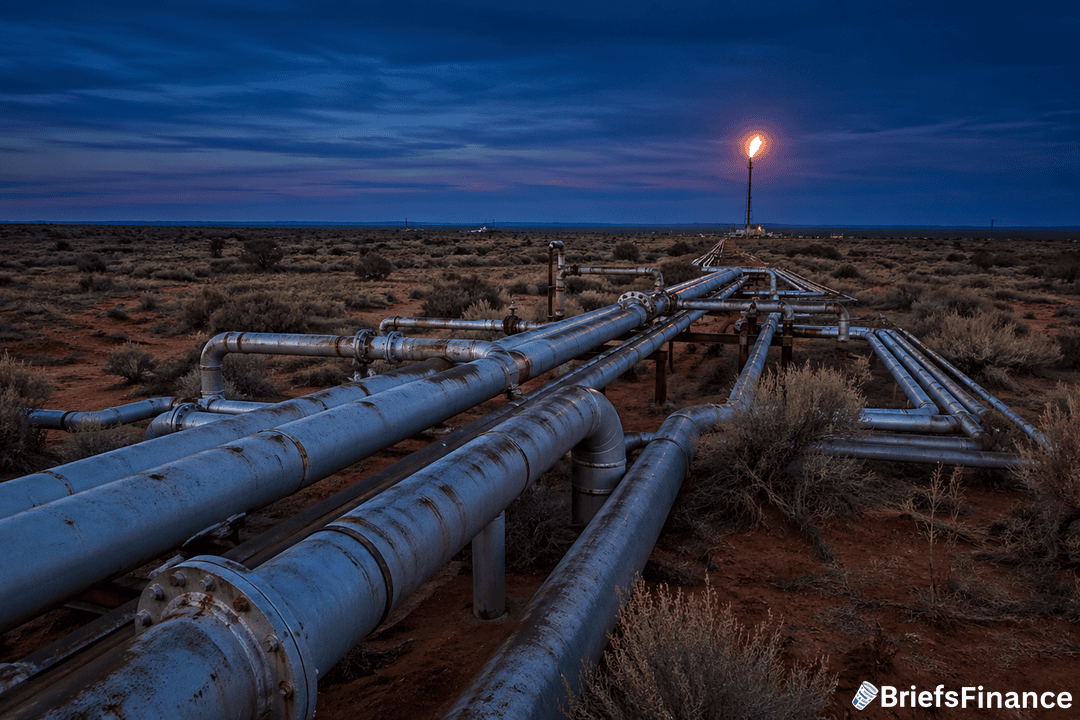
The Permian Basin in West Texas pumps a huge amount of natural gas. Most of it comes up as a byproduct of pumping oil. The pipelines that move that gas to anywhere useful are full.

Cash prices at Waha Hub, the regional benchmark, have been negative for 44 days in a row. They hit a record low of -$9.53 per MMBtu on April 15.

What does that mean in plain English? Producers are paying buyers to haul their gas off. They want to keep pumping the oil sitting under it.

Henry Hub, the national U.S. benchmark, is trading near $3. It is also at a premium to futures. The U.S. simply has more gas than it can move or use. LNG export ports cannot load fast enough to ship the surplus overseas.

Why European Prices Are Spiking

Europe is in the opposite spot. The continent's main gas point, the TTF benchmark, nearly doubled to over €60/MWh by mid-March.

The cause is mostly geographic. About 20% of the world's LNG comes from Qatar and the UAE. Both of those flows ship through the Strait of Hormuz. Shipping there has slowed to a near standstill since the strikes on February 28.

Europe's storage is also tighter than usual. Tanks held 46 billion cubic meters at the end of February. That is down from 60 last year and 77 the year before. Refilling those tanks for next winter just got a lot more costly.

The Investor Angle

The split is creating very different chances on each side of the Atlantic.

In the U.S., midstream pipeline firms that own Permian capacity are getting paid to move gas at top rates. Anyone with a contract to load LNG at Gulf Coast export ports is also booking a strong margin.

In Europe, power firms and gas-heavy plants are getting squeezed on every cubic meter. Some are likely to lean back into coal as a substitute. That is most likely in Germany.

Asian buyers are also in the mix. They are competing with Europe for the same flexible LNG cargoes that used to flow from the Gulf. That bidding war is part of why TTF doubled.

The split has consumer effects too. U.S. household gas bills are likely to stay low this year. European bills will not.

What To Watch

About 4.5 Bcf/d of new pipeline capacity is set to come online in the Permian later this year. That should drag Waha Hub out of negative ground. It should also let more gas reach U.S. LNG export ports.

Hormuz is not running on a U.S. infrastructure timeline. The U.S. price problem will likely fix itself by year end. The European one is tied to a war.

Disclosure

Get Market Briefs delivered to your inbox every morning for free!

No fluff. No noise. No politics. Just finance news you can read in 5 minutes.

Blogs

May 30, 2026
Financial Literacy Books That Actually Build Wealth
  • The best financial literacy books don't just teach budgeting, they shift how you think about money.
  • Two classics stand out: The Intelligent Investor for valuing investments, and Rich Dad Poor Dad for the owner's mindset.
  • Reading is only step one. The real wealth comes from acting on what you learn.
Read More
May 30, 2026
What Is a Roth Conversion? A Simple Guide
  • A Roth conversion moves money from a traditional retirement account into a Roth account.
  • You pay taxes on the money now, in exchange for tax-free growth and withdrawals later.
  • It can pay off if you expect higher taxes or more income in the future, but the timing and tax hit matter a lot.
Read More
May 30, 2026
Trailing Stop Loss: How to Protect Your Gains
  • A trailing stop loss is an order that automatically sells a stock if it falls a set percentage from its recent high.
  • As the stock rises, the sell point rises with it, locking in gains while capping losses.
  • It's most useful for active strategies like momentum investing, not for long-term buy-and-hold.
Read More
May 30, 2026
5 Types of Wealth: Why Money Is Only One of Them
  • Real wealth is more than a bank balance. It spans your finances, health, mind, purpose, and freedom.
  • Money is powerful, but it amplifies the life you already have rather than fixing a broken one.
  • True financial wealth means your cash flow covers your expenses, so your money works while you live.
Read More
May 30, 2026
How to Invest in Private Equity: A Beginner's Guide
  • Private equity means investing in companies that aren't listed on the stock market.
  • Traditional private equity is built for experienced, high-net-worth investors with large amounts to invest.
  • New rules have opened more accessible paths, like startup crowdfunding and real estate deals, often starting around $100.
Read More
May 30, 2026
What Is a Call Option? A Simple Guide With Examples
  • A call option gives you the right to buy a stock at a set price by a set date.
  • Investors buy calls when they expect a stock to rise, using less money than buying the shares outright.
  • The most you can lose buying a call is the premium, but time works against you, so it's an advanced tool.
Read More
May 30, 2026
EBITDA Formula: How to Calculate It Step by Step
  • EBITDA stands for Earnings Before Interest, Taxes, Depreciation, and Amortization, a measure of a company's core profit.
  • The formula adds those four items back to net income to show what the underlying business earns.
  • Investors use EBITDA to compare companies and to judge how many times earnings a stock is selling for.
Read More
May 30, 2026
What Is a Stock Option? A Plain-English Guide
  • A stock option is a contract giving you the right, but not the obligation, to buy or sell a stock at a set price by a set date.
  • There are two types: calls (the right to buy) and puts (the right to sell).
  • Options are powerful but risky, so they suit investors who already have the basics down.
Read More
May 30, 2026
Put Option: What It Is and How It Works
  • A put option gives you the right to sell a stock at a set price by a set date.
  • Investors use puts to bet a stock will fall, or as insurance to protect shares they own.
  • The most you can lose buying a put is the premium you paid, which makes it a defined-risk tool.
Read More
May 30, 2026
Operating Margin: What It Is and How to Calculate It
  • Operating margin shows how much profit a company keeps from its core business after paying its running costs.
  • The formula is operating income divided by revenue, shown as a percent.
  • A strong, steady operating margin signals a well-run business that controls its costs.
Read More
1 2 3 22
Share via
Copy link










