What the new devices do
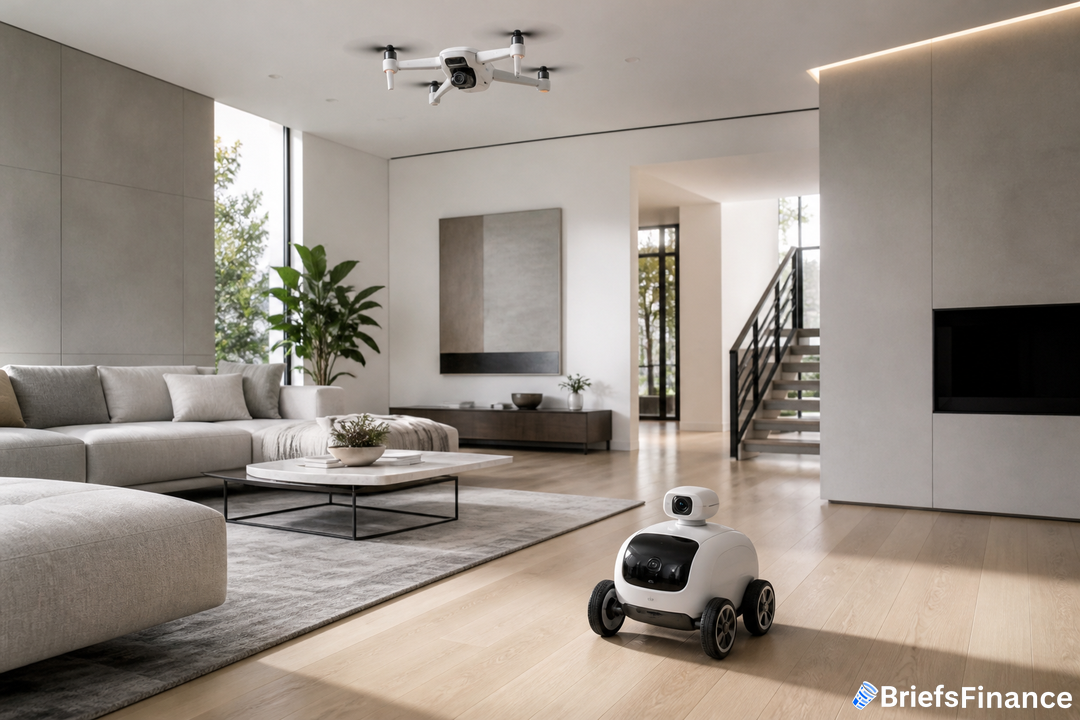
On Tuesday, Ring introduced two security devices aimed at covering more ground with fewer cameras. The Ring Drone Cam is a textbook-sized indoor drone that can fly between rooms, even upstairs, and record in daylight and at night. It uses two shrouded propellers that make an audible buzz while in the air.
The drone can stay aloft for up to eight minutes before docking itself to recharge. When a window, door or other security sensor or alarm trips, it follows a programmed route to check things out, and users can also launch it on demand.
Ring also repurposed Amazon's Astro consumer robot into the $1,000 Ring Rover Cam for offices, warehouses and other business spaces. Ring says it "leveraged the best of Astro" to build a purpose-built security unit. The Rover Cam features a screen on a rolling two-wheel chassis, an extendable periscope camera, a siren built into the unit, support for two-way talking, and a ceiling-directed tower light to indicate its location.
Safety, privacy and limits
At a Monday demo in New York, Ring CEO Jamie Siminoff pitched the drone as both a monitoring tool and a potential deterrent thanks to onboard LED lighting. "If someone is going around your house at night, and your motion detector goes off on your Ring doorbell, imagine if you see spotlights and something flying across the window," he said. "You're probably not going to go into that house." He added, "People like indoor cameras, but they don't necessarily want them everywhere around their home."
Ring said privacy is the "default" mode on both devices, and they flash an LED when they are recording. Siminoff noted the drone is not for outdoor use, citing Federal Aviation Administration rules that require drones to stay within a pilot's line of sight. "We have told our customers not to do that because it's illegal," he said. "We've also put guardrails in there to make it so it doesn't fly outside."
New technologies reshape how investors find opportunities, so staying curious pays off. We're hosting our first ever investor livestream on 11/17 to show you how to use ChatGPT and Claude to invest like a pro, hosted by Briefs Finance CEO Jaspreet Singh. Save your seat.
Timing, context and why it matters
Ring first previewed this drone in 2020 under the name Always Home Cam. Siminoff said he waited to release it until the design, sensors and data processing were ready. The Ring Drone Cam carries a $250 price tag and, subject to FCC approval, is scheduled to be available in the U.S. on Jan. 27. The Ring Rover Cam costs $1,000 and begins shipping Dec. 16.
These devices broaden Amazon's smart home push beyond Echo speakers and Eero routers, in a category where Apple and Google also play. Grand View Research projects the smart home sector to surpass $200 billion in revenue this year. Ring, acquired by Amazon in 2018 and best known for doorbells, continues to navigate privacy scrutiny, including renewed attention following a Super Bowl ad for its AI pet finder "Search Party" and the ending of a partnership integration with police-technology firm Flock Safety.
The bottom line: Ring is extending its security lineup with mobility - a flying cam for homes and a rolling robot for businesses - while signaling shipping timelines and price points in a large and competitive market. That tells you where Amazon is investing inside the smart home and where rivals might respond next.
Savvy investors use smarter tools to gain an edge in changing markets. On 11/17, our CEO Jaspreet Singh goes live for our first ever investor livestream on how to use ChatGPT and Claude to invest like a pro. Register to join him.