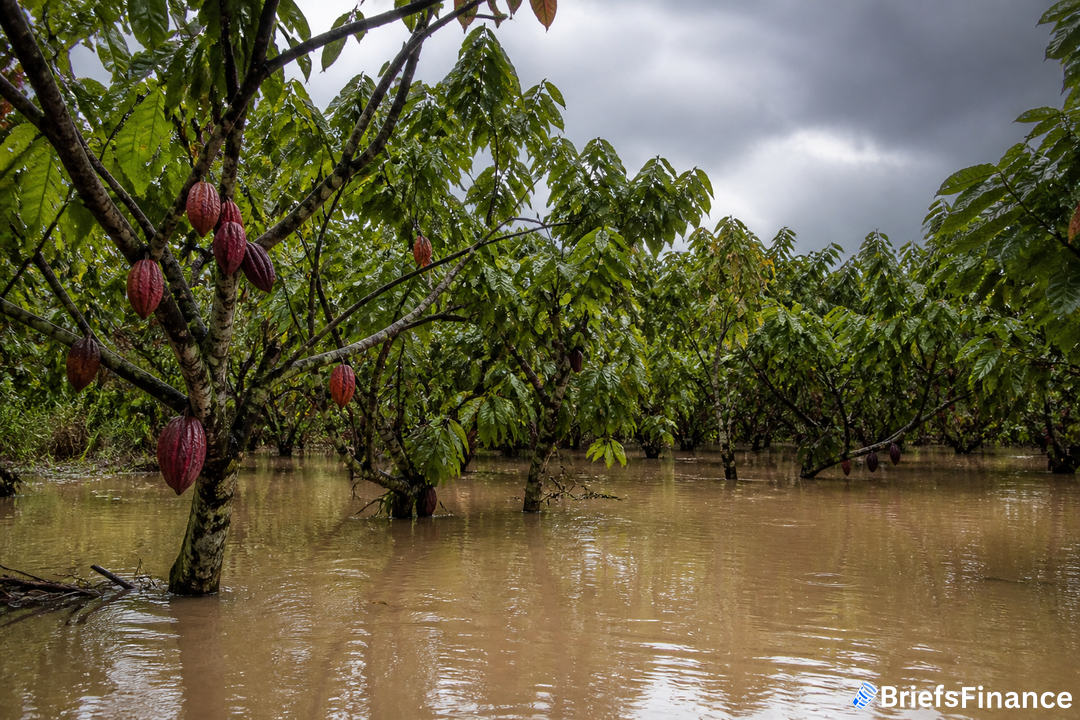
What happened in Ecuador
El Niño has soaked Ecuador's coast, where most cocoa grows. In October, rainfall exceeded historical averages by over 10,000% according to Vaisala Xweather. The flooding has washed out rural roads, damaged bean quality and accelerated tree disease, while soils stay waterlogged and landslides have been reported in the nearby Chongón Colonche range.
The weather threat is not just about today's harvest. Excess rain can knock off blossoms before they become pods, cutting future yields even after the waters recede. Ecuador's role in the cocoa world has grown as a crucial backstop for global supply, and an incoming European Union deforestation rule could make West African sourcing trickier, raising Ecuador's importance in the chocolate supply chain.
What the market is signaling
Bloomberg spoke with four traders and analysts who see Ecuador's current season slipping to 580,000 tons, around 7% below earlier forecasts. For now, plentiful near term supply from last season's large West African surplus is helping cap New York and London futures, and open interest in New York remains beneath historical norms.
There is some optimism that newer Ecuadorian plantations can offset part of the slump, said Javier Castro, managing director at exporter Grandsur. Carolina França of Hedgepoint Global Markets, a cocoa analyst, warned that confirmation of additional damage could prompt traders to rush back in and spark renewed volatility.
On-the-ground pricing shows the strain. Julio Moscoso of Latam Commodity Traders said Ecuadorian beans are now being offered at roughly the same level as New York futures or at about a 20 dollar per ton discount, compared with a discount of around 300 dollars before the rains.
Market disruptions remind investors that adapting their tools can preserve a long term edge. We're hosting our first ever investor livestream on 11/17 to show you how to use ChatGPT and Claude to invest like a pro, hosted by Briefs Finance CEO Jaspreet Singh. Save your seat.
Voices from the ground
Farmers are feeling the squeeze. "We've been hit hard by it," said grower Martín Pallares from northwest Ecuador. "In a good month, we could be harvesting $2,000 to $2,800 worth. We sold something like $60 last month."
Logistics are a choke point. Washed out roads "hinders or significantly delays access to the farms for harvesting, as well as the timely transport of the beans to collection centers," said Carlos Sánchez, president of exporters' group Anecacao.
StoneX senior commodities broker Vladimir Zientek summed up the uncertainty: "El Niño continues to worry me because we won't really have answers to all this until the end of the first quarter when the damage is done." And on the farm level, chocolate maker and grower Ronaldo Montesdeoca near Calceta in Manabí province said the soil is saturated and he has halted pruning. "It will be washed away by the water," he said of fertilizer. "This is a year to endure."
Why it matters for your portfolio
The notion that Ecuador can fully offset West African shortfalls is in doubt, as farmers there are preparing for unfavorable weather. That backdrop helps keep prices above long run norms. The bottom line: near term supply is cushioning futures today, but a low open interest base means any new damage reports could spark fast buying and bigger swings. Watch chocolate makers, commodity traders and any holdings exposed to softs - agricultural commodities - as weather headlines roll in.
Thoughtful use of new tools can help investors navigate uncertainty with greater confidence. On 11/17, our CEO Jaspreet Singh goes live for our first ever investor livestream on how to use ChatGPT and Claude to invest like a pro. Register to join him.