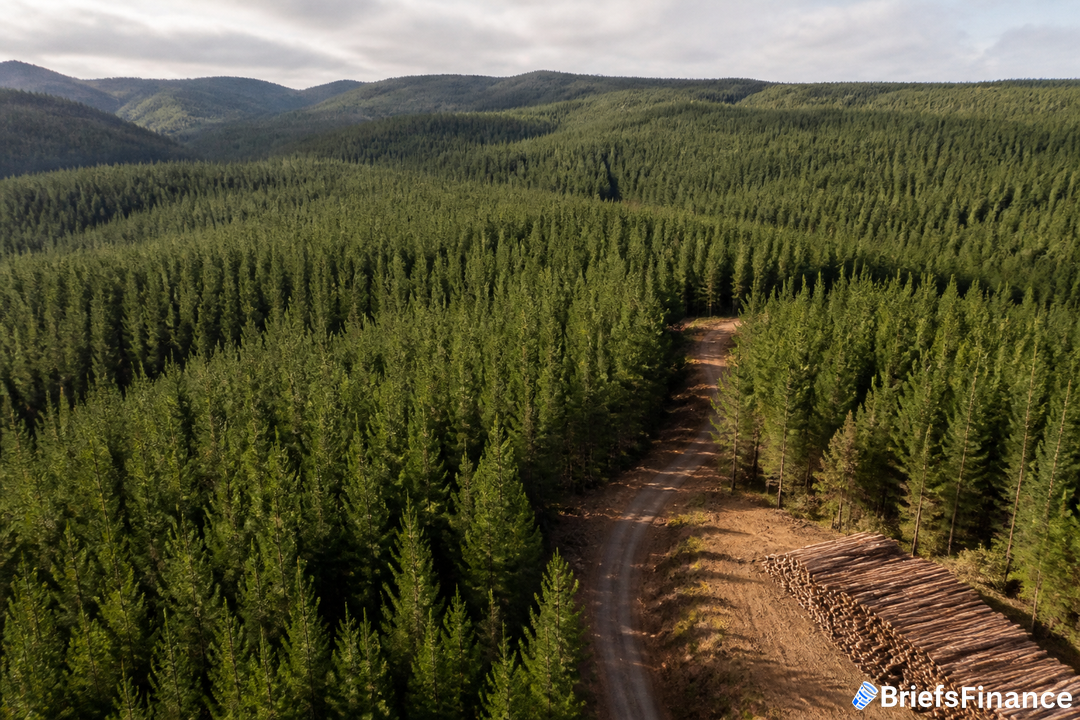
Why some investors are looking at timber now
When markets get shaky, portfolios often drift toward gold and government bonds. Lately, timberland is showing up as a basic real asset that grows while you hold it, can be harvested for cash, and can also be used for hunting or camping.
Big buyers have been busy. Bank of America says institutions have been adding roughly a million acres annually for three years, and it expects that pace to continue. In 2025, timber managers bought 55% of the acres that traded and accounted for only 15% of the selling, indicating long-horizon investors are building positions more than flipping them.
At Bank of America Private Bank, Ken Shepard, who oversees specialty asset management, described timberland as a slow, patient investment rather than a trade you flip quarter to quarter. "We view it as a strategic, long-term investment supported by several favorable secular trends, including the continued expansion of the timber industry in the U.S. South and growing demand for wood products beyond traditional construction uses," he said.
How returns and prices are behaving
Timberland's payoff has two parts - cash from cutting and any land appreciation - and they do not always move in sync. In the second quarter of 2026, the National Council of Real Estate Investment Fiduciaries' Timberland Property Index posted a 0.95% total return, with 0.34% from income and 0.61% from appreciation.
Producer prices for the raw materials tell a different slice of the story. That gauge tracks what producers receive, not land values or investor returns, and over very long periods those prices have increased substantially.
CME lumber futures were 531.00, down 5.50 (1.03%), as of 10/17/26 EDT. Local markets vary widely. Data from the South Carolina Forestry Commission indicate that average pine pulpwood stumpage - the price paid to landowners for trees still on the stump - declined from 5.67 dollars per ton in Q3 2025 to 3.79 dollars in Q3 2026, a decrease of roughly 33%. Pine sawtimber slipped about 6% over the same stretch, from 22.78 to 21.47 dollars, while hardwood sawtimber jumped roughly 40%, from 16.04 to 22.52 dollars.
History offers some context if housing revives. Pat Dorn recalled pulpwood reaching 12 to 18 dollars per ton at times, and soft timber around 35 to 40 dollars two decades ago.
What owners are seeing on the ground
The near term is a grind for some owners.
Biology sets the pace regardless of markets. Dorn noted pulpwood trees can take 12 to 14 years to mature, chip-and-saw trees a bit longer, and the highest value logs used for homebuilding about 25 years. "That is where the top value is," he said.
In a world where asset choices feel complex, sign up for the free Market Briefs newsletter to stay grounded
What owners earn depends on end use: pine pulpwood gets ground into paper and packaging, pine sawtimber becomes lumber for houses, and hardwood sawtimber - oak and other big trees - goes into flooring, furniture and pallets. Each product serves different buyers, so prices can diverge.
Location can flip the thesis from trees to dirt. "The return is in the land, not the timber," Dorn said. He advises scouting parcels just outside growing metro areas that may benefit as populations push outward. "If one hopes to buy land near growing metro areas and holds on to it, timber is a reasonable way to keep it earning something - a very low return - while you hold that land," he said.
The fine print for portfolios
Hands on is the rule, not the exception. He also urged sellers to shop the job. "If you simply go with a small local outfit without getting competing bids, you don't always know if you're getting the best price," Martin said.
Local prices can swing outcomes. Partial harvests roughly every ten years have barely covered the property taxes for him. "At the end of the day, I barely break even," he added.
Curiosity is real among some younger buyers, even if the evidence is still anecdotal. "One lesson from all of that we have learned is that scarcity matters when it comes to places to park your money," Kennedy said. "But you can't manufacture another 500 acres of land," Kennedy said. "Timber itself is a resource that takes decades to grow."
He also cautioned that durability does not guarantee profits because trees face many variables. "In the meantime, yes, hunting is a common activity while owners are waiting for the investment to grow and mature, literally," he said.
The bottom line: timberland is a slow-burn diversifier with secular demand drivers and, in the right spot, land appreciation. Near-term returns can be thin, pricing is hyper local, and cash flows show up on tree time, not quarter to quarter. Treat it like illiquid real estate with biological growth, not a quick fix for market jitters.
When long term decisions matter, get our free Market Briefs that explain markets and real assets in minutes a day